Oil prices rise after ceasefire-that-never-was ends
Oil, fundamental analysis
Global oil prices were higher this week as hostilities resumed in the Persian Gulf region and the status of the Strait of Hormuz came into question again.
The first crude inventory gain in several weeks did not dampen the war-related buying nor did lower refinery input and less oil exports. WTI’s High was Wednesday’s $76.10/bbl for August while the Low was Monday’s $67.80. Brent crude hit its High also on Wednesday at $77.50/bbl with the low on Thursday at $75.30. Both grades settled higher on the week. The WTI/Brent spread has now widened to $4.50.
The US and Iran resumed attacks on one another this week while President Trump declared the truce to be over and further revoked Iran’s license to sell oil on the global market. The IRGC fired missiles at both a Qatari LNG carrier and a Saudi oil tanker early in the week, leading to US retaliation. Hostilities between the US and Iran and, between Israel and Iran have never fully-ceased since the MOU was agreed upon.
Despite these actions, traders have only added a small risk premium to prices which have come down since Pres. Trump’s announcement as there are apparently talks continuing. And, despite a supposed agreement between the two nations, Israel continues to bomb Lebanon.
With the resumption of military action in the area, tankers have made U-turns in the Persian Gulf rather than take a chance with passage. Tanker-tracker reports have vessels down to 2-3/day now vs. 30-35/week recently. Maritime insurance rates also rise with any escalation in the conflict.
Prices also received support this week as Ukraine continues to hit Russian refinery infrastructure, raising the value of refined products. The government there has banned the exportation of diesel for at least a month. Ukraine has also used drones to attack a Chevron-chartered tanker loaded with Kazakhstani oil heading for a Black Sea port in Russia.
On the flip side, China has lifted refined product export restrictions for the rest of July for both state-owned and private refineries. The world’s No. 1 importer of crude has also resumed purchases of oil from Saudi Arabia after the kingdom lowered its selling price this past Monday. Meanwhile, OPEC+ agreed to increase output in August by another 188,000 b/d.
The Energy Information Administration’s (EIA) Weekly Petroleum Status Report indicated that commercial crude oil inventories for last week increased while production was steady at 13.8 million b/d. The Strategic Petroleum Reserve was down 6.2 million bbl to 320 million bbl.
The International Energy Agency (IEA) sees global oil demand recovering in fourth-quarter 2026 with the addition of 1.2 million b/d after a 4.8-million b/d decline in this year's second quarter and a 1.8 million b/d drop in third-quarter 2026.
Meanwhile the UAE pumped a record 4.1 million b/d last month, part of its plan to ramp up after leaving OPEC.
Oil, technical analysis
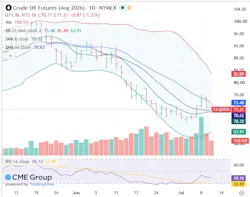
August WTI NYMEX futures are trading above the 8- and 13-day Moving Averages while just below the 20-day MA. Volume is below the recent average at 160,000. The Relative Strength Indicator (RSI), a momentum indicator is slightly oversold at 39. Resistance is now pegged at $71.20 (20-day MA) while near-term Support is $70.30 (8-day MA).
Looking ahead
It's anyone’s guess as to what the future holds for the conflict in the Persian Gulf. Steady flows of oil, refined products, and LNG had been traversing the Strait of Hormuz until this week’s return to military action on both sides.
E&P companies operating in Alberta are looking at further development of the Clearwater formation, a conventional heavy oil field as an alternative to the substantial investment in long-term oil sands projects. Clearwater oil extraction uses multilateral, horizontal drilling, and completion whereas, tar sands require a large amount of steam generation requiring natural gas.
An estimated 1.5 billion bbl was drawn from global strategic reserves over the past 90+ days to supplement the Persian Gulf outage. Replenishment of these inventories could start at anytime and last well into next year, providing somewhat of a floor for crude oil prices.
The University of Colorado has revised its forecast for hurricane season due to the possible effects of the developing Super El Nino weather system. What has been a quiet start is now projected to have 9 named storms with just 4 hurricanes, only one of which would be categorized as major.
Natural gas, fundamental analysis
Despite warmer weather, August NYMEX Henry Hub Natural Gas futures traded lower this week on an LNG outage and a larger-than-forecasted storage injection. The week’s High was Wednesday’s $3.35/MMbtu while the Low was Friday’s $2.87.
Natural gas demand this week has been estimated at about 108/111 bcfd on increased power consumption while supply was thought to be 116.5 bcfd. Gas-fired generation was a record 43 bcfd last month. Exports to Mexico were 7.5 bcfd while LNG exports were 14-15 bcfd. In the UK, natural gas prices at the NBP were most recently higher at $15.60/MMbtu. Dutch TTF futures were also higher at $16.80/MMbtu. Asia’s JKM was quoted at $16.60/MMbtu as Asian and European markets are essentially competing for the same shipments.
The EIA’s Weekly Natural Gas Storage Report indicated an injection of 61 bcf vs. a forecast of +51 and a 5-year average of +51 bcf. Total gas in storage is now 2.983 tcf, now 0.5% below last year and 6.6% above the 5-year average.
Natural gas, technical analysis
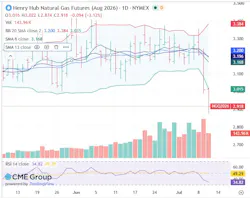
August 2026 NYMEX Henry Hub Natural Gas futures are trading below the 8-, 13-, and 20-day Moving Averages and have breached the Lower-Bollinger Band limit. Volume is about the recent average at 145k. The RSI is oversold at 35. Critical Support is $2.85 with Resistance at $3.02 (Bollinger Band).
Looking ahead
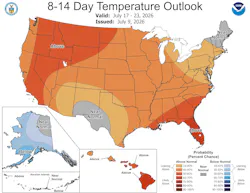
Qatar has slowed-down its LNG export recovery operations as an LNG tanker has been attacked by Iranian drones. However, US LNG exporters can’t fill the gap as Freeport LNG is reducing output for an unplanned outage that should last until the end of August, reducing input gas by 1.0 bcfd. The 8–14-day forecast looks favorable for natural gas-fired generation.
About the Author
 Tom Seng
Tom Seng
Dr. Tom Seng is an Assistant Professor of Professional Practice in Energy at the Ralph Lowe Energy Institute, Neeley School of Business, Texas Christian University, in Fort Worth, Tex.