Oil prices plummet on hopes for peace
Oil, fundamental analysis
Last Sunday, US President Trump announced that a Memorandum of Understanding (MOU) had been agreed to by the US and Iran, according to mediators in Pakistan. That evening, the oil market opened lower and continued downward despite few details being released.
Another draw in crude stocks did not provide price support. Both major grades of crude fell below the key $80/bbl mark while Brent managed to climb back above there on Friday. Prices are now at levels not seen since Mar. 11, 2026. WTI’s High was Monday’s $82.40/bbl for July while the Low was Thursday’s $73.60. Brent crude hit its High on Friday at $80.60/bbl with the low on Wednesday at $78.75. WTI settled lower week on week Brent was higher. The WTI/Brent spread has now widened to ($3.75). NYMEX regular session trading was closed on Friday for Juneteenth while thin volumes traded on their electronic platform.
While the MOU was met with a lot of optimism by oil markets, details were sporadic as a formal document did not initially exist. The proposal was to provide an immediate cessation of hostilities by all parties, the removal of the US naval blockade, the free opening of the Strait of Hormuz by Iran and the start of a 60-day period for the negotiation of a detailed peace accord.
Representatives from the US and Iran were to sign the MOU in Geneva on Friday. However, at the onset, Israel was not a party to the MOU and would not agree to a ceasefire with their IDF claiming as a sovereign state, Israel would do whatever was necessary to protect itself. In fact, Israel made further attacks on Lebanon, a key sticking point for Iran to abide by the MOU. In turn, Iran did not send delegates to Switzerland and VP Vance canceled his trip there.
By Friday, however, reports emerged that Israel and Hezbollah had agreed to a ceasefire. Some key aspects of the MOU, in addition to those stated above, include the promise to Iran of a $300 billion fund for restoration and rebuilding while Iran would not charge tolls for the Strait for (60) days. Iran has previously hinted at operating the Strait under a JV with Oman and charging “administrative” fees and insurance. Additionally, the US would lift existing sanctions on Iran while the latter agrees to work with the IAEA in “downgrading” its stockpile of enriched nuclear materials.
With the MOU pending, ships have begun to traverse the Strait of Hormuz as Kpler’s tracking service reported that three Saudi crude tankers have left the Persian Gulf carrying a total of six million bbl of oil. As many as 12 ships are believed to have passed through this week. Rystad Energy analysts have estimated it could take 4-6 months for tanker traffic to return to normal if the ceasefire remains.
Meanwhile, Lloyd’s of London, in coordination with Chubb insurers, have assembled a $400 million protection, indemnity and cargo package now available for those now wishing to leave the Persian Gulf. Even so, shipping companies will be wary until there is a prolonged period of calm.
The US has so far not renewed the waiver on Russian oil sanctions which expired on June 17, 2026, while Iraq has boosted its crude production to 1.5 million b/d. Saudi Arabia is looking for storage outside of the Persian Gulf to lessen the impacts of any future regional disruptions. Meanwhile, in its 2026 World Oil Outlook, OPEC is forecasting global oil demand to rise by 8 million b/d by 2030 with a peak of 124 million b/d by 2050.
The Energy Information Administration’s (EIA) Weekly Petroleum Status Report indicated that commercial crude oil inventories for last week decreased while production held at 13.8 million b/d. The SPR was down 8.9 million bbl to 340 million bbl as part of the US commitment as an IEA member.
Stocks at Cushing, Okla., were down 1.6 million bbl to 20.0 or 26% of capacity (operators there have stated that there are issues delivering volumes below 20 million bbl).
The Federal Reserve held is first meeting this week with Chairman Warsh at the helm and decided to hold interest rates at current levels for now. Members will be monitoring the impact of the now lower energy prices on future inflation readings.
All three major US stock indexes were up this week on the prospect of a peace agreement in the Middle East. The Dow hit a new high barely under 52,000 at 51,991.67 on Wednesday. The USD was also higher, which added downward pressure on oil prices. Gold is down and hasn’t been at $5k/oz since mid-March.
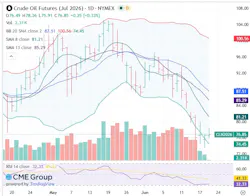
July WTI NYMEX futures have below the 8-, 13-, and 20-day Moving Averages with Thursday’s Low breaching the Lower-Bollinger Band limit. Volume is below the recent average at 67,000 as July expires Monday and traders shift their focus to August. The Relative Strength Indicator (RSI), a momentum indicator is oversold at 34. Resistance is now pegged at $78.50 while near-term Support is $74.60 (Lower-Bollinger Band).
Looking ahead
Since the start of the Iran war, there has been a wide disparity between crude oil futures and the realities of the physical, cash market which continued this week. Last Friday, WTI settled at $84.88/bbl but plummeted to $73.60 by Wednesday, a drop of $11/bbl merely on the announcement of the MOU. This, despite many unknowns regarding the on-the-ground condition of oil fields, pipelines and marine facilities in the Persian Gulf region. A very detailed assessment of damage needs to be conducted along with both the estimated repair costs and timeframe for those to be completed.
Furthermore, traders appear to be discounting the need to replenish the strategic and commercial reserves that have been drawn-down over the past 90+ days. Not to mention the fact that we are less than halfway through the summer peak demand period. For now, crude appears to be undervalued.
International Petroleum Corp. has started commercial production at its Blackrod oil sands project, the first new bitumen project since 2014. It is expected to produce about 80,000 b/d once it ramps up.
Natural gas, fundamental analysis
The July NYMEX natural gas futures were higher this week on a lower-than-expected storage injection and increased demand for power generation. The week’s High was Wednesday’s $3.30/MMbtu while the Low was Tuesday’s $3.02. Natural gas demand this week has been estimated at about 100 bcfd on increased power consumption while supply was thought to be 107 bcfd. Exports to Mexico were 7.0 bcfd.
In the UK, natural gas prices at the NBP were most recently lower at $14.70/MMbtu. Dutch TTF futures were also lower at $16.10/MMbtu. Asia’s JKM was quoted at $15.30/MMbtu as Asian and European markets are essentially competing for the same shipments.
The EIA’s Weekly Natural Gas Storage Report indicated an injection of 73 bcf vs. a forecast of +82 and a 5-year average of +73 bcf. Total gas in storage is now 2.759 tcf, -1.0% above last year and 5.8% above the 5-year average.
Natural gas, technical analysis
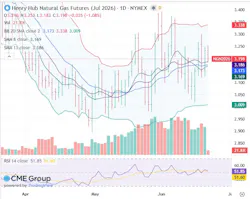
July 2026 NYMEX Henry Hub Natural Gas futures have rallied above the 8-, 13- & 20-day Moving Averages. Volume is about the recent average at 145,000 (Thursday). The RSI is neutral at 52. Critical Support is $3.20 with Resistance at $3.30 (Tuesday’s High).
Looking ahead
Europe is currently under a heat dome which should keep LNG demand fairly strong. However, Qatar is expected to resume their shipments of LNG which could lower prices in Europe, the UK, and Asia.
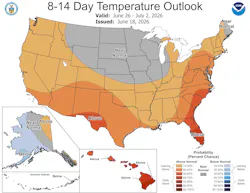
The 8-to-14-day forecast indicates that the southern half of the country will experience seasonal to above-normal summer temperatures. Repeated storm fronts have kept a cap on high temperatures thus far in June. However, summer is here so expect rising temperatures and an increase in gas-fired power generation which should lead to lower storage injections as well.
About the Author
 Tom Seng
Tom Seng
Dr. Tom Seng is an Assistant Professor of Professional Practice in Energy at the Ralph Lowe Energy Institute, Neeley School of Business, Texas Christian University, in Fort Worth, Tex.