Longer-term supply impacts and US-China meeting rally crude prices

Oil, fundamental analysis
Crude oil prices stair-stepped higher this week as it became apparent that global stored reserves are being depleted to offset the 10-14 million b/d of supply estimated to be stranded behind the Strait of Hormuz. Traders also took a bullish perspective after the US-China summit resulted in no real change in the status of the strait. Another draw in US crude and gasoline stocks further underscored the scarcity issue.
WTI’s high was Friday’s $105.80/bbl while the Low was Monday’s $96.15. Brent crude for June hit its high on Monday and Wednesday at $109.75/bbl with the low on Monday at $107.80. Both grades settled higher than last week, and the WTI/Brent spread has now tightened to $4.05.
Declining supply, both active production and stored reserves, kick-started this week’s price rally. The IEA has reported that about 250 million bbl of strategic oil reserves were drawn down over March and April. Meanwhile, OPEC has stated that its total production has fallen by 30%, or about 9.7 million b/d and has decreased its 2026 demand growth to +1.2 million from +1.4 million. The International Energy Agency (IEA) indicated a larger, 420,000 b/d decrease in consumption.
Iran is allowing some shipments of oil to pass through Hormuz, depending on the destination country. Chinese tankers were given passage recently while US President Donald Trump was in Beijing hoping to get China’s assistance in dealing with Iran and getting the strait fully opened. Some 30 ships have left the Persian Gulf this week compared to a previous average of about 140 weekly transits.
The outcome of the US-China talks provided no concrete measures to ensure the permanent opening of the Strait of Hormuz which fueled higher prices this week. While the Chinese President evidently agreed not to supply military weaponry to Iran and sees the opening of the Strait as necessary, there was no pledge by China to intervene in any way. Evidently, China’s oil imports fell 20% from March to April to a 2-year low of 8.2 million bbl. The world’s No. 1 importer of crude had been stockpiling all of last year. This, along with the IEA’s coordinated strategic reserve release, has helped lower the spread between futures prices and the physical market. Some refiners have also cut back on utilization as they balk at $130+ spot barrels.
It turns out the UAE has been conducting limited retaliatory strikes against Iran, including on an oil refinery. However, the government has not made this public knowledge.
The Energy Information Administration’s (EIA) Weekly Petroleum Status Report indicated that commercial crude oil inventories for last week fell while production increased slightly. The Strategic Petroleum Reserve was down 8.6 million bbl to 384 million bbl.
Inflation soared higher in April due to increasing energy prices. The March/April increase was 0.6% but the year-on-year Consumer Price Index (CPI) change was +3.8%. Core inflation, absent food and energy, rose 2.8% vs. an expected +2.7%. Pointing to longer-term inflation, the Producer Price Index was +1.4% for April, much higher than the expected 0.5% increase. Those prices will impact the CPI in the future. Worries over inflation has led to a May consumer sentiment index of 48.2, the lowest since the index was first reported in 1952. The Dow and S&P are lower on the week due to the inflation reports and a lack of progress on Iran coming out of the US-China meeting. The tech-heavy NASDAQ was lower Friday but slightly higher week-on-week. The USD is slightly higher than last week while gold is lower.
Oil, technical analysis
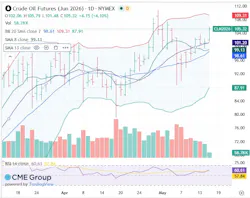
June WTI NYMEX futures have moved back above the 8-, 13, and 20-day Moving Averages on this week’s rally. Volume is well-below the recent average at 60,000. The Relative Strength Indicator (RSI), a momentum indicator, is moving out of the neutral area and into slightly-overbought at 66. Resistance is now pegged at $102.30 (05/04/26 Close) while near-term Support is $102.20 (13-day MA).
As has been the pattern for several weeks now, traders have to be cautious with their Friday positions as the market is closed until Sunday evening and anything can happen over the weekend.
Looking ahead
The draw-down of crude reserves will lead to an invisible underlying demand months from now as these strategic inventories will need to be replenished. Thus, the impacts of this Middle East conflict will last for several months even after it is resolved and the Strait of Hormuz is once again operating normally.
Should a resolution emerge, detailed analysis of all structural damage in the region will be needed to assess exactly how long it will take to return to pre-war production of oil, refined products, LNG, and petrochemicals.
Pres. Trump appears to be willing to make some concession on Iran’s nuclear ambitions by agreeing to a 20-year ban. Time will tell.
Natural gas, fundamental analysis
June NYMEX natural gas futures are slightly higher this week on a smaller-than-expected storage injection and the prospects for warmer weather. The week’s High was Friday’s $2.98/MMbtu while the Low was Monday’s $2.75. Natural gas demand this week has been estimated at about 93-96 bcfd while production was thought to be 109-110 bcfd.
Inputs to LNG export plants remain about 18-19 bcfd. Exports to Mexico are up slightly to 7.0 bcfd. In the UK, natural gas prices at the NBP were most recently higher at $16.65/MMbtu. Dutch TTF futures were also higher at $17.40/MMbtu. Asia’s JKM was quoted at $17.10/MMbtu as Asian and European markets are essentially competing for the same shipments.
The EIA’s Weekly Natural Gas Storage Report indicated an injection of 85 bcf vs. a forecast of an additional 87 bcf and a 5-year average of +84 bcf. Total gas in storage is now 2.290 tcf, 2.3% above last year and 6.5% above the 5-year average.
Natural gas, technical analysis
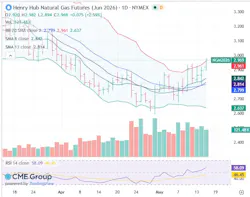
June 2026 NYMEX Henry Hub Natural Gas futures stayed above the 13- and 20-day Moving Averages this week with Friday’s High and Close breaching the Upper-Bollinger Band Limit. Volume is close to the recent average at 120,000. The RSI is neutral at 58. Support is $2.85 (8-day MA) with key Resistance at $3.00 (Bollinger Band).
Looking ahead
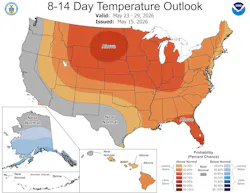
Caturus has taken a final investment decision for its Commonwealth LNG plant in Cameron Parish, La. It has secured long-term supply deals and expects to be operational in 2030. Negative prices for natural gas in the Permian basin spot markets continue due to the glut in supply. LNG exports are limited and power demand for A/C has yet to materialize on a wide scale in the US. This does benefit commercial and industrial consumers of natural gas, along with residential electricity ratepayers. Additional takeaway capacity of 11.0 bcfd is expected to come online in October when the Blackcomb Pipeline becomes operational. The 8-14-day forecast looks favorable for some A/C loads in the south.
About the Author

Tom Seng
Dr. Tom Seng is an Assistant Professor of Professional Practice in Energy at the Ralph Lowe Energy Institute, Neeley School of Business, Texas Christian University, in Fort Worth, Tex.