'Ceasefire' takes on new meaning as crude oil prices fluctuate
Oil, fundamental analysis
Once again, back-and-forth statements by the US and Iran regarding a peace settlement have jostled crude prices this week with the results being decidedly bearish. Another decrease in crude inventory and concerns over refined product stocks buoyed markets on the downside. WTI’s high was Monday’s $107.50/bbl while the Low was Wednesday’s $88.65, a $19/bbl trading range.
Brent crude for June traded in a similar pattern with its high on Monday at $115.25/bbl but the low on Thursday at $96.30. Both grades settled lower than last week, and the WTI/Brent spread is now ($5.25).
While the US has contended that there is a ceasefire still in place, attacks from both sides continue. Iran has hit the UAE Port of Fujairah, a key crude export site downstream from the Strait of Hormuz. The port had been hit earlier in the conflict but was still operating.
Meanwhile, Iran supposedly launched missiles and used small boats to attack US ships in the blockade while the US responded by striking Iranian military installations including the island of Qeshm. The Trump administration had announced Operation Project Freedom, an effort to guides ships through the Strait of Hormuz but had to scuttle the mission after Saudi Arabia refused to allow the US to use the airbases as part of the effort.
The US has sent a peace proposal to Iran but has yet to receive any response and the Strait of Hormuz remains closed for all intent and purposes.
However, the lower prices this week reflect trader optimism that the key bottleneck will be opened before long.
A key factor for ships to cross the Strait of Hormuz which is largely being ignored is the cost of marine insurance. Providers have either been reluctant to provide coverage or the premiums have been prohibitive. A true and guaranteed opening of the strait will have to happen before those rates come down.
China and India have turned to Brazil for cargoes of crude to offset the disrupted Persian Gulf supplies as the country hits a new record of 2.3 million b/d. Asian economies, in general, are starting to feel the pinch of both higher energy costs and scarcity as the region traditionally received 85% of its oil imports from the Persian Gulf. Meanwhile, Canada’s increasing oil exports helped achieve an overall trade surplus in March as well as with the US.
The futures market continues to show a sharp disconnect with the physical market despite the backwardation. June Brent futures trading around $101/bbl while Dated Brent, the physical market for available cargoes to be delivered in a few weeks, has traded at a premium of up to $30-40/bbl. It’s an indication that traders are perhaps more optimistic about both the opening of the Strait of Hormuz and the long-term impacts of this war.
The once cancelled Keystone XL pipeline is seeing signs of life as President Trump has signed a permit authorizing the Bridger Pipeline Expansion, a Keystone XL successor. Dubbed 'Keystone Light,' the new, 36-in. OD crude pipeline will run from the Canadian/Montana border to a hub in Wyoming where the oil can then flow onto Midwest refineries and Cushing, Okla. A lateral to the Bakken may also be possible. Initial volumes are said to be up to 550,000 b/d with upwards of 1.0 million b/d in the future. Opposition from landowners and environmental groups along the US corridor is expected.
The Energy Information Administration’s (EIA) Weekly Petroleum Status Report indicated that commercial crude oil inventories for last week decreased while production held at 13.6 million b/d. The SPR was down 5.2 million bbl to 393 million bbl.
Oil, technical analysis
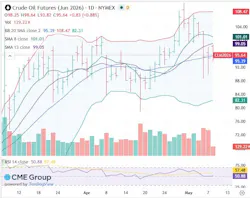
June WTI NYMEX futures are trading below the 8- and 13-day Moving Averages but right around the 20-day MA. Volume is below the recent average at 125,000. The Relative Strength Indicator (RSI), a momentum indicator, has fallen back into neutral territory at 51. Resistance is now pegged at $99.05 (13-day MA) while near-term Support is $93.80 (Friday’s Low). As has been the pattern for several weeks now, traders have to be cautious with their Friday positions as the market is closed until Sunday evening and the status of the US/Iran negotiations is not known.
Looking ahead
With US exports of both crude and refined products in demand, our own inventories could be in jeopardy as we are now just 3 weeks from the start of the official summer driving season. While crude supplies are currently ample, refinery inputs will increase in the coming weeks and remain high throughout the summer. Distillate (diesel, jet fuel) inventories are below where they normally are relative to the 5-year average.
We continue to see mixed signals coming out of both the US and Iran over the exact status of the conflict. And, should a solid ceasefire come to be and the Strait of Hormuz is reopened, the market will still need to quantify the long-term supply and refining impacts on the Persian Gulf Region.
Natural gas, fundamental analysis
June NYMEX natural gas futures are slightly higher this week on a smaller-than-expected storage injection and the prospects for warmer weather. The week’s High was Monday’s $2.88/MMbtu while the Low was Thursday’s $2.68.
Natural gas demand this week has been estimated at about 103-106 bcfd while production was thought to be 109-110 bcfd. Inputs to LNG export plants continue to remain strong ranging from 18-19 bcfd.
In the UK, natural gas prices at the NBP were most recently lower at $15.40/MMbtu. Dutch TTF futures were also lower at $15.20/MMbtu. Asia’s JKM was quoted at $16.80/MMbtu as Asian and European markets are essentially competing for the same shipments.
The EIA’s Weekly Natural Gas Storage Report indicated an injection of 63 bcf vs. a forecast of +76 and a 5-year average of +77 bcf. Total gas in storage is now 2.205 tcf, 3.5% above last year and 6.7% above the 5-year average.
Natural gas, technical analysis
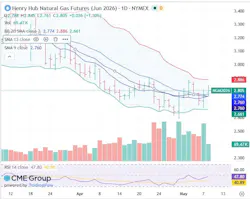
June 2026 NYMEX Henry Hub Natural Gas futures have risen above the 13- and 20-day Moving Averages this week but in a very tight trading range. Volume is lower than the recent average at 70,000. The RSI is neutral at 48. Support is $2.76 (convergence of 8-, 13-day MAs) with key Resistance at $2.85 (Friday’s High).
Looking ahead
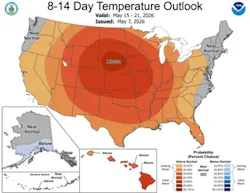
Global LNG prices remain strong which is keeping US demand strong. US storage levels are running above-normal and should remain that way until warmer weather sets in and A/C demand picks up. The 8-14-day forecast looks favorable to such a situation.
About the Author

Tom Seng
Dr. Tom Seng is an Assistant Professor of Professional Practice in Energy at the Ralph Lowe Energy Institute, Neeley School of Business, Texas Christian University, in Fort Worth, Tex.