Blockade stalemate rallies crude
Oil, fundamental analysis
The 9-day downtrend in oil prices reversed this week as both the US Navy and Iran block different areas of the Persian Gulf. A decrease in crude inventory and draws in refined products aided the rally. WTI’s high was Thursday’s $98.40/bbl while the Low was Friday’s $85.45. Brent crude for June traded in a similar pattern with its high on Thursday at $107.40/bbl and the low on Monday at $92.75. Both grades settled higher than last week and the WTI/Brent spread is now ($5.45).
The US Navy is blocking Iranian ports and instructing ships to turn back. Meanwhile, the IRGC continues to control the Strait of Hormuz while the Iranian government has stated that will continue so long as the US Navy blocks their ports. The IRGC capture two vessels in the Strait of Hormuz and fired upon another even after President Trump extended the deadline of the ceasefire. However, he ordered the US Navy to continue its blockade. On Thursday, US forces boarded a sanctioned Iranian oil supertanker after having intercepted two other Iranian oil tankers that attempted to evade the blockade.
The US President has also extended the current Jones Act waiver for another (90) days to aid in the movement of oil, refined products, and fertilizer around the country. And, despite optimistic statements from the US, Iranian officials have insisted they will not meet for negotiations until the US naval blockade is removed, and Israel halts all bombing in Lebanon. Pakistani officials are said to be trying to get Iran to agree to restarting peace talks.
While most of Asia is now struggling with oil and fuel supplies, China and Japan have reported reserves of both that will sustain them for some period of time yet. Meanwhile, the executive director of the International Energy Agency (IEA) has categorized the current Middle East situation as “the biggest energy security threat in history” and that it has hamstrung the global economy. The IEA is estimating a current loss in supply of 13 million b/d of crude and 100 bcm of natural gas.
The Energy Information Administration’s (EIA) Weekly Petroleum Status Report indicated that commercial crude oil inventories for last week decreased while production was steady. The Strategic Petrleum Reserve was -4.1 million bbl to 405 million bbl as part of a pledged release.
US consumer confidence fell to 49.8 this month, down from March’s 53.3. Respondents in the survey are also expecting inflation to increase in the coming months citing higher energy prices. Claims for unemployment benefits rose by 6,000 last week to 214,000, above forecasts calling for 214,000.
Consumer prices rose by 3.3% last month due to gas prices that have risen on a percentage basis by the most in decades. This was up from February’s +2.4% reading. The economy did add 178,000 jobs last month which placed unemployment back at 4.3%. The Dow is lower week-on-week while the S&P and NASDAQ have both posted weekly gains. The USD is slightly higher than last week but is not stifling crude’s rally. Gold is down on the week as well.
Oil, technical analysis
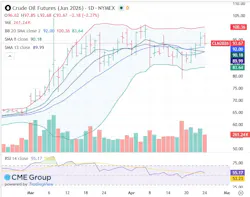
June became the prompt month this week and WTI NYMEX futures are trading just above the 8-, 13-, and 21-day Moving Averages. Volume is about the recent average at 260,000. The Relative Strength Indicator (RSI), a momentum indicator, has fallen back into neutral territory at 55. Resistance is now pegged at $98.75 (Friday’s Hi) while near-term Support is $92.00 (20-day MA). As has been the pattern for several weeks now, traders have to be cautious with their Friday positions as the market is closed until Sunday evening and there are no planned US/Iran talks this weekend.
Looking ahead
The US is currently in an enviable position relative to crude supplies. While we only produce just under 14 million b/d of oil while consuming 16 million b/d at our refineries, we receive heavy crude via pipeline from Canada and by tanker from Venezuela. A small amount also is also imported from Mexico. Supply disruption is not so much of an issue as is price since we do import and export in the global oil market. No one knows what will happen next with the US/Iran war. If talks resume, that will certainly lead to optimism about an eventual peace agreement and the full opening of the Strait of Hormuz. However, President Trump’s ever-changing rhetoric continues to fuel volatility in crude markets. We are, once again, heading into unknown territory as the weekend is upon us and markets are closed until Sunday evening. And we are now just 5 weeks from the start of the official summer driving season.
Natural gas, fundamental analysis
May NYMEX natural gas futures reversed the recent short-term uptrend to continue the 6-week downtrend on mild weather and a larger-than-expected storage injections despite healthy LNG export volumes. The week’s High was Wednesday’s $2.76/MMbtu while the Low was Friday’s $2.50. Natural gas demand this week has been estimated at about 95 bcfd while production was thought to be 106 bcfd. LNG exports are averaging about 13 bcfd so far this year with daily volumes here in April pushing up to 19 bcfd equivalents. This is helping to offset the loss of Qatari shipments.
In the UK, natural gas prices at the NBP were most recently back up to $14.95/MMbtu. Dutch TTF futures were also higher at $15.30/MMbtu. Asia’s JKM was quoted at $16.40/MMbtu as Asian and European markets are essentially competing for the same shipments. 72% of Europe’s LNG imports are coming from the US. The EIA’s Weekly Natural Gas Storage Report indicated an injection of 103 bcf vs. a forecast of +55 and a 5-year average of +50 bcf. Total gas in storage is now 2.063 tcf, 7.4% above last year and 7.1% above the 5-year average.
Natural gas, technical analysis
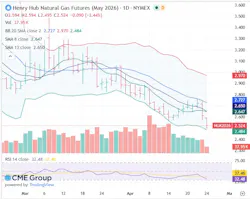
May 2026 NYMEX Henry Hub Natural Gas futures have fallen below the 13- and 20-day Moving Averages but just above the Lower-Bollinger Band Limit. Volume is low at 40,000 as the May contract will expire next week and traders turn their attention to June. The RSI is now approaching oversold at 32. Support is $2.48 (Bollinger Band) with key Resistance at $2.65 (convergence of the 8- and 13-day MAs).
Looking ahead
Global LNG prices have rebounded this week as the US/Iran war drags on. US storage levels are running above-normal and should remain that way given that April is typically a “shoulder” month. This week’s injection was historically huge compared to the average.
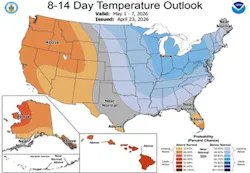
The 8-14-day forecast shows some areas of below-normal temperatures for early May which could provide some demand still for space heating. In other areas, below-normal represents mild temperatures where A/C won’t be needed.
Once again, given the infrastructure limitations on US LNG export volumes, domestic natural gas prices remain under pressure.
About the Author

Tom Seng
Dr. Tom Seng is an Assistant Professor of Professional Practice in Energy at the Ralph Lowe Energy Institute, Neeley School of Business, Texas Christian University, in Fort Worth, Tex.