Aker BP increases project cost estimates to protect 2027 startups
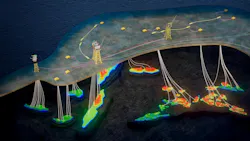
Aker BP ASA executives are adding capital to the Yggdrasil and Valhall PWP-Fenris development projects this year to protect their 2027 startup schedules, a key step toward the Norwegian operator's target of about 35% companywide production growth from 2026 to 2028.
While reporting second-quarter results—net profit of $521 million on total income of $3.68 billion (up from $3.03 billion in the year's first quarter), and net average production of 383,600 boe/d—executives raised combined investment estimates for Yggdrasil and Valhall PWP-Fenris by roughly $1.1 billion at the midpoint of guidance, or about 6% above prior guidance. Roughly half of the increase is expected to materialize this year, chief financial officer David Tønne said on a call with analysts, with the remainder spread over the projects' completion period.
Net profit fell from $758 million in the first quarter, reflecting a $625 million impairment on Valhall intangible assets that offset a $522 million impairment reversal booked in the year's first quarter.
Yggdrasil, Valhall PWP-Fenris drive the increase
Yggdrasil, in the Alvheim-Frigg area of the North Sea, is progressing toward 2027 startup. Power-from-shore was commissioned in June and the Hugin B topside installed offshore in early July; Hugin A topside sail away is scheduled for December 2026. The updated investment estimate is $12.5-13.0 billion pre-tax, up from about $12.1 billion previously. Chief executive officer Karl Johnny Hersvik said the increase reflects "investing more in the final onshore completion work to ensure that the Hugin A platform is as complete as possible before sail away," adding that the added scope "reduces both execution risk and the remaining offshore work."
Valhall PWP-Fenris, in the Norwegian North Sea, is also progressing toward startup next year. Offshore hook-up of the Fenris topside has begun, and Valhall PWP topside sail away is confirmed for August. The updated investment estimate is $7.3-7.6 billion pre-tax, compared with about $7 billion previously. Here, Hersvik said, "the updated estimates mainly reflect a larger remaining offshore scope, including hookup and completion activity."
Responding to analyst questions, Hersvik characterized the increase as "really nothing dramatic," describing it as the operator "adjusting as necessary to make sure that the plans are as robust as we can possibly make them" as the projects near completion. Aker BP has, he said, "put some more robustness around the investment program to make sure that we deliver on" a summer 2027 startup.
Progress continued elsewhere in the portfolio, the company said, with Skarv Satellites on track for startup in August and the two Johan Sverdrup Phase 3 subsea templates installed ahead of planned production startup in 2027.
On full-year guidance, Tønne said 2026 remains the company's peak investment year. Aker BP invested $3.5 billion in the first half and, reflecting the updated Yggdrasil and Valhall PWP-Fenris estimates, now expects full-year capex of about $6.8-7.2 billion pre-tax. Full-year production guidance has been narrowed to 380,000-400,000 boe/d from previous guidance of 370,000-400,000 boe/d.
About the Author

Mikaila Adams
Managing Editor, Content Strategist
Mikaila Adams has 20 years of experience as an editor, most of which has been centered on the oil and gas industry. She enjoyed 12 years focused on the business/finance side of the industry as an editor for Oil & Gas Journal's sister publication, Oil & Gas Financial Journal (OGFJ). After OGFJ ceased publication in 2017, she joined Oil & Gas Journal and was later named Managing Editor - News. Her role has expanded into content strategy. She holds a degree from Texas Tech University.