M&A activity in oilfield service sector off to a running start

Miro Lazarov, McGladrey Capital Markets, Costa Mesa, Calif.
M&A in the oilfield service (OFS) sector in 2011 is off to a considerably fast pace with total transaction value exceeding $21 billion as of June 28th. This represents an increase of 140% over the same period in 2010, with total transaction value of $9 billion. Numerous high profile energy deals were announced in the first half as oil prices hovered around $100 per barrel and oil and gas exploration and production companies made plans to accelerate capital spending.
With the increasing turmoil in the Middle East and North Africa, we also saw deals shift away from these regions towards more stable markets. In H1 2011, deals in North America and Europe represented 63% and 27% of total deal volume, respectively. This reflects an increase over the same period in 2010 when North American and European transaction volume accounted for 59% and 20%, respectively. Deal volume in Africa/Middle East, Asia and Latin America fell from 21% of total deal volume in H1 2010 to 10% in H1 2011. (See Figure 1.)

Several notable transactions drove deal value up in 2011. To start, Acergy SA completed its $3 billion merger with Subsea 7 Inc. in January. The combined entity has a stronger local presence in all of the major oil and gas markets, as well as possesses greater technical capabilities required from the increasingly complex subsea projects.
In February, VetcoGray, a subsidiary of GE Oil & Gas, completed its acquisition of Wellstream Holdings for $1.4 billion. The acquisition of Wellstream by VetcoGray reflects General Electric's focused effort to grow its industrial business as well as to strengthen its presence in Brazil.
General Electric also announced the $2.8 billion acquisition of John Wood Group's well support division. The acquisition included Wood Group ESP Inc., Wood Group Pressure Control LP, and Wood Group Logging Services Inc. and consists of manufacture, testing, and repair services of submersible pumping equipment; and onshore and offshore cased hole services; as well as wellhead systems, gate valves, chokes, and actuators.
Most notably, however, Ensco plc completed its acquisition of Pride International in May 2011. The transaction, valued at over $9.2 billion, establishes Ensco as the world's second largest offshore drilling company, just behind Transocean. Chairman and CEO Dan Rabun said, "Through this transaction, we have expanded our deepwater fleet with drillship assets, and now have a substantial presence in Brazil and West Africa – both strategic, high-growth markets. In addition, we have gained major new customers from around the world."
The stage is set for the strength in the M&A market to continue throughout the rest of the year and into 2012 as well. From a seller's perspective, not only have businesses' financial performance recovered to pre-crisis levels, but multiples have also improved, bringing valuations closer in line with the owners' expectations. Although the first half of 2011 was marked by these particularly large transactions, the hotbed of activity in H2 2011 and 2012 is expected to be in the middle market as the larger companies look to acquire additional service offerings and technology and not just market share.
There are several trends driving M&A activity, including healthier capital markets, easier financing and significant amounts of deployable cash, as well as improved strength in the commodities market. Now that earnings in the industry are beginning to recover, corporate buyers are once again seeking scalable transactions that will further contribute to their bottom line. Furthermore, the strategic buyers that have been hoarding cash since the downturn have seen a significant improvement in free cash flow and are now looking for opportunities to gain a foothold in new markets and make acquisitions to accelerate growth. From Q1 2006 to Q1 2011, cash flow increased from just under $10 billion to $24 billion, representing a compound annual growth rate of 16%. In addition to the cash, stock prices have recovered and have become an attractive option in terms of a form a currency. (See Figure 2.)

After sitting on the sidelines of M&A activity for several quarters, private equity transactions are gaining traction. Private equity groups have raised record levels of committed capital that needs to be deployed before the firms are forced to return the unused portion back to the limited partners. To top it all off, the credit markets have recently ignited and banks are starting to offer cheap debt at leverage ratios reminiscent of pre-crisis days. (See Figure 3.)

Several favorable industry trends are also responsible for this renewed interest in energy assets, including the strength in the commodities markets, an ongoing shift in drilling techniques, and a significant ramp-up in capex and potential capacity constraints. These trends are expected to continue, which will lead to even more deal activity in oil and gas, particularly in the OFS segment of the industry.
In North America, high oil prices and signs of stability in gas prices are spurring a ramp-up in corporate spending as projects become more attractive at these levels. The oil prices have pushed liquids activity up while the stability in gas has resulted in a smaller than anticipated drop in the gas rig count. At current levels of activity and pricing, spending is expected to grow around 25% over last year's levels.
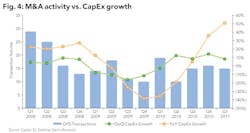
After a sharp decline in capex in 2009, most companies increased spending in 2010, with global O&G spending up by 14% in 2010 over 2009. In Q1 2011, we saw a significant ramp up in spending among US OFS providers with total spending increasing 51% compared to Q1 2010. In 2011, global capital expenditure is expected to increase 15% over 2010 levels to reach $220 billion. By 2013, global capex is expected to reach nearly $300 billion. This growth will be driven primarily by NOCs and integrated oil companies, which will contribute 97% of total capex growth in 2011. (See Figure 4.)
Possibly a more significant driver than the rise in commodity prices and corporate spending is the increase in unconventional production and the corresponding benefits to OFS providers. With the recovery in oil prices, unconventional plays are now economically viable again, thus spurring drilling activity in these regions. The number of rigs drilling horizontally has increased almost 640% since the beginning of 2005 and the percentage of fleet drilling horizontally has increased from 10% to 57%. Horizontal drilling – the primary method of developing unconventional resources – is roughly four to six times mores service-intensive than the conventional vertical drilling activity that dominated the cycles of the 1990s and 2000s. This method shortens the useful life of equipment and requires increased maintenance. Consequently, oilfield service and equipment providers benefit greatly from the rise in unconventional production. (See Figure 5.)

Looking further into the future, oil production will increasingly originate from unconventional sources as the easiest reservoirs to discover and exploit are depleted; a heightened reliance upon unconventional drilling will continue to be the foundation of the growth in OFS intensity over the next several years. Due to the service-intensive nature of unconventional wells, large integrated service providers are best suited for this type of drilling. These service-intensive development and exploration areas require the broad-based product and service offerings and global footprint that the large integrated vendors can provide.
However, many companies do not currently possess the necessary workforce and resources to manage the increasingly large and complex multi-well projects associated with these projects. As E&P players increasingly focus on service-intensive sources in North America and deepwater sources abroad, the major OFS companies are responding by making acquisitions that expand their geographical reach and/or add to their portfolio of product and service offerings, allowing them to better service their customers.
The next upcycle for OFS is expected to be more powerful than the last with drilling activity rising well above prior cycle highs. The international rig count is already 4% above the prior high, which is consistent with the expected number of new projects being sanctioned as the industry monetizes recent exploration successes and technological advances. After taking a pause over the past three years, capex in the E&P sector is expected to reach a new record as most companies across the globe are undertaking construction of their capital-intensive projects.
By comparing the recent increase in drilling activity to the reported assets of the major OFS providers, it can be determined that spare capacity has slowly declined since its peak in 2009. Although the service companies have also announced record capex spending levels for the year and have plans to increase fleets, the ramp up in drilling activity is expected to outpace the growth in service capacity. As such, the decline in spare capacity is expected to decline throughout 2013, creating bottlenecks for E&P companies. OFS margins, which have been declining since 2009, will gradually surpass prior highs as capacity becomes more limited and pricing power shifts to the service companies. (See Figure 6.)

In April, Chesapeake Energy Corp. announced that it will buy Bronco Drilling Co., which provides contract land drilling to oil and natural gas exploration companies, for about $315 million as it looks to increase its rig count. The acquisition is a signal that land rigs are in short supply as producers rush to exploit onshore oil and gas reservoirs. Chesapeake's move to increase its OFS capabilities will give the company the ability to move into potential plays quickly without rig limitations.
The gradual decline of service capacity coupled with the substantial rise in costs associated with increased service intensity may lead E&P companies to bring more oil and gas service activities and equipment in-house to reduce costs, driving the sector towards further consolidation. Ideal targets will offer services and equipment that present bottlenecks to operators or generate outsized returns to the providers. However, we anticipate that most E&P companies will continue to focus on upstream operations, while relying on the OFS providers for services, equipment, and technology.
Another catalyst for OFS acquisitions is technology as major players continue to look for companies that can deliver the innovative drilling technology required in areas such as shale extraction. The industry's shift toward horizontal drilling and advanced completion/stimulation techniques has been a seminal event for OFS vendors, transforming what had been a relatively sleepy, mature sector into a hotbed of activity and technological innovation.
Emerging unconventional plays are rapidly adopting optimization technologies such as LWD and micro-seismic technologies, while some of the more commoditized services that cater to conventional drilling are falling out of favor. Companies with niche expertise in pressure pumping, coiled tubing, cased hole stimulation, and mud logging should continue to attract buyers' interest.
An increase in demand for innovative technologies is coming from overseas as well. Foreign players such as Statoil and CNOOC have invested billions of dollars in US shale plays in large part to better understand the technical nuances of shale drilling and production. Ultimately, their participation in the US shale arena is likely a precursor to widespread international extraction. This migration of technological expertise to international sites presents a sustainable long-term opportunity for OFS providers.
The first half of 2011 has been a turning point for M&A activity in the oilfield service sector. Although M&A volume has been marked by notably large transactions, middle market activity has increased significantly as well. The financial markets have improved greatly since 2008 and the industry outlook for OFS providers is robust. We anticipate that this will continue to drive transaction activity throughout 2012.
About the author

More Oil & Gas Financial Journal Current Issue Articles
More Oil & Gas Financial Journal Archives Issue Articles
View Oil and Gas Articles on PennEnergy.com