OGJ SPECIAL India's Refining Prospects Linked To Economic Growth
Everett Lewis
Consultant
Houston
International investors assess refining ventures in India the same way they do comparable projects elsewhere in the world: according to their expectations about investment returns.
By that standard, India's appeal is mixed, although its need for some measure of additional refining capacity seems certain. The success of future refinery investments will depend heavily on the government's commitment to policies allowing the economy to grow faster than the population. Unless accompanied by economic growth, expected increases in the population will not automatically raise demand for petroleum products.
Decisions about investments in India's refining sector, therefore, must carefully weigh market fundamentals, the business environment, and likely investment performance.
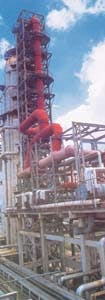
India will need much more refining capacity if demand for petroleum products develops as expected. This hydrocracker is at Indian Oil Co. Ltd.'s refinery in Koyali, Gujarat.
Market fundamentals
A major reason for interest in investments in India is the large potential market.
The estimated population of India was 897 million as of mid-1994. At current growth rates the population is expected to top 1 billion by the year 2000 and possibly make India the most populous country, exceeding even China by the year 2030.
Recent population totals and growth rates by year are: 1961, 439.2 million, 1.96%/year; 1971, 548.2 million, 2.2%/year; 1981, 685.2 million, 2.25%/year; and 1991, 843.9 million, 2.21%/year.
The large population has an equally large potential demand for refined products. Energy demand growth has been 8-10%/year for some products, but per capita energy consumption remains less than one-half that of China and a fifth of the world average. Compared to other developing countries on the basis of tons of oil equivalent, India is less oil-intensive than most (Fig. 1) [11000 bytes].
![(Fig. 1) [11000 bytes]](http://images.pennwellnet.com/ogj/images/ogj/624le-1.jpg)
Similar patterns can be seen in specific products. For example, India is a heavy kerosene consumer for domestic use, including cooking, heating, and lighting. Indonesia has similar uses for kerosene. Fig. 2 [9000 bytes] shows the relationship between India's consumption and Indonesia's consumption, indicating the potential for consumption growth in India as the economy expands.
![Fig. 2 [9000 bytes]](http://images.pennwellnet.com/ogj/images/ogj/624le-2.jpg)
There is also potential for other areas of low current usage as economic growth occurs. Fig. 3 [9000 bytes] shows car ownership as a function of gross domestic product (GDP) per capita. While India lies close to the average for car ownership versus GDP per capita, the anticipated increase for economic growth is large.
![Fig. 3 [9000 bytes]](http://images.pennwellnet.com/ogj/images/ogj/624le-3.jpg)
The number of registered vehicles increased from 5.2 million in 1981 to 23.4 million in 1991. The amount of roadway was only 1 million km, and generally below international quality standards, but carried nearly 60% of passenger traffic.
Economic growth
The population and demand potential is not sufficient alone to generate a rapidly growing market for refined products. The engine for this growth in demand is economic growth in India.
While India had the world's sixth largest gross national product (GNP) in purchasing power parity terms in 1992-after the U.S., Japan, China, Germany, and France-this translated into $1,210 per capita, ranking only 100th in the world. The low level of GNP per capita is but one indicator that there is potential for economic growth. Fig. 4 [13000 bytes] compares India with Asian competitors on the basis of other indicators.
![Fig. 4 [13000 bytes]](http://images.pennwellnet.com/ogj/images/ogj/624le-4.jpg)
The potential in India is not new. What is new is the opening of these markets to foreign investors and the economic reforms instituted by the current government in 1991. Fig. 5 [21000 bytes] is a partial list of the industrial, trade, and fiscal policy reforms that have been sanctioned.
![Fig. 5 [21000 bytes]](http://images.pennwellnet.com/ogj/images/ogj/624le-5.jpg)
Economic indicators since the programs were initiated in 1991 are showing favorable responses in most areas, including a return to economic growth rates of 5%-plus and a healthy increase in foreign investment to fuel economic growth (Fig. 6) [10000 bytes].
![(Fig. 6) [10000 bytes]](http://images.pennwellnet.com/ogj/images/ogj/624le-6.jpg)
The economic growth has yet to reach the explosive rates seen in other countries in the region, and it is important that the government not slacken its efforts to further liberalize and reform the economy, as growth in the economy is required just to maintain position given the increasing population (Fig. 7) [12000 bytes].
![(Fig. 7) [12000 bytes]](http://images.pennwellnet.com/ogj/images/ogj/624le-7.jpg)
A key issue in the economic growth relative to demand for refined products will be the restructuring of the economy as well as the overall growth. The indications are that the economy is becoming more balanced, with a larger portion of the GDP coming from industry.
Product markets
Economic growth and its effects on oil consumption are reflected in recent and forecast product demand in India.
Numerous forecasts for demand growth in India have emerged from a range of petroleum consultants, financial institutions, and the government of India itself. The range of growth forecasts is wide and varies primarily with assumptions about economic growth rates for India and the success of economic reforms.
Secondarily, there are differing views concerning LPG and kerosene domestic consumption, motor vehicle use, naphtha for petrochemicals, and fuel oil for industrial use or power generation, which further differentiate the demand forecasts. Fig. 8 [13000 bytes] shows the range of a typical group of forecasts, including the official Ninth Plan for India, against current refining capacity and planned expansions.
![Fig. 8 [13000 bytes]](http://images.pennwellnet.com/ogj/images/ogj/624le-8.jpg)
Under any of the demand growth scenarios, the existing refinery capacity, including expansions, is not sufficient to meet demand on an overall basis. Also shown is the estimated crude oil supply available from Indian production, which indicates a need for continuing significant imports of crude oil.
Table 1 [24000 bytes] lists refining capacity and the expansions included in Fig. 8 [13000 bytes].
![Table 1 [24000 bytes]](http://images.pennwellnet.com/ogj/images/ogj/94244801.jpg)
The validity of the demand forecasts is supported by the recent history of growth. The actual reported consumption against the official plan forecasts is shown in Fig. 9 [24000 bytes].
![Fig. 9 [24000 bytes]](http://images.pennwellnet.com/ogj/images/ogj/624le-9.jpg)
Generally, the reported actual figures are at or above the forecast figures, indicating that at least in the near term the forecasts have tended to be conservative relative to economic growth.
It is interesting to note that growth rates in diesel and motor spirits (gasoline) are particularly strong, as would be expected. The kerosene growth rates are a function of government subsidy policy and the volumes limited to an extent by the amount of subsidy available.
The supply-demand gap that develops with growth will not be the same for all products. This will have to be reflected in the plans for new refining capacity, to avoid surpluses of some products.
Potential capacity need
The supply-demand gap illustrates there is a potential market for new refining capacity. The gap varies from 21 million metric tons/year to 34 million tons/year over the range of forecasts shown.
There are a number of new grassroots refining projects being developed by public sector companies, private Indian companies, and joint foreign-Indian companies competing to fill the supply-demand gap. Table 2 [21000 bytes] lists some of these projects, probably the most firm at this point.
![Table 2 [21000 bytes]](http://images.pennwellnet.com/ogj/images/ogj/94244802.jpg)
Some of the projects are under construction, some in the final stages of approval, and some just entering the approval process. If all the projects were to proceed on schedule, more than enough capacity would be built to fill the anticipated gap; however, it is unlikely, given experience elsewhere in the world, that all the projects will move forward.
Just as demand growth is not spread equally across all products, neither is it spread equally over the country. Fig. 10 [16000 bytes] shows the relative size of demand centers in India for high speed diesel (motor diesel). Also shown are the existing and proposed refineries and major pipelines. There are concentrated areas of demand, but there are also widely dispersed markets. Refinery location and access to efficient distribution make up a key competitive element.
![Fig. 10 [16000 bytes]](http://images.pennwellnet.com/ogj/images/ogj/624le-10.jpg)
Competition for the Indian product market will be from imports from refineries in the Middle East and possibly Asia. Fig. 11 [12000 bytes] shows the typical supply routes and the relative cost premium for transportation of imported product relative to moving crude directly to India for refining.
![Fig. 11 [12000 bytes]](http://images.pennwellnet.com/ogj/images/ogj/624le-11.jpg)
The competition from Asia will likely be limited since the area is crude-short and marginal crude supplies will come from the Middle East. Furthermore, the demand growth and shortages of many products in Asia will limit the export volumes available.
The Middle East is the traditional supplier to India. Recent cutbacks in refining investment plans and continuing domestic demand growth are serving to limit the export availability growth from the region. Nonetheless, export product from the Middle East will likely continue to be the basis for open market price comparisons on marginal product in India (Fig. 12) [13000 bytes].
![(Fig. 12) [13000 bytes]](http://images.pennwellnet.com/ogj/images/ogj/624le-12.jpg)
Business environment
The business environment in India can be characterized in a positive direction by its relatively low labor cost and well-developed manufacturing base for most materials required for refineries. The negative aspects include the lengthy approval processes and relatively high tax and duty rates. In addition, the refining segment is subject to a high level of central control.
The literacy rate is relatively low in India, reported at 52% in 1991; however, there are over 2 million engineers and scientists, 10 million graduates, and 185 universities. The total labor force is estimated at over 350 million, of which about 50 million are educated to the higher secondary level.
There are no firm unemployment figures, but the estimate of urban job seekers is 17 million, of which 7 million are educated based on adjusted registrations of job seekers. The result is a ready labor pool, including a large number of educated people.
The manufacturing base for materials required in refining is well-developed. Between 65% and 100% of the equipment and materials required for the various types of refinery construction are available from Indian sources. The concerns would be around production capacity if several major projects were done at the same time, rather than a basic ability to produce.
The combination of labor and materials factors leads most engineering and construction firms to conclude that refinery construction is possible in India at about 85-90% of the cost for a baseline U.S. Gulf Coast facility.
Duties and taxes
The savings in labor and materials are partially offset by the structure of duties and excise taxes in India. Table 3 [12000 bytes] compares India's duties and excise taxes with those of other countries in the region.
![Table 3 [12000 bytes]](http://images.pennwellnet.com/ogj/images/ogj/94244803.jpg)
There are administrative procedures for seeking specific relief in India from the duty and excise rates, but they are complex and the outcome is uncertain.
There have been changes in the business licensing requirements as part of the economic reform effort. However, it remains a complex and time-consuming activity to obtain approvals for refinery investment in India. Recent experience would indicate that an approval process of 2-3 years is required. These reviews are not always transparent to a foreign joint venture partner, and political pressures can impact the ability to optimize economic performance for the investor.
Corporate tax structures in India are relatively high (Table 4) [16000 bytes].
![(Table 4) [16000 bytes]](http://images.pennwellnet.com/ogj/images/ogj/94244804.jpg)
Tax holidays are available for projects in India, but comparable or better incentives are available in other countries in the region.
The refining and marketing industry is currently controlled, with the assets largely in the hands of three public sector companies. Crude oil is procured centrally, product distribution plans done centrally, and pricing controlled to generate a fixed return for refiners.
The system is under review by the government, and the indications are that over some period of time the industry will be moved to a more market-related, competitive environment. Some decontrol activities have been initiated. A limited number of products have been decontrolled, and parallel marketing of specific products on a market-price basis is allowed.
At the same time, there are indications the government recognizes the need to provide an environment that will generate sufficient returns for investors to attract the capital necessary for the refining capacity required. The concern for investors is that the policy and system to replace the current mechanism of centrally administered pricing has not been defined by the government, making it difficult to produce reliable economic performance forecasts for investors and bankers.
Investment performance
Refinery investments are capital-intensive and produce a commodity product that can be traded and interchanged virtually without barriers other than freight and storage costs. The industry has a penchant for over-capacity, which drives prices down to break-even contribution levels for marginal producers and keeps returns low for everyone else.
A typical example would be a moderate-complexity greenfield refinery with advanced cracking capability and the products priced at historical Middle East open market levels plus freight to India, including taxes and duties (Table 5) [22000 bytes].
![(Table 5) [22000 bytes]](http://images.pennwellnet.com/ogj/images/ogj/94244805.jpg)
This is not an attractive prospect for an investor but is typical of a greenfield refinery investment devoid of specific market position or other competitive advantages. The very difficult economics of greenfield refining is a major reason why so few greenfield refineries get built of the many that are proposed.
An apparent shortage of refined product in a country is a necessary condition to interest investors in refinery investment-but not a sufficient condition. A refinery investment will have appeal only if it can demonstrate a combination of unique advantages relative to a generic refinery project. Combination of advantages is a key concept as a single advantage is not generally sufficient.
Cost-efficient construction, world-class operating cost-competitiveness, and an internationally competitive tax environment are base requirements and generally cannot be considered significant unique advantages, but minimum requirements.
Areas of advantage
An examination of India's environment leads to a list of possible areas of advantage for a refinery project, including:
- Careful attention to strategic siting and transportation to generate value from distribution cost advantages given market dispersion in India and limited distribution facilities.
- Utilization of cutting-edge technology in a capital-efficient manner to best match the market and reduce residual production relative to other Indian and regional refiners.
- Utilization of Indian and international resources on a selective basis to generate advantages against other regional refiners in capital and operating costs.
- Building flexibility to access international markets for products and feedstocks, including optimization expertise in supply, to gain advantage during the transition of Indian refining from a centrally controlled environment to an international market-related environment.
- Building an alliance of international supply strength and Indian distribution and marketing capability to gain competitive advantage over importers and less-capable domestic refiners.
- Understanding and fully utilizing the available investment incentives in India for greenfield refineries.
- Developing an early position in the approval process in India to establish a market entry advantage and to be well-positioned for the initial supply-demand gap.
- Developing synergistic alliances with related industries that can generate mutual advantages, such as power plants or petrochemical facilities.
Unique advantages
The two joint venture refineries being developed by Oman Oil Co. Ltd., Hindustan Petroleum Corp. Ltd., and Bharat Petroleum Corp. Ltd. are examples of developing unique project advantages.
The joint venture refinery projects between Oman and India encompass a number of the concepts listed and as a result are expected to generate a performance level above that of a generic greenfield refinery.
The Bharat Oman Joint Venture project is strategically located in Central India in an area served by expensive rail freight. The project will include a cost-efficient crude pipeline and product pipeline access to key market concentrations. The technology used is an advanced form of hydrocracking, which simultaneously produces high quality lube stocks and distillate fuels from a variety of crudes.
The joint venture structure combines international supply capability with Indian distribution and marketing capability. The development of alliances for power generation and petrochemical feedstocks is currently under discussion. The project detailed feasibility report was submitted to the Indian government in October 1994 and was approved in November 1995.
The Hindustan Oman Joint Venture project is also strategically located and will access pipeline links to key inland markets in addition to the immediate market area. Further, the coastal location provides access to international markets for feedstocks and products.
The cracking technology employed should enable the refinery to use purchased residual cracking feedstocks and adjust production between distillates and gasoline with minimal added investment. Ocean freight facilities allow access to international product markets. The joint venture features and early entry capability are similar to those of the Bharat Oman project.
Both of these projects will use low-cost, efficient approaches to contracting and operations incorporating both international and Indian capability to be competitive in the world. In addition, each project incorporates a number of intended project-specific concept advantages.
An average performing greenfield refinery project will generally not generate return sufficient to investors. Refining projects that will interest investors, especially international investors, are those which can generate upper-quartile performance relative to regional competition.
The Oman-India joint venture refinery projects should be developed on the basis of generating the best returns possible under open market conditions and on the basis that they must be internationally competitive. This is a prudent approach in view of the uncertain specific future policy of the Indian government toward the refining industry.
Careful assessment
To summarize, India's population growth by itself does not ensure rapid market growth or success of refining investments in the country. Careful assessments are essential.
There is potential in India for strong refined product demand growth associated with overall economic growth. While the economic reform program in India appears to be generating results and improved economic growth rates, further reforms will be required if India is to experience growth rates comparable to those of other Asian countries.
Under reasonable expectations about demand growth, existing refining capacity in India, including planned expansions, is insufficient.
For refining ventures drawn to the need for new capacity, the business environment has certain advantages related to labor and materials. But it remains disadvantaged with regard to taxes and foreign investor incentives relative to opportunities in other countries.
Pressure on refinery returns in India will be similar to those in other countries. Under uncontrolled conditions, only superior projects will generate returns acceptable to investors or lenders.
Factors that can be used to generate such superior project performance exist in India, if the projects are carefully developed.
The opportunity for refinery entry is limited by the size of the supply-demand gap, the number of projects already proposed, and the lengthy approval process in India, which should reward the early entrant.
It is very important for the government, at the central and state level, to clarify the policy and environment for the refining industry to provide the level of certainty required for investors and lenders to make commitments to Indian refinery projects. n
The Author
Everett Lewis is a consultant, currently involved in refining projects in India, Oman, and Thailand, who formerly worked as refinery project executive with Oman Oil Co. Inc. He has 25 years of experience in refining, having worked for Chevron U.S.A., Pacific Resources Inc., and BHP Australia, with assignments in engineering, operations, marine transportation, terminals, pipelines, planning, supply trading, project development, and international joint ventures. He holds a BS in chemical engineering and an MBA.
Copyright 1996 Oil & Gas Journal. All Rights Reserved.