Foreign partners scarce in OPEC gulf states
David Knott
Senior Editor
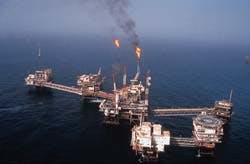
Total's Abu Al Bukhoosh oil field off Abu Dhabi is an example of an OPEC country's success in attracting foreign investment to its petroleum sector. Photo courtesy of Total.Members of the Organization of Petroleum Exporting Countries that border the Persian Gulf long have dominated the group by virtue of their massive oil reserves. When it comes to efforts to attract foreign investment to their petroleum sectors, however, the Persian Gulf OPEC states lag their counterparts elsewhere in the world. Countries such as Venezuela, Algeria, Nigeria, and Indonesia are well advanced in efforts to hike production capacity with an infusion of foreign capital and expertise (OGJ, July 29, p. 31). But upstream foreign joint ventures are scarce among the group's giants (in terms of oil reserves). Saudi Arabia and Kuwait in particular have proven reticent in this regard, and international politics have cast a pall over upstream foreign ventures in Iraq and Iran.
Still, there are some deals being made with foreign investors, notably in downstream sectors and especially in petrochemicals. And Asia is shaping up as a key market for these ventures.
Asian markets
One road to expansion for OPEC members is supplying Asia's developing markets, contends OPEC Sec. Gen. Rilwanu Lukman.
Lukman said OPEC members are looking not only to supply crude oil to Asia but also more refined products and petrochemicals.
"OPEC member countries are particularly interested in the development of the oil industry in Asian newly industrializing countries," said Lukman, "and in turn we offer opportunities for the developing countries of Asia that should prove beneficial to us all, since without the required investment in their upstream sectors, OPEC member countries may not be able to provide the growing oil supplies demanded by Asian developing countries."
One western company targeting Asia's booming economies through Middle Eastern projects is Borealis AS, Copenhagen, the petrochemical joint venture of Finland's Neste Oy and Norway's Den norske stats oljeselskap AS (Statoil).
A Borealis official said the company strategy is to increase activities in the Asian region and one of the ways to achieve this is participation in Middle East ventures, in or outside OPEC.
"Like the rest of our competitors," said the Borealis official, "we see huge potential in the Asian markets the next 10 years."
Under a joint venture Abu Dhabi National Oil Co. (Adnoc) and Borealis are assembling a project team to build an ethylene cracker and twin train polyethylene plant at Ruwais, Abu Dhabi.
In July the companies signed a memorandum of understanding and aim to complete the plant by 2000. It will have capacity to produce 450,000 metric tons/year of high density and linear low density polyethylene.
The agreement is for a joint venture production company to be owned 60% Adnoc and 40% Borealis and for a separate, 50-50 joint venture to market the plant's polyethylene.
The official said a project group is being established to start work on the plant. Several contractors have tendered for plant construction, and the main contract could be awarded later this year.
The plant will be built on a new site in a large industrial area, near an existing oil and gas terminal. The cracker will run locally produced ethane feedstock. Polyethylene will be made using Borealis' Borstar bimodal process.
The plant is expected to cost $1 billion. Output will be marketed in Southeast Asia and India.
Borealis is also negotiating a similar polyethylene venture in Oman, said the official, and the company has so far reached the letter of intent stage with Omani authorities.
The Oman PE plant is expected to consist of a 260,000 metric ton/year ethylene cracker and two polyethylene units with combined capacity to produce 260,000 metric tons/year of high density and linear low density polyethylene.
With similar ambitions in mind, in May a venture of Saudi Basic Industries Corp. and Mobil Corp. disclosed a $2 billion project to more than double production capacity at its Yanbu petrochemical complex (OGJ, May 20, p. 39).
Saudi Arabia
Julian Lee, oil analyst at London's Centre for Global Energy Studies, said Saudi Arabia has claimed all along that it does not need foreign involvement, because it has 2 million b/d spare production capacity and enough capital to meet investment requirements.
"But the way OPEC members' production costs have increased and the opening up of new non-OPEC plays means there is now no financial barrier to investing in non-OPEC projects," said Lee.
"Whatever the outlook for oil prices, companies are not going to stop investing in non-OPEC production projects. And now OPEC countries cannot afford to embark on a price war."
Lee said the most sensible approach for OPEC members to cope with the competitiveness of non-OPEC projects is to make sure that some of the oil industry's investment is going to their own countries.
"There is a strong argument," said Lee, "that Saudi Arabia ought to rethink its policy on the basis that it should be taking investment that will otherwise be invested elsewhere.
"Also, this would give outside partners a vested interest in maintaining Saudi production levels. So while it is true that Saudi Arabia doesn't necessarily need outside involvement, it would make sense on other grounds."
Lee said CGES does not see foreign involvement in Saudi Arabian oil industry as a near term prospect because so much depends on what happens to the country's political regime.
The general consensus is that the transfer of power in Saudi Arabia from King Fahd to his brother Crown Prince Abdullah will be smooth, said Lee. However, problems may arise over transfer to the next generation, he added.
"Prince Abdullah is seen as more of a fundamentalist Muslim than Fahd," said Lee. "He may take things the other way. He may be more concerned with the way the country is run and may see 10 million b/d production capacity as adequate.
"If the Saudi situation blows up, much depends on the nature of the regime that comes to power. But we don't see this as something for the near future."
There has been a surge of anti-U.S. feeling in Saudi Arabia of late, culminating in planting of a car bomb at a U.S. military housing complex near Dhahran on June 25. The bomb killed 19 U.S. personnel and injured hundreds more. It followed a year of rising tension in the kingdom, as fundamentalist Muslim groups opposed to government grow increasingly restive (OGJ, July 1, Newsletter).
Iraq
A number of oil companies have agreements to develop oil fields in Iraq, once the United Nations lifts its embargo against all trade with the country.
For the time being, Iraq has agreed to export $2 billion worth of oil under U.N. Resolution 986 to enable it to pay for food and medical supplies for its citizens.
Despite the oil-for-food agreement, Iraq appears to be viewing the Resolution 986 plan as shopping list for computers, telecommunications and oil drilling equipment, and spare parts for helicopters.
Iraq's apparent attempts to wriggle out of the actions agreed under the resolution and U.S. refusal to give way despite pleas on behalf of Iraq's suffering citizens by other U.N. members, mean the wrangling over limited oil sales could carry on indefinitely (OGJ, July 22, p. 21).
CGES said that, faced with Saudi Arabia's growing internal problems, the U.S. is keen to avoid any risk of a sharp fall in oil prices that might add to the kingdom's worries.
"Saudi Arabia has earned $8 billion more than it expected so far this year as a result of high oil prices," said CGES, "and this has helped alleviate its financial troubles.
"If oil prices were to erode as a result of Iraqi exports, Saudi budgets would be squeezed once more, adding to the pressure for economic and political reform in a country that is used to spending its way out of trouble.
"Although the U.S. is reluctant to interfere directly in the oil market, it is certainly prepared to influence the course of events when it is being deflected from the pursuit of its economic or strategic objectives."
Iraq produces about 600,000 b/d of oil at the moment but has capacity to produce 2.5 million b/d. In March 1995 Iraq offered 33 oil fields for joint development by foreign companies.
These are expected to be able to produce as much as 4.65 million b/d of oil, and 10 projects have been subject of negotiations for production sharing agreements and service contracts.
Four giant fields with potential to produce a total 2.1 million b/d are the plums. Agreements to develop are in hand for Elf Aquitaine for Majnoon field, Total for Nahr Umr, and Lukoil for West Qurna, while Halfaya remains open (OGJ, July 17, 1995, p. 22).
Iran
In July 1995 Total became the first western company to participate in an Iranian upstream project since the revolution of 1978-79, after U.S. government intervention whisked the contract from Conoco Inc. even as the ink was drying.
Conoco had just secured the contract to develop Sirri A and E oil fields off Iran when President Clinton ordered an embargo on U.S. trade with Iran.
Royal Dutch/Shell and Total then stepped in, and Total emerged with the deal after Shell pulled out. Shell chose instead to concentrate on pursuit of South Pars field development in Iran.
Total took over the Sirri contract on the same terms as Conoco: a $600 million investment for 5 years, expected to lead to first oil in first half 1998 and combined production peaking at 120,000 b/d.
The Orizont jack up has begun drilling for Total in Sirri and will carry out delineation drilling for 4 months.
Total and National Iranian Oil Co. (NIOC) are reportedly completing a drilling plan that will involve 68 development wells in Sirri and is expected to take 3 years.
NIOC is also seeking international partners for a liquid petroleum gas plant, to utilize gas currently flared offshore and base gas expected to be available when expansion of Lavan refinery is completed (OGJ, Feb. 26, p. 40).
Kuwait
Lee said there is debate in Kuwait's government over whether foreign firms should be given a role in Kuwait's oil industry.
"Public opinion has moved away from seeking foreign involvement in the onshore industry," said Lee, "but Kuwait Petroleum Corp. is working to persuade Parliament to allow foreign involvement offshore."
Since the expulsion of Iraqi invaders from Kuwait in February 1991, Kuwait has spent much time and money on repairing war damage, and only recently have the country's upstream and downstream operations fully recovered.
Kuwait has reportedly discussed allowing foreign oil companies in for exploration projects in Kuwait, but there has been little action as a result.
BP held a contract with Kuwait Oil Co. (KOC) to provide technical consultancy during recovery of oil production operations. Part of the contract was for assessment of reservoir damage, but no details have been disclosed.
In June KOC received bids for a 5 year project management contract worth about $75-125 million for technical and engineering services for future oil field developments, including evaluation of bids.
KOC intends to raise production capacity to more than 3 million b/d by the early part of the next century. Bidders reportedly include Bechtel Corp., ABB Lummus Crest Inc., Parsons Corp., and Foster Wheeler Corp.
In early July Kuwait National Petroleum Co. (KNPC) awarded a consultancy project to Conoco Inc. covering a broad range of refinery operations.
Conoco said the technical services agreement will cover safety and occupational health, maintenance and inspection, project development, and process technology.
Besides sharing expertise at KNPC's refineries in Kuwait, Conoco will also train KNPC staff at its own refineries in the U.K. and U.S.
U.A.E.
In July Enterprise Oil plc, London, acquired a farmout of a redevelopment program in Mubarek field off Sharjah operated by the Buttes Gas & Oil Co. International (BGOI) unit of Crescent Petroleum Co., Sharjah (OGJ, July 15, p. 22).
Mike Pink, Enterprise managing director said: "We believe that this venture, our first in the Middle East, could form a good foundation for further growth in the region.
"There is opportunity for Enterprise to apply its special technical skills and be an early participant in Arabian Gulf exploration and production activities that are now being opened up to external oil industry investment."
Qatar
Qatar General Petroleum Corp. (QGPC) aims to raise oil production capacity by 200,000 b/d by 2000 through new developments by foreign partners, according to Middle East Economic Survey (MEES).
The regional newsletter said more than $2 billion will be spent by four companies that have made discoveries in Qatar: Elf in Al-Khalij field area, Maersk Olie & Gas AS in Al-Shaheen field area, ARCO in North gas field area, and Occidental Petroleum Corp.
In April QGPC signed a production sharing agreement with Chevron and Hungary's MOL Rt. for exploration of offshore Block 1NW. Operator Chevron will acquire 3D seismic data and drill two exploration wells.
Qatar also expects to bring on stream soon the 6 million metric ton/year Qatargas LNG export project. This is being developed by a joint venture of QGPC, Total, Mobil, and Japan's Mitsui & Co. and Marubeni Corp.
A second LNG project, the 5 million metric ton/year Ras Laffan plant, is also expected on stream in 1999 under a joint venture of QGPC and Mobil.
Qatar is also expanding its refining and petrochemical complex at Umm Said under joint ventures. Projects include a methanol plant, a fuel additives plant, expansion of the ethylene plant at the site by 280,000 metric tons/year to 520,000 metric tons/year, expansion of the polyethylene plant by 180,000 metric tons/year to 360,000 metric tons/year, and expansion of the 63,000 b/d refinery to more than 80,000 b/d, with installation there of a 20,000 b/d fluid catalytic cracker.
Copyright 1996 Oil & Gas Journal. All Rights Reserved.