NEWS Advances in offshore technology pave the way into world frontiers


Attendees began to fill the exhibition area early for last week's 28th Offshore Technology Conference in Houston. As many as 33,000 were expected to attend and tour more than 1,400 exhibits of new technical capabilities driving offshore oil and gas exploration and development into frontier deepwater areas.
The role of advancing technology in extending offshore oil and gas exploration and development (E&D) into frontiers was a recurring theme last week at the 1996 Offshore Technology Conference (OTC).
Technical papers, press conferences, and exhibits offered a thorough view of the places where offshore operators are bringing much of the new technology to bear.
Show participants presented many perspectives on resurging oil and gas E&D in the Gulf of Mexico resulting from technological advances. Also accorded strong coverage were the outlook for oil and gas development on the North Atlantic frontier west of the U.K.'s Shetland Islands and Brazil's plans to boost its ambitious deepwater development program.
The technical program included scores of papers about applications of deepwater technology, especially subsea capabilities and various types of floating production systems. Officials in addition scheduled two full technical sessions on exploration and development of the Atlantic frontier and on development of LiuHua 11-1 field in the South China Sea and Heidrun field in the Norwegian Sea.
About 1,400 exhibitors from more than two dozen countries occupied about 250,000 sq ft in the Houston Astrodome ExpoCenter. Show officials expected more than 33,000 visitors to attend the 4 day conference.
Offshore importance
Many of the topics covered at OTC press conferences reflected the increasing importance of offshore operations in world oil and gas E&D.
Officials of three industry associations at an OTC press conference reviewed effects of improved offshore technology on activity in the Gulf of Mexico.
Matthew R. Simmons, president of Simmons & Co. International, Houston, and chairman of National Ocean Industries Association, said advances in offshore technology has revived activity in the Gulf of Mexico, transforming the region to the world's hottest offshore oil and gas basin.
Max L. Lukens, president and chief operating officer of Baker Hughes Inc. and chairman of the Petroleum Equipment Suppliers Association, said service companies will continue to help offshore producers acquire new technology and remain competitive by applying it in effective ways.
W. Dennis Heagney, president and chief operating officer of Sonat Offshore Drilling Inc., Houston, and chairman of the International Association of Drilling Contractors, said the resurgence of offshore oil and gas activity and the increased complexity of offshore rigs are straining the ability of drilling contractors to find personnel capable of working offshore.
Meantime, Joe Foster, chairman, president, and chief executive officer of Newfield Exploration Co., Houston, and chairman of the Independent Petroleum Association of America's offshore committee, said timely transfer of offshore oil and gas technology especially is important to U.S. independents, many of whom are becoming increasingly active in the Gulf of Mexico.
Foster appeared at an OTC press conference on a panel that included representatives of the Petroleum Technology Transfer Council and the Department of Energy.
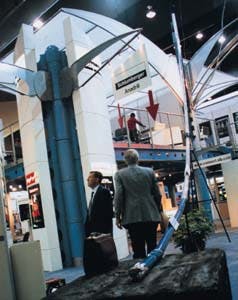
Schlumberger Oilfield Services displayed an Anadrill 31/2 in. downhole motor with a slim hole measurement while drilling tool for short radius horizontal wells.
Hottest offshore basin
Describing the Gulf of Mexico as "the hottest offshore basin in the world" and "a showcase of leading edge offshore energy technology," Simmons credited improved technology with underpinning the gulf's subsalt and deepwater plays.
Successes in the gulf on those two frontiers, he said, "are remarkably important to the future of the entire offshore."
Simmons said effects of offshore technology were abetted last month at OCS Sale 157 (OGJ, May 6, p. 40) by recently legislated royalty relief on deepwater production. Combined, the two incentives prompted sale participants to:
- Lease 401 tracts in more than 2,600 ft of water, three times the number of deepwater tracts leased at the central gulf sale in 1995 and 10 times the 1994 total.
- Offer 1,381 bids, 32% more than the previous record set in 1970.
- Bid on tracts covering 4,761 acres, 39% more than the 1988 record.
- Increase the OCS area in the gulf under lease by 58%.
Effects of technology
By enabling operators to develop fields not previously believed economic, Lukens said, improved technology has changed the way the petroleum industry does business.
"More than ever," he said, "there is a willingness to explore new ideas and innovative technologies that reduce costs and bring greater returns to the bottom line for everyone. Operators are working with service companies to develop new valued added technologies that will reduce costs."
Among the new technologies and operating strategies reducing costs, Lukens cited 3D and 4D seismic technology; extended reach drilling and horizontal, multilateral wells; slimhole, reentry, and turnkey drilling; subsea and low intervention completions, deepwater production equipment and instrumentation and floating production systems; and unmanned or low maintenance facilities; integrated solutions; and partnering.
Lukens said combining technology with skills and experience of a reservoir engineer, geophysicist, geologist, and wellbore engineer on integrated teams sharply lowers finding costs.
"Technology has restriped the playing field," Heagney said. "If we're to make full use of technology, we must expect to recruit and train more highly skilled individuals than in the past."
However, for several reasons, the pool of workers with adequate skills might not exist, he said.
"People without the ability to operate computers and to adapt to new technologies simply will not advance," Heagney said. "In the U.S., sadly but unarguably, the level of training of entry level people has never been lower."
Heagney said offshore drilling contractors should resist the temptation to raid competitors for qualified employees. Instead, drilling contractors, producers, and service companies must replace experienced rig hands now retiring with skilled, motivated, quick minded newcomers.
Heagney challenged his peers to frame human resource goals in terms of decades, rather than whatever staffing level is needed for the next job.
"It's a difficult challenge, and it is going to cost us a lot more," he said. "But our industry can overcome this problem rationally if we each do our part."
Independents
Foster said independents in the Gulf of Mexico have lowered oil and gas unit costs, expanding the window of profitability on many leases.
"Independents also have the continuity and diversity of viewpoint to be persistent drillers, testing smaller targets than the majors might, intensely developing old fields, and sometimes making large discoveries," he said.
The increasing importance of independent producers in the gulf is reflected in the group's relative shares of oil and gas production and acreage under lease.
Foster cited figures showing that 13 major oil companies in November 1995 operated properties in the Gulf of Mexico with gross production averaging 11.68 bcfd of gas equivalent (bcfde), or about 62.1% of gulf oil and gas flow. Leases operated by 16 other companies integrated or affiliated with large parent companies accounted for about 14.5% of the region's daily production.
All other operators-small companies, including 21 independents-operated leases with gross production of 4.4 bcfde, more than 23.4% of totals gulf-wide. Nonintegrated, unaffiliated independent companies in 1986 operated leases accounting for 9.4% of the oil and gas produced in the gulf.
Newfield Exploration since its formation in late 1989 has risen to 15th on the list of top Gulf of Mexico oil and gas producers, with daily production in November 1995 averaging about 308 MMcf of gas equivalent.
Of the 8.22 million acres under primary lease in the gulf in less than 600 ft of water, independents in July 1995 held 33.1%-more than the 31.6% held by major integrated oil companies and the 28.1% held by major integrated or affiliated companies.
Foster also presented Sale 157 bidding summaries that showed independents played a key role in the auction (see table, p. 32).
Foinaven field
The Atlantic frontier west of the Shetland Islands will see its first production in mid-1996 from BP Exploration Operating Co.'s Foinaven field on U.K. Block 204/20a.
Although production is to start less than 2 years after government approval and only 3 years after drilling the discovery well, the area generally has been disappointing for the industry.
BP said new technologies such as 3D seismic and horizontal, multilateral, wells-along with more cost effective business practices-have finally led to a commercial find and development. Since the government began awarding licenses in the area in 1972, industry has drilled 133 exploration and appraisal wells at a cost of about $2 billion.
Foinaven development is a $1 billion project in 1,500 ft of water, the deepest yet for a development project off the U.K. BP will produce the field with the Petrojarl Foinaven floating production storage and offloading (FPSO) vessel leased from Golar-Nor Offshore AS under a payment schedule based on production.
BP plans to drill 22 Foinaven wells: 14 producers, seven water injectors, and one gas injector. Because of the field's thin, shallow, but areally extensive sands, wells will be drilled from two sites about 2 miles from the FPSO. Shuttle tankers will carry the oil to Flotta terminal in the Orkney Islands.
Foinaven's producing wells will be horizontal, high angle, geosteered holes with some multilateral completions. Gas will be reinjected into a separate nearby structure.
BP expects production to peak at 85,000 b/d from oil reserves estimated at about 200 million bbl during the first phase of development.
The field will have a first of its kind, permanent, seabed seismic system to monitor reservoir fluid movement.
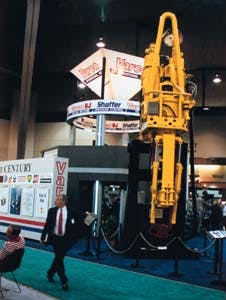
Varco International Inc. erected a dual motor, 700 hp AC top drive unit for offshore drilling rigs. The unit can be skid mounted for onshore use.
Schiehallion field
BP expects to start production from Schiehallion field in first half 1998. The field lies in 1,150-1,300 ft of water on Blocks 204/20, 204/25b, 205/1c, and 205/21b, 9 miles east of Foinaven.
BP discovered Schiehallion late in 1993.
The U.K. in April approved a $1.3 billion development plan for the field, including a southern extension onto an Amerada Hess block and a northern satellite field, Loyal. BP estimates combined reserves of Schiehallion and Loyal at about 425 million bbl.
An extended test in a Schiehallion horizontal appraisal well flowed at rates of more than 20,000 b/d and recovered a cumulative 714,000 bbl of oil in 60 days. BP said the oil quality is similar to Foinaven's, but the reservoir does not have a gas cap.
BP plans to develop Schiehallion and Loyal with 29 subsea wells drilled from four sites, including 22 in Schiehallion. The well count involves 16 producing wells, 12 water injection wells, and one gas injection well.
Like Foinaven, this development will also have horizontal producers with some multilateral completions.
Production is to flow to an FPSO with 900,000 bbl of storage capacity designed to produce as much as 142,000 b/d. Gas is to be reinjected.
![Sale 157 Bids by Company Classification [21240 bytes]](http://images.pennwellnet.com/ogj/images/ogj/94203201.gif)
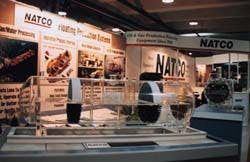
Natco, Houston, exhibited a transparent version of a horizontal separation vessel designed to reduce effects on processing of turbulence created by waves. Typical uses of the technology include floating production systems in deepwater fields.
Brazil's new regulations
Petrobras Pres. Joel Mendes Renno said Brazil's congress by August is expected to approve a bill setting up a regulatory framework for a more competitive oil market in the country.
The new rules stem from passage in November 1995 of Constitutional Amendment No. 9 (OGJ, Feb. 19, p. 29). That amendment requires the Brazilian government to maintain its monopoly over the oil sector through Petrobras, while retaining powers to let contracts to private and state owned companies for activities such as finding and producing oil and gas, refining, and importing and exporting crude oil and products.
Under the Draft Law for the Oil Sector Regulations, the Brazilian energy market is open to private investment either in cooperation with Petrobras or independent of it. The government will continue to own 51% of the company.
Renno said the rules will establish Agencia Nacional de Petroleo (ANP) as an independent government body with administrative and financial autonomy, responsible for overseeing the oil monopoly on behalf of the government.
Among ANP's responsibilities is preparing of Brazil's oil refining and supply program, organizing tenders for bids, granting licenses for oil exploration and production, and authorizing other oil sector activities under specific contracts.
Another proposal under consideration would establish a National Oil Policy Council to advise the Ministry of Mines & Energy.
Among more immediate efforts, Renno said, are steps to coordinate licensing processes for new offshore and onshore areas, encouraged by expansion of oil product demand. ANP is to define blocks in unexplored areas or in areas returned to the government by Petrobras either because of a lack of interest or expiration of the 3 year deadline for appraisals.
Copyright 1996 Oil & Gas Journal. All Rights Reserved.