Dynamic positioning, compact power system create new life for semisubmersible
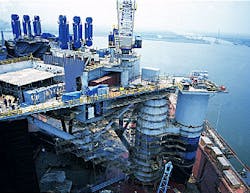
Due to be completed late last month, the Paul Wolff will be able to drill in water depths greater than 2,700 m to a depth of 5,300 m below the mud line. It is a triangular-shaped semisubmersible that will include two 60-ton Dreco pedestal cranes and one 40-ton Craneman bridge crane (shown). It will also include a Varco TDF-45 top drive (1.5 million lb hookload) in addition to a 3,000 hp drawworks (Fig. 1, photograph by Mieko Mahi).A compact power system, together with the addition of dynamic positioning capabilities, are among the changes that have been made to Noble Drilling Corp.'s newly redesigned semisubmersible, Paul Wolff (Fig. 1), scheduled for departure this fall from Port Sabine, Tex.
![The Paul Wolff is powered by seven 16-cylinder, seawater-cooled, Caterpillar diesel generators. Each three-phase generator, installed to the left of the deck crane in Fig. 1, will produce 11,000 v at 60 hz (Fig. 2 [41,818 bytes]).](http://images.pennwellnet.com/ogj/images/ogj2/9640jdy02.jpg)
The Paul Wolff is one of six submersibles purchased from Kerr McGee Corp. in 1991. Since then, Noble has boosted electric-power capacity on the rig from 3.6 mw to more than 30 mw.
According to Scott Marks, project manager for Noble, most of the additional power will operate six 3,728-kw thrusters, which are designed to keep the rig positioned over well sites in the Campos basin, located in the South Atlantic Ocean about 160 km out from Rio de Janeiro. Once it reaches the basin, the Paul Wolff will operate under a 6-year contract with Petrobras, the Brazilian national oil company.
Providing compact power
Marks said a key challenge during the 16-month, $146 million conversion was to fit the additional power into available space and to avoid major structural changes in the rig.To power the Noble Paul Wolff, converted in drydock at TDI-Halter Inc. near Port Sabine, Noble Drilling chose seven Caterpillar 3616 diesel-generator sets, each rated at 4.4 mw at 900 rpm (Fig. 2). Each seawater-cooled, 16-cylinder turbocharged and after-cooled engines drives a 65,714 kva (kilovolt-ampere) Kato synchronous generator. Each generator produces 11,000 v at 60 hz using three-phase power.
The generator sets are installed on the rig's main deck-four in an existing engine room and three in a new engine room. An SCR (silcon controlled rectifier) room on the main deck also houses the rig's emergency power system-a Caterpillar D399 generator set rated at 1,050 kw at 1,200 rpm.
The Noble Paul Wolff, a triangular, three-column rig that measures 73.4 m on each side, is Noble's fourth dynamically positioned rig. The company is considering more such projects in the future.
To outfit the Noble Paul Wolff for deepwater offshore drilling, the company added deep pontoons measuring 11.8 m wide and 5 m deep. These pontoons span 73.4 m between columns.
The dynamic positioning system, which accounts for about 60% of the rig's electric power demand, includes six thrusters, two within each pontoon. Kamewa AB of Sweden manufactured the thruster gear reducers and the 2.2-m-diameter, three-bladed propellers.
Cejelec of France packaged the electric-drive systems, each featuring a 3,728 kw air-cooled, ac motor with variable speed control. Each thruster is capable of full 360-degree rotation.
When the Noble Paul Wolff drills in water depths greater than 2,700 m in the Campos basin, the dynamic positioning system will hold the drawworks within 12.5 m from a point directly over the well.
To monitor the rig's position, Sonardyne solar beacons implanted in the sea floor will signal transducers on the rig's bottom. A PLC-based control (programmable logic controller) system will then direct the thrusters to compensate for rig movement caused by ocean conditions.
Fiber optic communication between the PLC and the thrusters will speed thruster response and maximize positioning accuracy. Each thruster will operate independently as directed by the PLC.
As a cross-check and as a back-up in case of a failure in the sonar-based system, a global positioning system (GPS) using satellite references will also operate continuously. A similar redundancy also exists in the engine room.
According to Mark Storms of Caterpillar Inc., all operating engines will share the load equally, running at 50-80% of rated output to maximize fuel efficiency and service life. The Noble Paul Wolff's electric distribution system includes transformers that step down 11,000-v power from the generators to serve the thrusters, the drawworks, and other rig functions.
Copyright 1998 Oil & Gas Journal. All Rights Reserved.