Reassessing Iraq's OPEC membership in light of national development priorities
Key Highlights
- Reforms such as phased exemptions, revised quota formulas, and infrastructure-linked flexibility could help Iraq realize its full resource potential within OPEC.
- The UAE's recent withdrawal from OPEC demonstrates that member states may reconsider their participation if collective restrictions hinder economic growth.
Iraq has a compelling case for seeking special consideration within the framework of the Organization of the Petroleum Exporting Countries (OPEC), and if such consideration continues to be denied, there is a credible argument that Iraq should seriously reassess the long-term strategic value of its membership. This is not an argument for immediate withdrawal or for undermining collective oil market stability, but rather a call for a realistic reassessment of whether the current quota structure adequately reflects Iraq’s unique historical circumstances, resource potential, and pressing national economic priorities.
Unlike several other major OPEC members, Iraq’s oil sector development was severely disrupted for nearly two decades by a combination of international sanctions, prolonged armed conflict, foreign intervention, infrastructure destruction, and political instability (see figure). From the early 1990s through the early 2010s, Iraq’s ability to invest in, modernize, and expand its oil production infrastructure was profoundly constrained. During this period, Iraq was unable to compete on equal footing with other OPEC producers that enjoyed relatively stable political environments and uninterrupted access to international capital, technology, and export markets.
Historical crude oil production (million bbl/year)
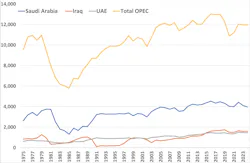
While Iraq’s oil industry was effectively frozen or operating under highly restrictive conditions, countries such as the UAE and Saudi Arabia were able to make sustained investments in upstream development, production efficiency, export terminals, refining capacity, and international energy partnerships. These states were able to steadily increase production capabilities, expand spare capacity, and consolidate their influence within both OPEC and the wider global energy market.
The accompanying table compares Iraq with Saudi Arabia, the UAE, and total OPEC, presenting the ratio of total crude oil production (1975–2024) to reserves. Iraq’s historical production-to-reserve ratio remains the lowest at 31%, compared to 63% for Saudi Arabia, 43% for the UAE, and 42% for the OPEC average.
Cumulative crude oil production to reserves ratio

The consequence of this divergence is that Iraq entered the post-sanctions and post-conflict era at a structural disadvantage. Although the country possesses some of the world’s largest proven oil reserves, its production infrastructure has had to be rebuilt and expanded from a far weaker starting point than many of its regional peers. The quota system within OPEC, however, largely reflects current production levels and installed production capacity rather than reserve size, historical disruption, or unrealized production potential.
This creates a structural imbalance that can reasonably be viewed as inequitable. A system that allocates production limits based primarily on existing capacity effectively rewards countries that had the opportunity to expand during periods when Iraq was constrained by circumstances beyond its control. In doing so, it risks institutionalizing a historical disadvantage and perpetuating an uneven playing field among member states.
Iraq’s current production levels do not accurately reflect the scale of its actual resource base or its long-term productive capacity. Iraq holds one of the largest proven crude oil reserves globally. Its unexplored and underdeveloped fields could substantially increase this figure if fully assessed and developed. Fields such as West Qurna, Rumaila, and Majnoon possess enormous output potential. Given sufficient investment in infrastructure, water injection systems, export terminals, and technical modernization, Iraq could significantly increase production capacity over the coming decade.
In addition to the major producing fields in southern Iraq, the hydrocarbon potential of the Kurdistan Region further strengthens Iraq’s case for greater production flexibility. The region contains substantial proven and probable oil and gas reserves, many of which remain underexplored or underdeveloped due to political disputes between the federal government and the Kurdistan Regional Government on implementation of the Iraqi constitution, and repeated interruptions to export infrastructure.
If these political and logistical challenges were resolved through a stable federal-regional energy framework, the Kurdistan Region could significantly increase its contribution to Iraq’s overall hydrocarbon output. Any assessment of Iraq’s future quota entitlement within OPEC should therefore account not only for the undeveloped supergiant fields in the south but also for the substantial export potential of the Kurdistan Region, which remains constrained more by political factors than geological limitations.
For a country whose national budget remains heavily dependent on hydrocarbon revenues, restrictions on production expansion carry major economic consequences. Oil revenues are not simply a matter of maximizing state profit; they are central to Iraq’s ability to finance reconstruction, modernize public infrastructure, create employment, improve electricity generation, strengthen public services, and address pressing development needs after decades of conflict and underinvestment.
This gives Iraq a legitimate basis for requesting an exceptional arrangement within OPEC. Such a request would not represent a rejection of collective market coordination but rather an appeal for a more nuanced and equitable interpretation of burden-sharing within the organization.
Practical options
First, Iraq could seek a phased exemption period that would permit it to gradually expand production above standard quota limits for a defined number of years. This would provide the country with an opportunity to recover some of the development ground lost during sanctions and conflict.
Second, Iraq could advocate for a revised quota formula that incorporates not only current production capacity but also reserve size, historical production suppression, infrastructure recovery requirements, and national development needs. Such a formula would better reflect the diversity of circumstances among OPEC members.
Third, Iraq could request temporary quota flexibility tied specifically to infrastructure rehabilitation projects or field development milestones. This would create a transparent framework linking production increases to measurable technical progress rather than arbitrary political negotiation.
These proposals are not unreasonable. They reflect a recognition that formal equality among member states does not always produce substantive fairness when historical circumstances differ so dramatically.
If OPEC remains unwilling to accommodate these realities, Iraq would be justified in reconsidering whether continued membership serves its long-term national interests. Membership in OPEC undoubtedly provides important benefits, including market coordination, diplomatic influence, and participation in collective efforts to stabilize global oil prices.
These advantages should not be dismissed lightly. They must, however, be weighed against the opportunity costs of constrained production. For a country with urgent fiscal and developmental requirements, the economic cost of underutilized reserves may eventually outweigh the strategic advantages of collective membership.
The recent decision by the UAE to formally withdraw from OPEC underscores the reality that even long-established member states are prepared to pursue independent energy strategies when collective production restrictions no longer align with national economic priorities. The UAE’s departure reflects growing tensions between national production ambitions and OPEC’s quota-based framework, particularly for states that have invested heavily in expanding output capacity.
While Iraq’s circumstances differ significantly and comparisons should be made cautiously, the UAE’s exit demonstrates that OPEC membership is not immutable. It highlights an important precedent: when an organization’s constraints are perceived to limit a member state’s ability to fully capitalize on its natural resources and advance its long-term economic objectives, reassessment of membership can become a rational strategic option rather than merely a symbolic political gesture.
At the same time, advocating for Iraq’s withdrawal from OPEC would undoubtedly be politically and institutionally difficult. Iraq is not simply another member; it is one of OPEC’s founding states and has played a significant historical role in shaping the organization’s identity and strategic direction. For many Iraqi policymakers and oil sector officials, membership carries substantial symbolic importance as a reflection of Iraq’s historic standing in global energy politics.
There is also the practical concern that withdrawal could create market uncertainty, strain regional diplomatic relationships, and expose Iraq to greater pricing volatility in the absence of coordinated production frameworks.
Some of these concerns are valid and should be carefully considered. Withdrawal should not be approached as a symbolic gesture or emotional reaction to disagreement over quotas.
However, policy decisions of this magnitude should not be driven primarily by institutional nostalgia or historical attachment. They must instead be guided by a sober assessment of Iraq’s present economic needs, its sovereign right to maximize the value of its natural resources, and its long-term development strategy.
Ultimately, the central issue for Iraq is not merely increasing short-term oil exports. It is about securing fair recognition of its right to fully develop its natural resources after decades of extraordinary external constraints.
The most constructive path forward is likely one of assertive negotiation within OPEC, pressing for structural reforms that account for Iraq’s unique circumstances. But if meaningful accommodation proves impossible, Iraq would be justified in considering alternative production strategies outside the organization.
Whether through reform from within or eventual withdrawal, Iraq is entitled to pursue an energy policy that reflects the true scale of its reserves, its sovereign economic priorities, and its ambition to achieve long-term national development. The question is not whether Iraq should seek fairness, but whether OPEC is willing to evolve sufficiently to provide it.
The views expressed in this opinion piece are solely those of the author and should not be interpreted as reflecting the official position, policies, or perspectives of the Kurdistan Regional Government.