Iraq signs agreements aimed at increasing country’s oil, gas production
Iraqi regulators have signed preliminary agreements for management and development of Iraqi fields, the Media Office of Prime Minister Mohammed S. Al-Sudani said in a Feb. 23 release.
Basra Oil Co. and Chevron Corp. signed a management transfer of West Qurna 2 field. Dhi Qar Oil and North Oil Co. signed an agreement for development of Nasiriyah field as well as for four exploratory blocks in the Dhi Qar Governorate, plus development of Balad field in the Salah Al-Din Governorate.
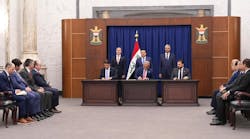 Signing ceremony Iraq Ministry of Oil, ExxonMobil
Basra Oil and Lukoil had previously signed a settlement agreement providing for the temporary transfer of the contract to Basra Oil and the settlement of all outstanding financial entitlements between the two parties. This settlement requires approval by the Council of Ministers.
In addition, a framework agreement was signed by Basra Oil, Lukoil, and Chevron allowing for the temporary transfer of the contract to Basra Oil, which will subsequently assign it to Chevron upon the completion of negotiations and agreement on the terms of the new contract. The framework agreement grants Chevron exclusive negotiation rights for a period of 1 year, in accordance with criteria agreed by the parties.
In October 2025, Iraq signed agreements with ExxonMobil, Chevron, and bp to develop Majnoon, Nasiriyah, and Kirkuk fields.
In 2024 Wood Mackenzie reported that, by 2030, Iraq’s gas output could reach 4.4 bcfd, while oil output could hit 5.5 million b/d, but fiscal terms at the time had discouraged both foreign investment and exploration activity. Potential growth largely will come from oil fields in the south, such as Rumaila, West Qurna, Zubair, and Majnoon.
About the Author
 Alex Procyk
Alex Procyk
Upstream Editor
Alex Procyk is Upstream Editor at Oil & Gas Journal. He has also served as a principal technical professional at Halliburton and as a completion engineer at ConocoPhillips. He holds a BS in chemistry (1987) from Kent State University and a PhD in chemistry (1992) from Carnegie Mellon University. He is a member of the Society of Petroleum Engineers (SPE).