Equinor, Orlen discover gas and condensate in the North Sea
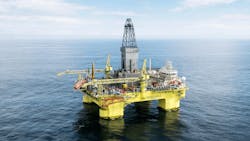
Equinor and ORLEN have discovered gas and condensate in the Sissel prospect in the North Sea. The partners will consider opportunities to develop the discovery as a tie-back to existing infrastructure in the area. The preliminary calculation of the size of the discovery is 1–4.5 million std cu m of recoverable oil equivalent (6.3–28.3 MMboe).
Exploration well 15/8-3 S was drilled by the Deepsea Atlantic rig in production license 1137 about 5 km southeast of Utgard field and 250 km southwest of Stavanger. The well was drilled to a vertical depth of 4,282 m subsea and a measured depth of 4,359 m. It was terminated in the Rattray formation in the Middle Jurassic. Water depth at the site is 110 m.
The well encountered condensate-rich gas in sandstone layers in the upper part of the Hugin formation with an overall thickness of 148 m. 57 m of which consist of sandstone layers with moderate to good reservoir quality. The well proved a hydrocarbon column of about 95 m, but the gas-water contact was not encountered.
The secondary exploration target in the lower part of the Hugin formation was aquiferous with poor reservoir quality and a thickness of 53 m.
The primary exploration target was to prove petroleum in Middle Jurassic reservoir rocks in the upper part of the Hugin formation (Vestland Group). The secondary exploration target was to prove petroleum in Middle Jurassic reservoir rocks in the lower part of the Hugin Formation (Vestland Group).
The well was not formation-tested, but extensive volumes of data and samples were collected. The well has been permanently plugged.