Air Products scraps Louisiana blue hydrogen, CCS project
Key Highlights
- The proposed $4.5-billion Louisiana clean energy complex aimed to produce blue hydrogen and sequester over 5 million tonnes/year of CO2.
- The project faced opposition from local residents and environmental groups, which hindered permit approvals and project progress.
Air Products & Chemicals Inc. has cancelled its previously proposed plans to build a 750-MMcfd blue hydrogen and carbon capture and sequestration (CCS) complex near Burnside, Ascension Parish, La.
Known as the Louisiana clean energy complex (LCEC), the originally planned development was to include construction of a 750-MMcfd plant for production of blue hydrogen alongside what was, if completed, to become the world’s largest permanent carbon dioxide (CO2) sequestration project, Air Products said in a late-June statement confirming the project’s cancellation.
The decision not to proceed with the LCEC resulted from Air Products’ determination that anticipated “financial returns” from the project no longer met the company’s “stringent return criteria,” according to the operator.
Air Products said the project’s cancellation would not impact the company’s ongoing commitment to profitably growing its established Louisiana operations, businesses which include 18 industrial gas installations as well as the world’s largest existing hydrogen pipeline network that serves multiple refinery customers along the US Gulf Coast.
Air Products’ formal cancellation of the LCEC—most recently delayed for targeted startup in 2028 from its initial planned commissioning in 2026—follows the operator’s early 2025 termination of three other US-based clean-energy projects in February 2025 due to lack of economic incentives.
In a separate statement posted to its website following the cancellation, Air Products said it would proceed with “responsibly and ethically winding down activities and fulfilling outstanding contractual obligations at the proposed plant site in Ascension Parish, at Lake Maurepas, and surrounding area, and pipeline rights-of-way.”
Post-cancellation activities also will involve closing out all project-related regulatory and permitting processes and partnerships in collaboration with Ascension Parish staff, emergency responders, contractors, and other unidentified parties during the wind-down period, the company said.
In addition to its production of blue hydrogen from a hydrocarbon-based feedstock, the now-defunct $4.5-billion LCEC was slated to capture and permanently sequester more than 5 million tonnes/year of CO2 from the production process and to include a separate production plant and associated logistics assets for low-carbon ammonia to ultimately be owned and operated by potential partner Yara International ASA.
About 95% of CO2 generated at the complex was to be captured, compressed, and transported by pipeline to inland sequestration sites along a pipeline corridor extending 35 miles east of the complex.
As of early February, Air Products—which had completed purchase of all major equipment as well as about 90% of detailed design for the LCEC—was still in the process of finalizing contracts for the project’s construction, according to a Jan. 30 presentation to investors.
While cancellation of the LCEC comes as part of a reduced focus on energy transition-related projects across the broader US industrial landscape, the proposed Ascension Parish complex also had been opposed by local residents and environmental groups since announcement of its proposed development in 2021.
The LCEC—which, if completed, would have had a footprint stretching across five Louisiana parishes—specifically was to be built on the site of the former Orange Grove sugar plantation, where local communities raised the alarm regarding the presence of unmarked graves of people who had been enslaved on the property, Earthjustice said in a release on July 1, just a day following Air Products’ announcement of the cancellation.
Of particular concern to area residents was the project’s plan to compress and transport its industrial CO2 waste through a new 38-mi. pipeline, scheduled for construction close to a local primary school and neighboring subdivisions, through the protected Maurepas Swamp Wildlife Management Area (MSWMA) near communities in St. John Parish, and on to a sprawling carbon sequestration system that would include a network of additional pipelines and 19 platforms spread across Lake Maurepas, according to Earthjustice.
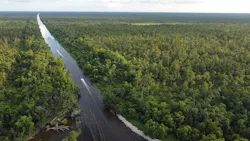
Alongside protecting South Louisiana residents from hurricane impacts, the MSWMA—one of Louisiana’s largest areas of forested coastal wetlands set aside for conservation—also acts as a vibrant freshwater fishery for the state.
“Air Products proposed a massive project with significant environmental and human impacts, so our challenge had to match that threat,” said Corinne Van Dalen, senior attorney at Earthjustice.
Earthjustice led challenges to Air Products’ applications and the issuance of environmental permits, including a US Army Corps of Engineers Clean Water Action Section 404 permit, Louisiana Department of Conservation and Energy coastal use permit, and various US Clean Air Act permits.
"When Air Products decided to pull the plug on [the LCEC],” the operator had been unable to secure any of [the above-mentioned permits],” Earthjustice noted.
Despite the project’s cancellation, Earthjustice and its coalition of member organizations said Air Products still holds an agreement with the state to use the pore space beneath Lake Maurepas for industrial-scale carbon storage, which potentially could be transferred to another company.
“We fought back for 4 years because of the enormous health risks to communities and [Lake Maurepas]. Those risks likely won’t change if another company takes on a similar project,” said Darryl Malek-Wiley, senior organizing representative for Sierra Club.
About the Author
 Robert Brelsford
Robert Brelsford
Downstream Editor
Robert Brelsford joined Oil & Gas Journal in October 2013 as downstream technology editor after 8 years as a crude oil price and news reporter on spot crude transactions at the US Gulf Coast, West Coast, Canadian, and Latin American markets. He holds a BA (2000) in English from Rice University and an MS (2003) in education and social policy from Northwestern University.