EIA: Permian production surges as horizontal wells grow longer
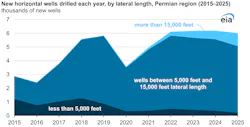
Permian basin operators are producing more oil and natural gas as they drill longer horizontal wells, including a growing share of wells with super-laterals exceeding 15,000 ft.
The shift toward longer laterals has changed the profile of Permian horizontal drilling over the past decade. Wells with shorter than 5,000 ft accounted for 43% of completions in 2015 but represented just 4% of horizontal wells in 2025, according to Enverus cited by the US Energy Information Administration (EIA).
Mid-length lateral wells of 5,000-15,000 ft increased to a peak of 90% in 2021 from 57% of completions in 2015, before declining to 81% in 2025.
The rise of super-laterals exceeding 15,000 ft reduced the share of mid-length lateral wells over the past 5 years. Although nonexistent before 2020, super-laterals account for 15% of new Permian basin well completions in 2025.
Hydrocarbon production in the Permian region increased 284% to 11.2 MMboe/d in 2025 from 2.9 MMboe/d in 2015, even though new horizontal well completions have remained largely unchanged, averaging about 6,000 annually since 2022.
Average lateral length increased 77% over the decade, to 10,867 ft in 2025 from 6,149 ft in 2015, Enverus data show. Longer laterals allow operators to contact more reservoir rock from each well while limiting the number of wells needed to develop a given area.