Trillion Energy discovers light oil in southeast Türkiye
Key Highlights
- Trillion Energy discovered light oil at the Çetinkaya-1 well in Southeast Türkiye.
- The well confirmed 32.4° API light oil within Cretaceous Beloka and Mardin Group carbonates.
- A follow-up sidetrack well (C-1ST) is planned to target the structural crest.
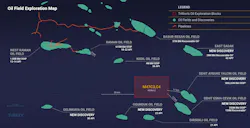
Trillion Energy International Inc. discovered light oil at the Çetinkaya-1 (C-1) well in Southeast Türkiye.
The C-1 exploration and appraisal well on Block M47C3,C4 in Şırnak Province has successfully confirmed 32.4° API light oil within the Cretaceous Beloka and Mardin Group carbonates, the company said.
A wireline logging program included gamma ray, dual laterolog resistivity (shallow and deep), compensated density, compensated neutron porosity, sonic, spontaneous potential, and multi-arm caliper. Log analysis was performed using Archie's equation with parameters calibrated to the C-1 formation conditions.
The results confirmed hydrocarbon-bearing intervals in both the Beloka and Mardin formations and fractured dolomitic oil reservoir containing light oil. Up to 38.0 m of net oil pay was identified within a 76.6-m gross reservoir interval, representing about a 50% net-to-gross ratio. Fracture-adjusted gross pay is about 40.6 m with about 36.0–38.5 m fracture-adjusted net pay.
Average effective porosity (PHIE) is 5.5% and estimated fracture-enhanced effective permeability is 5–50 md, with potential upside. The average water saturation (Sw) is 25%.
The best reservoir interval of 7 m shows PHIE up to 8.1% and Sw as low as 8% with >90% oil saturation. The reservoir is composed predominantly of dolomitic carbonate (77% dolomite), consistent with productive regional analogues. The best log-derived oil saturated reservoir intervals (2,418–2,448 m) have not been properly tested.
A 30-bbl, 15% hydrochloric acid stimulation occurred and confirmed fracture permeability and produced 32.4° API light oil at increasing oil cuts, reaching 36% oil cut in the final swab campaign.
The well intersected only about 38 m of a targeted 250–350 m reservoir section, as drilling was halted at 2,455 m due to loss of circulation. Additional reservoir section (about 160 m) remains unpenetrated due to early termination of drilling.
Zone A (2,384–2,397 m) is the primary target with 13.0 m of net pay and has not yet been perforated. This represents a near-term testing opportunity in the existing wellbore. The Near TD zone (2,447–2,455 m) shows an improving reservoir trend at total depth, indicating that the deeper, untested and unpenetrated reservoir section to be accessed by a planned sidetrack.
Multiple stacked pay zones were identified across the Beloka and Derdere formations, demonstrating a robust, multi-zone oil system, the company said. The C-1 well was drilled on the eastern flank of the North Lead structure near the spill point, suggesting that only a limited portion of the hydrocarbon column was encountered.
A follow-up sidetrack well (C-1ST) is now planned to target the structural crest, about 75–100 m higher, where the interpreted oil column is significantly greater.
Block M47C3,C4 is about 11 km southeast of Şehit Aybüke Yalçın field, Türkiye’s largest onshore oil discovery, which produces from the same Beloka and Mardin Group carbonate reservoirs. Trillion Energy believes the reservoir characteristics observed at C-1, including oil gravity, porosity, and fracture-driven flow, are directly analogous to those of nearby producing fields, reinforcing the commercial potential of the North Lead oil discovery.