Energy’s Imperative: How To Advance Emissions Management

Pressure around emissions management is intensifying. With a concentrated focus on the energy sector, the drive for emissions reduction – primarily, methane – is spurring new initiatives to catalyze change. Country and corporate commitments in support of the Paris Agreement are being bolstered by legal actions, regulatory drivers, shareholder activism, and consumer demands. Energy companies have no choice – they must embrace and rapidly deploy emissions management.
The good news is that oil and gas emissions can be readily mitigated with promising results for both the environment and oil and gas companies. For the environment, timely methane reductions could decrease emissions by 70 MMT, which would provide significant climate benefits within a few decades. For oil and gas companies, using or selling recovered methane can make emissions management a financially positive venture.
The emissions management journey, however, is not a simple “flip of the switch.” It is fraught with complexities and challenges that require new competencies. Leading energy companies are co-navigating that journey via collaborative partnerships to accelerate the attainment of their ultimate goal: To reduce the impacts of climate change.
An urgent imperative
Although no industry is exempt from examining its environmental impact, the energy sector generates about 30% of the world’s methane emissions. As a result, the energy industry faces mounting societal, legal, financial, and regulatory pressures to help meet global climate goals. Around the world, 190 countries plus the European Union, are committed to the Paris Agreement – and the COP26 targets -- with pledges to reduce their emissions by 25–37% by 2030 and to increase those reductions over time.
Emissions management has become a must-have capability to sustain ongoing operations. Beyond financial penalties, corporations also risk the loss of social license to operate from being out of step with industrial decarbonization emissions management. For energy companies, these collective forces make emissions management a corporate imperative.
OGMP 2.0: A helpful framework
As the need for emissions management escalates, so does the need for industry-based standards in emissions measurement and reporting. OGMP 2.0 was launched in November 2020 to bring transparency accuracy, standardization, and consistency to the emissions management journey.
The OGMP 2.0 is a multi-stakeholder initiative launched by the United Nations Environment Programme (UNEP) and Climate and Clean Air Coalition (CCAC) in partnership with the European Commission, the Clean Air Task Force, the UK Government, Environmental Defense Fund, and leading oil and gas companies. OGMP 2.0 membership is voluntary and helps companies progress and share their methane emission reductions with stakeholders – in a uniform, transparent fashion.
The OGMP 2.0 multi-tier framework consists of five levels plus the “Gold Standard”, the ultimate level of achievement.
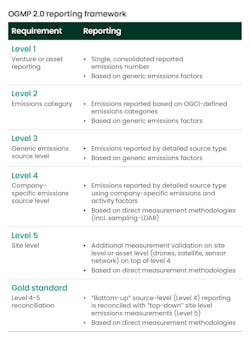
The emissions management journey
Tools such as the OGMP 2.0 framework are helpful for energy companies navigating the emissions management journey. As with any journey, it can be enhanced via expert-based collaborations to help steer, augment, and accelerate progress.
A portfolio of technology solutions, including software-based solutions, exists and is a vital element to a successful emissions management journey. That journey can be described in five progressive steps, each with distinct challenges and novel solutions. At a high level, here are the five steps:
STEP 1. Create source inventory and baseline emissions. Identify sources based on existing measurements and estimations.
STEP 2. Develop an organization-wide roadmap. Articulate a plan and specific goals to more effectively navigate the emissions management journey.
STEP 3. Take representative measurements. Emissions measurements are required for quantifying and understanding progress.
STEP 4. Take action for verifiable emissions reductions. Undertake meaningful actions to achieve verifiable emissions reduction via industry standards.
STEP 5. Communicate and report. Ongoing stakeholder communications are an important part of the emissions management journey.
Beyond emissions management, near-future synergies and disruptions will be driven by expanding decarbonization capabilities, particularly in areas such as carbon capture, utilization, and storage (CCUS); fuel switching such as hydrogen power; clean, integrated power systems; and geothermal energy. Partnering with technology providers and developers will likely be a key to successfully navigating the energy transition.
Taking energy forward
Energy companies have a significant role in the world’s future – in mitigating emissions and providing energy. That makes emissions management, without question, critical for the foreseeable future.
Baker Hughes is passionate about catalyzing change and committed to taking the energy industry forward. With its rich history and deep expertise in the energy sector, the company helps mitigate risks and realize opportunities throughout the emissions management journey and the energy transition. By developing a clear roadmap, and applying its comprehensive portfolio of emissions management solutions, Baker Hughes is helping companies navigate and solve the complicated and evolving emissions challenges that stand between them, a prosperous future, and a better world.
To learn more, please visit: https://www.bakerhughes.com/emissions-management-whitepaper?utm_source=oilandgasjournal&utm_medium=nativead&utm_campaign=emissionsmanagement