PBF extends timeline for Martinez refinery’s full restart
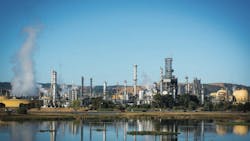
PBF Energy Inc. has once again postponed restoration of full operations at its 157,000-b/d dual-coking refinery in Martinez, Calif., to complete further repairs in the wake of a February 2025 fire at the site.
With rebuild activities at the refinery still ongoing and now projected to continue through February, PBF anticipates achieving planned operating rates at the California manufacturing complex by the beginning of March, the operator told investors in its initial annual guidance update for 2026 published in early January.
Initially targeted by April 2025 and subsequently pushed back to yearend-2025, the refinery’s return to normal operations has been hampered by a confluence of factors, including an expanded scope of required repairs amid discovery of additional damage during inspections, as well as supply chain delays and equipment procurement challenges.
Regarding current progress at the site, PBF said it is now in the commissioning phase of the refinery’s utility systems and other “idled” but yet-to-be-identified equipment.
Despite this latest 2-month delay to the full-restart process, the refinery has continued to maintain partial operations in a range of 85,000-105,000 b/d since the beginning of second-quarter 2025, according to the company.
Subsidiary PBF Holding Co. LLC began operating the dual-coking Martinez refinery—located on an 860-acre plot 30 miles northeast of San Francisco—following PBF’s 2019 acquisition of the site from Shell plc subsidiary Equilon Enterprises LLC.
2026 guidance, turnarounds
In addition to its operational update on the Martinez refinery, PBF provided investors initial projections for annual crude throughputs and planned turnarounds across its US regional refining system in 2026.
Along its US East Coast system—which includes the 180,000-b/d refinery in Delaware City, De., and 150,000-b/d refinery in Paulsboro, NJ—the operator said it expects combined throughput rates of 300,000-320,000 b/d.
In the US Midcontinent, the 180,000-b/d refinery in Toledo, Ohio, is set to average annual run rates in a range of 135,000-145,000 b/d, while the US Gulf Coast system’s 185,000-b/d dual-train coking refinery operated by subsidiary Chalmette Refining LLC in Chalmette, St. Bernard Parish, La., is projected to maintain throughputs in a range of 170,000-180,000 b/d, the company said.
Along its US West Coast system—which includes both the Martinez refinery and 166,000-b/d refinery in Torrance, Calif.—the operator said it expects combined average throughputs of 280,000-300,000 b/d.
Scheduled maintenance and turnaround events this year will include works at the following refineries and their respective units:
- Torrance refinery’s catalytic hydrodesulfurization and hydrotreating units in first-quarter 2026.
- Martinez refinery’s hydrocracker in second-quarter 2026.
- Chalmette refinery’s crude and coking units in fourth-quarter 2026.
- Paulsboro refinery’s crude unit in fourth-quarter 2026.
- Toledo refinery’s fluid catalytic cracker (FCC) in fourth-quarter 2026.
About the Author
 Robert Brelsford
Robert Brelsford
Downstream Editor
Robert Brelsford joined Oil & Gas Journal in October 2013 as downstream technology editor after 8 years as a crude oil price and news reporter on spot crude transactions at the US Gulf Coast, West Coast, Canadian, and Latin American markets. He holds a BA (2000) in English from Rice University and an MS (2003) in education and social policy from Northwestern University.