Libya advances downstream recovery with Ras Lanuf ethylene restart
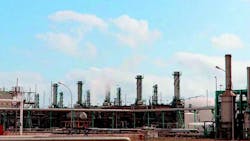
In October 2025, Ras Lanuf Oil and Gas Processing Co. (RASCO), a subsidiary of Libya’s National Oil Corp. (NOC), resumed ethylene production at its integrated refining and petrochemical complex about 615 km southeast of Tripoli, following an 8-month shutdown for extensive maintenance.
The ethylene plant’s restart marks a key milestone in the gradual reactivation of RASCO’s Ras Lanuf complex, one of North Africa’s largest integrated projects as well as one of its most troubled. With ethylene operations resuming and polyethylene output at the site expanding, RASCO stands at the center of Libya’s broader downstream recovery, as operational stability at the site will be critical for sustaining petrochemical supply to local industries and positioning Libya for renewed exports to regional markets.
Alongside providing an overview of the ethylene plant’s recent restart and examining the RASCO complex’s extended journey to reaching full-design capacities across the integrated landscape, this article also briefly discusses Libya’s plan to modernize operations of subsidiary Zawiya Oil Refining Co.’s (ZORC) conventional crude oil refinery in Az-Zawiyah, Libya.
Ethylene plant restart
Offline since February 2025 for planned maintenance, executed by state-owned technical teams, NOC confirmed in mid-October RASCO’s restart of the petrochemical plant’s steam cracker, which is configured to produce 330,000 tonnes/year (tpy) of ethylene from a feedstock of naphtha sourced from the adjacent refinery (Fig. 1).
As part of RASCO’s safety protocol to ensure stable plant performance and personnel protection, the plant’s initial restart began with introduction of naphtha into the unit’s thermal-cracking furnaces, followed by activation of the main compressor.
At the time, NOC anticipated the unit would reach full production of ethylene meeting commercial specifications by Oct. 16.
While neither NOC nor RASCO revealed details regarding specific works completed during the shutdown, NOC said restart of the ethylene unit was part of the state-owned company’s multiyear program to restore the Ras Lanuf industrial complex to its original design capacities.
A complex history
Developed beginning in the early 1980s and officially established under Libya’s General People’s Committee Resolution No. 137 of 1982 (amended by Resolution No. 523 of 1986), RLOGPC was conceived as a fully integrated refining and petrochemical hub designed to process 220,000 b/d of crude to produce fuel oil, gas oil, LPG, naphtha, kerosine, and basic and intermediate petrochemicals for domestic and export markets.
Construction at the site—which was selected for its proximity to Libya’s crude-producing regions and direct access to the coast—began soon after, with the refinery officially commissioned in 1984.
Startup of the site’s petrochemical complex followed in 1987, with both refining and petrochemical units operating smoothly until the United Nations imposed sanctions in 2011 amid ongoing civil conflict in the country that led to intermittent disruptions and extended shutdowns through 2018, including various sitewide shutdowns of units at the integrated complex in 2011-13. RASCO reinitiated petrochemical operations in October 2019 with restart of a polyethylene unit using imported feedstocks. Plans to resume operation of the site’s second polyethylene line began in May 2023, when naphtha was reintroduced into the furnaces of the integrated complex’s main steam cracker.
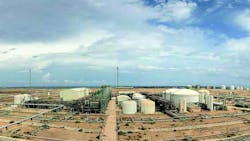
RASCO officially completed restart of the second polyethylene production line in January 2025 following more than 12-years of inactivity (Fig. 2).
Operational overview, increased output
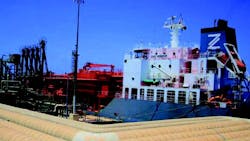
In addition to its co-located refinery, RASCO’s existing integrated complex houses the main ethylene plant, a two-line polyethylene plant, and power and steam generation, all of which connect to a dedicated port for loading petroleum and petrochemical products (Fig. 3).
Rated at an overall production capacity of nearly 1.2 million tpy, the 330,000-tpy ethylene plant also is equipped to produce:
- 171,770 tpy of propylene.
- 130,500 tpy of mixed C4s.
- 323,000 tpy of pyrolysis gasoline.43,500 tpy of fuel oil.
- 172,260 tpy of fuel gas.
The complex’s 160,000-tpy polyethylene plant consists of a linear low-density polyethylene line and a high-density polyethylene line, each of which are configured to produce 80,000 tpy of product.
RASCO’s full ethylene output will ensure secure feedstock for production of polyethylene and other derivatives. The polyethylene lines support local plastics industry and open up the potential for regional exports.
NOC anticipates RASCO’s petrochemical production will supply local manufacturers and reduce dependence on imported polymers, which have accounted for a major share of Libya’s non-fuel import bill in recent years. According to NOC data, Libya imports 60-70% of its domestic plastic and packaging material requirements.
By helping replace imports with domestically produced chemical feedstock and providing less expensive, readily accessible options for small- and medium-scale manufacturing companies, stabilized ethylene and polyethylene output would also contribute to improving Libya’s broader trade balance, according to NOC.
Zawiya refinery upgrade
The recent restart of petrochemical operations at Ras Lanuf coincides with NOC’s parallel plan to modernize ZORC’s 120,000-b/d Zawiya refinery, another of the state-owned company’s key downstream assets, located about 40 km west of Tripoli (Fig. 4).
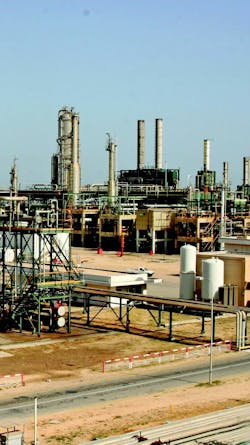
In August 2025, NOC and ZORC reviewed findings from a feasibility study conducted by Honeywell UOP LLC which assessed technical and economic pathways to upgrade the refinery’s process units. NOC described results of the study as “very encouraging,” pointing to the potential for the refinery to meet a major portion of Libya’s gasoline demand and potentially helping to further reduce the country’s annual import expenditures and subsidy burden.
The upgrade would specifically involve expanding overall processing capacity by 24-25%, doubling gasoline supplies to the domestic market. In addition to installing new units that could include a continuous catalytic reformer and hydrotreaters for naphtha and gas oil, the two-phased project would also entail work to improve efficiency of the refinery’s existing processing and production units, according to ZORC.
A timeline for the proposed refinery project has yet to be revealed.
Downstream regeneration
Together, the Ras Lanuf’s petrochemical restart and Zawiya refinery’s planned upgrade reflect NOC’s coordinated approach to reviving Libya’s downstream refining and chemical capabilities, a strategy extending beyond domestic supply objectives.
The reactivation of RASCO’s steam cracker in particular signals a broader return of Libyan refining and petrochemical output to regional markets, with increased ethylene and polyethylene production capacity at the site—once fully restored—positioning Libya to re-enter a North African polymer export market historically dominated by Egypt and Algeria. The complex’s proximity to the Mediterranean Sea also offers potential export channels to southern Europe.
The RASCO and ZORC projects offer opportunities for Libya to reestablish reliability in its energy infrastructure, a prerequisite to competing with Egypt for future global investments in refining, petrochemicals, and related logistics.
Bringing Ras Lanuf back to full design capacity would support Libya’s broader objective of transforming from a crude exporter into a diversified energy and petrochemical producer.
About the Author
 Robert Brelsford
Robert Brelsford
Downstream Editor
Robert Brelsford joined Oil & Gas Journal in October 2013 as downstream technology editor after 8 years as a crude oil price and news reporter on spot crude transactions at the US Gulf Coast, West Coast, Canadian, and Latin American markets. He holds a BA (2000) in English from Rice University and an MS (2003) in education and social policy from Northwestern University.