BPCL’s petrochemical plans complement India’s downstream growth

In late-October 2025, state-owned major Bharat Petroleum Corp. Ltd. (BPCL) entered three strategic memoranda of understanding (MOU) with partners Oil India Ltd. (OIL), Numaligarh Refinery Ltd. (NRL), and Fertilisers & Chemicals Travancore Ltd. (FACT) to develop greenfield projects across India’s petrochemicals, refining, logistics, and green energy sectors.
Aimed at expanding and optimizing the country’s downstream ecosystem, the projects also align with India’s national goals for energy self-reliance and increased downstream integration.
This article provides an overview of these latest project agreements within the context of India’s evolving imperatives in relation to preparing for a reduced-carbon future while continuing to meet in-country demand for energy.
Ramayapatnam integrated complex
Under the first of the recent MOUs, BPCL and OIL agreed to jointly collaborate on development of a greenfield refining and petrochemical complex that, if approved, would be built at Ramayapatnam port in the Nellore district of Andhra Pradesh, along India’s southeastern coast.
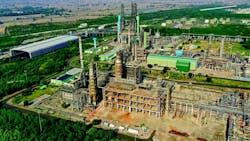
The Ramayapatnam complex at Andhra Pradesh is part of BPCL’s plan to expand its existing nameplate refining capacity to a potential 45 million tpy.
To be configured with a crude oil refining capacity of 9-12 million tonnes/year (tpy), the integrated complex would also house petrochemical production units, including a 1.5-million tpy ethylene cracker that, if completed, would become the first of its kind in southern India, with a competitive complex-wide petrochemical intensity of 35%.
Estimated to require an overall investment of about 1 trillion rupees ($11.4 billion), BPCL said the proposed complex forms a strategic anchor for its downstream growth program in southern India to accelerate petrochemical feedstock integration while leveraging port-based logistics.
OIL’s participation in the project would combine the companies’ complementary strengths to further reinforce India’s fuel and petrochemicals self-sufficiency, according to Sanjay Khanna, who serves as BPCL’s director of refineries as well as its acting chairman and managing director.
The partners confirmed that with Andhra Pradesh government’s approval already secured for 6,000 acres of land across five parcels—including 3,352 acres for core operations and the remaining acreage to be dedicated to green space—preliminary project development activities are already under way.
Announcement of the partnership follows BPCL’s initial unveiling of a plan in December 2024 to develop a new integrated refining and petrochemical complex in Andhra Pradesh, for which—at the time—the operator was initiating its detailed feasibility report, environment impact assessment, basic design engineering package, and front-end engineering and design (FEED) study.
Planned for startup by yearend 2030, the proposed Ramayapatnam complex comes as part of BPCL’s broader plan to expand its existing nameplate refining capacity of 35.3 million tpy to a potential 45 million tpy as part of its strategic framework for FY 2024-29.
The operator also is executing a 3.2-million tpy expansion of its 7.8-million tpy refinery in Bina, Madya Pradesh, as part of its Bina petrochemicals and refinery expansion plan (BPREP) project (see photo). Approved in 2023 at an investment of 490 billion rupees (nearly $6 billion), the project will expand processing capacity of the refinery to 11 million tpy to primarily cater to feed requirements for the new petrochemical units’ production of polymer-grade ethylene and propylene to supply downstream polymer production units.
In addition to boosting crude capacity, BPREP involves installation of a dual-feed cracker that—scheduled for completion in 2028—will produce 1.2 million tpy of ethylene for new downstream units equipped to produce 1.15 million tpy combined of linear low-density polyethylene (LLDPE) and high-density polyethylene (HDPE), 550,000 tpy of polypropylene, and aromatics such as benzene, toluene, and mixed xylenes.
BPCL also has said potential exists for expanding crude capacity at its 12-million tpy refinery in Mumbai, Maharastra, by 4 million tpy to 16 million tpy, as well as for a 2.5-million tpy expansion of its 15.5-million tpy Kochi refinery at Ambalamugal, Ernakulam, Kerala, to 18 million tpy.
Logistics integration
Complementing its refining growth, BPCL’s recent agreements included a tripartite MOU with OIL and NRL to construct a 700-km, cross-country pipeline that would run from Siliguri to Mughalsarai via Muzaffarpur.
Designed to transport motor spirit (MS, or gasoline), high-speed diesel (HSD), and aviation turbine fuel (ATF), the proposed pipeline is budgeted at 35 billion rupees ($396.8 million), with BPCL to hold 50% ownership alongside OIL (25%) and NRL (25%).
The planned products pipeline will primarily accommodate NRL’s ongoing 3-million tpy expansion of its 6-million tpy Numaligarh refinery in the Brahmaputra valley of Assam’s Golaghat district, in far-northeastern India, which—in addition to lifting overall crude processing capacity to 9 million tpy—involves construction of a crude-import terminal at Paradip and a 1,640-km import pipeline to Numaligarh.
BPCL said the pipeline project—including development of new but yet-to-be-identified installations at Singrauli (Madhya Pradesh), Korba (Chhattisgarh), Khagaria (Bihar), and Tatanagar (Jharkhand)—would also augment transport of finished products from other regional upstream and refining hubs, enhancing supply chain resilience in India’s eastern corridor while strengthening its own distribution footprint into Bihar, Jharkhand, Chhattisgarh and Madhya Pradesh.
Green energy plans at Kerala
Under the third of its late-October MOUs, BPCL formed an agreement with FACT to address green-energy and circular-economy goals via a planned municipal solid waste (MSW)-based compressed biogas (CBG) plant to be built at Brahmapuram, near BPCL’s Kochi refinery.
The plant will process 150 tonnes/day of biodegradable waste to produce about 5.6 tonnes/day of CBG, 28 tonnes/day of fermented organic manure, and 100,000 l./day of liquid fermented organic manure, with FACT committed to handling trading of the organic fertilizer products.
Reporting from Indian local media indicated the plant is to be built on about 10 acres obtained from Kochi Municipal Corp., with BPCL’s cost for the project estimated at about 900 million rupees ($10.2 million).
Intended to help meet a growing need for sustainable fertilizer supply and aimed at supporting Indian sustainable agriculture while contributing to the national waste-to-energy and green fuel vision, the partners said the MSW-CBG plant collaboration also underscores a shared commitment by India’s leading public-sector units to strengthen energy infrastructure, streamline logistics, and ensure reliable fuel and petrochemical supplies across the eastern and northern regions.
For BPCL, the project specifically supports its ambition to reach net-zero Scope 1 and 2 emissions by 2040 at its downstream operations via integration of green feedstocks that could be supplied by the MSW-CBG plant.
Strategic implications, risks
Together, the trio of MOUs demonstrates BPCL’s integrated growth strategy across petrochemical, refining, logistics, renewable fuel and fertilizer portfolios, all of which align with the government of India’s Atmanirbhar Bharat agenda that emphasizes domestic capacity expansion, feedstock integration, and reduced import dependence.
The operator’s proposed downstream investment for the grassroots integrated complex in southern India positions BPCL at the forefront of India’s east coast refining surge, where capacity historically has lagged additions along the country’s west coast, with the associated logistics tie-up via the planned Siliguri-Mughalsarai pipeline potentially further strengthening regional supply-chain coherence. Though modest in scale compared with the operator’s core refining and petrochemical assets, the proposed MSW-CBG plant also could help bolster the company’s intent to further diversify its business by reducing municipal waste and monetizing by-product fertilizer.
With the agreements still in their preliminary stages, however, deliverables to be monitored include:
- Finalization of the BPCL-OIL joint-venture structure for the Ramayapatnam complex, as well as tendering and major contract awards for engineering, procurement, and construction on the ethylene cracker and downstream petrochemical units.
- Progress on the Siliguri–Mughalsarai pipeline, including determination of its final route, environmental impact clearances, and status of land acquisition required for the project.
- Commissioning status of the Brahmapuram MSW-CBG plant, as well as waste feed tie-up agreements and offtake contracts for fertilizer products.
- Mid- to long-term refining margin and petrochemical feedstock pricing trends that will inevitably bear on project economics.
About the Author
 Robert Brelsford
Robert Brelsford
Downstream Editor
Robert Brelsford joined Oil & Gas Journal in October 2013 as downstream technology editor after 8 years as a crude oil price and news reporter on spot crude transactions at the US Gulf Coast, West Coast, Canadian, and Latin American markets. He holds a BA (2000) in English from Rice University and an MS (2003) in education and social policy from Northwestern University.