Opportunity in aging assets
MAXIMIZING OPERATIONAL PERFORMANCE TO WITHSTAND TURBULENT TIMES
ANDREEA ENE, EY, STAVANGER, NORWAY
DISTRESS IS TAKING ITS TOLL on the global oil and gas sector. The wait-and-see approach adopted by companies over the last year is coming to an end - and not by choice. The lower-for-longer price outlook is set to force the hand of many companies as margins succumb to enormous pressure. Many distress situations kept out of the public eye won't stay hidden much longer.
Enter operational performance.
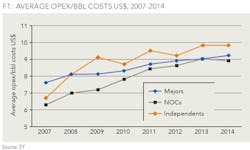
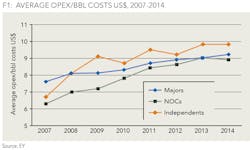
Excellence in operational performance is not a new concept - or an unfamiliar one. Operating costs have been on the rise over the past 10 years and are expected to keep growing, regardless of oil price fluctuations. Price volatility is adding more urgency to the need for operational excellence programs across the sector and recent dips below $30 per barrel are not helping the situation.
Operational excellence programs were first introduced by companies to improve health, safety and environmental (HSE) performance or respond to an HSE incident. Since then, they have become much more focused on improving financial and operating performance in an effort to close the performance gap among peers. The prize of operational excellence programs is simple: cost savings.
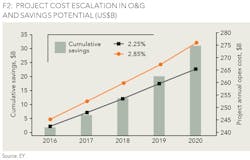
Running a model using majors that assumes 93.5 million barrels per day, a starting cost basis of US$6.80 per bbl and cost escalation at 2.85% and 2.25% identifies US$30 billion in available savings over the next five years between best-in-class and average performance. And that is just a conservative estimate. In these turbulent times, critical examination of operational performance can help with the cost cutting measures that are desperately needed in making every dollar count.
The opportunity in aging assets
Realizing the full potential of cost savings requires companies to address aging assets. Over 50% of global oil and gas production comes from assets beyond the mid-point in their life cycle. That means over half of the assets are not performing at optimum efficiency. Aging equipment rarely functions at peak levels and, as a result, complicates the decline curve and efficiency initiatives. Assets that do fail outright, of course, result in severe financial implications.
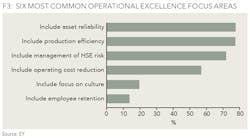
Mitigating the effects of aging assets requires companies to build a comprehensive asset reliability and integrity management plan into their overall operational excellence program. EY looked closely at sample 30 oil and gas companies - including majors, NOCs and independents - and found that 77% currently have an operational excellence program in place or have previously run one. Of those companies, 29% reported improved asset uptime and availability. Why aren't more companies in the sample experiencing improved asset reliability? Here are five common mistakes and simple approaches to turn programs around:
1. Discounting predictive maintenance for scheduled maintenance
Scheduled asset maintenance does not always protect against potential failures. Consider cyber security. It is not enough to respond to attacks - companies must use predictive maintenance to anticipate and prevent potential failures.
2. Poor shutdown and turnaround management
Planned outages are critical to long-term asset performance, but their infrequent nature and large scopes of work present a daunting task. Too often, organizations fail to effectively plan, schedule and execute these major facility inspections and repairs in a way that ensures on-time completion, cost control and safe completion of activities.
3. Ineffective operational readiness planning
Upstream operators are routinely bringing new assets online to increase production capacity though development of operating plans and capability with the early integration of operations into the project planning cycle does not always occur. When integration and planning are inadequate, operators incur increased difficulty bringing the new asset to anticipated production numbers on time, on budget and without experiencing recurrent production upsets.
4. Over-abundant maintenance activities
Effective oversight of asset performance does not mean more maintenance and more spend. It is about the right kind maintenance. That is where big data and analytics come into play.
5. Insufficient data analytics
Leveraging the data currently captured and effectively applying the correct analytics can keep maintenance activities at a minimum without sacrificing oversight.
The pinnacle of great operators is the ability to reliably meet production targets within budgetary expectations. This requires the ability to transition capital projects into producing assets, improve day-to-day asset uptime and minimize planned outage impact. In a sector where production volume and new asset growth is a leading business driver, it is easy to overlook legacy assets and fail to maintain the facilities and infrastructures that already exist - despite the immense opportunity.
Consider this example: an upstream company with a headcount of 10k and output of approximately six million tons of oil and two billion m3 of gas annually is experiencing a decline in operating efficiency. What are the problems? Growth in product cost, excess staff, low meantime between failures, low inventory turnover and ineffective utilization of transport. A comprehensive cost-cutting program can address these issues and deliver substantial value. In fact, a real-life program with similar characteristics helped a company achieve a 27% reduction in optimized costs, 20% headcount optimization and 2% revenue growth as a result of increased oil production.
An organization that has total reliability is able to identify potential failures for elimination, track and investigate failures for improvement, and plan for the complete life cycle of the asset - from design to decommissioning. With optimism of oil price recovery waning, that kind of oversight is crucial.
Executing operational excellence programs
Operational excellence programs are part of a wider corporate transformation and their success depends on strong leadership, engaged personnel, a clear focus and leveraged technology --cultural being important. As more companies feel the strain of oil price volatility, communicating and engaging staff with an organization's operational excellence program is not a critical focus among layoff and other cost-cutting measures. In reality, these programs aim to shift companies in the right direction for the future and are crucial especially in these times. When we look back at previous boom and bust cycles, there is a clear expand-and-contract routine in place. Companies need to break free of this pattern and put the plans in place to withstand market volatility without the knee-jerk reactions.
The sector is undergoing a structural shift and gone may be the days of high highs and low lows. Avoiding Chapter 11 depends on embracing operational excellence at every level of the organization - especially when it comes to existing infrastructure and aging assets. Every dollar counts in a low oil price world. Current market conditions are creating a unique opportunity for the sector to realize its full potential. It is time to seize it.
ABOUT THE AUTHOR

Andreea Ene is EY's EMEIA Oil & Gas Advisory Leader. She is based in Stavanger, Norway. For more information and to access EY's Driving operational performance in oil and gas report, visit ey.com/oilandgas/opex.
The views reflected in this article are the views of the authors and do not necessarily reflect the views of the global EY organization or its member firms.