Early 2016 oil rout has industry players' war rooms humming 24/7
DAVID MICHAEL COHEN, PLS INC., HOUSTON
THE FIRST TWO WEEKS of 2016 saw the bottom drop out of the oil markets as both WTI and Brent plunged below $30/bbl for the first time in about 12 years. Not only are oil prices now below breakeven costs for many capital projects and resource plays, but they are also getting dangerously close to operating costs and in some cases (such as oil sands) already below them. This market low comes as industry executives are finalizing their annual reports and facing difficult 2016 budget decisions.
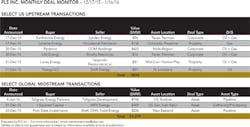
The pressure to sell is mounting, as indicated by PLS Inc. research that shows the upstream M&A markets are continuing to pick up momentum, building on the gains seen in 4Q15. Recent weeks have brought successful acquisitions by a number of buyers that had struck out in 2015. Most notably, Suncor won approval from Canadian Oil Sands' board and major investor Seymour Schulich on Jan. 18 (too late to make it into our deal table) for a revised stock-and-debt takeover deal valued at $4.5 billion (C$6.6 billion) after raising its offer from 0.25 to 0.28 Suncor shares per COS share. An earlier bid was opposed by the COS board in October and rejected by shareholders Jan 11.
In the US, the Permian still reigns over the deal markets with core acreage commanding substantial value even as oil prices explore a twenty-dollar handle. Most recently, Concho Resources announced a series of deals on Jan. 18 to consolidate and high-grade its interests in the southern Delaware Basin, buying bolt-on assets in the North Harpoon prospect area for more than $19,000/acre and selling acreage it considered non-core in Loving County, Texas, for more than $14,000/acre, according to PLS Inc.'s proprietary valuation metrics.
Part of the reason Permian valuations remain so high is that it is one of the few plays where top drillers are still able to tap equity markets to reload for 2016. The proof is leading Spraberry/Wolfcamp producer Pioneer Natural Resources, which on Jan. 5 priced a 12 million-share offering at $117/share or ~$1.4 billion. The capital raise was upsized by 16% from the 10.5 million shares originally announced earlier the same day. Fellow Permian players Parsley Energy and Diamondback Energy also raised fresh equity.
Some companies are selling assets elsewhere to fund their core Permian drilling programs. Among these is Occidental Petroleum, which sold its Bakken operations to Lime Rock for ~$600 million in October and then sold the majority of its Piceance Basin assets to Laramie Energy II in December for $157.5 million.
Also contributing to deal flow, albeit at much lower valuations, are 42 industry bankruptcies announced in 2015, including some of the longest-running independent enterprises in the oil patch. This trend gives opportunistic, well-funded companies an opportunity to acquire solid assets at bottom dollar.
In the most recent and high-profile example, Quicksilver Resources announced Jan. 23 that its US asset base sold in a bankruptcy auction to Natural Gas Partners-backed BlueStone Natural Resources II for $245 million or ~$1,850 per Mcfe/d, including a 113,200-net-acre position concentrated in the Barnett shale. Quicksilver valued those assets at $1.2 billion last March when it went into bankruptcy after a failed company-wide marketing effort. Founded by the Darden family as Mercury Exploration in 1963 and taken public under the new name in 1999, Quicksilver was an early Barnett entrant in 2003 and became a significant horizontal player there. It was sent reeling by the 2008 financial crisis but scraped by for years by farming out stakes in its active plays.
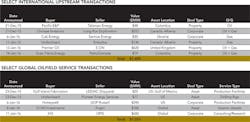
In Canada, the upstream sector saw more corporate turnover than in the US last year, which was not surprising given the more challenging capital environment and tighter operating margins. Capping off the year was the $552 million acquisition of Montney player Long Run Exploration by a group of Chinese investors, reminding the markets that foreign buyers still have plenty of cash to spend on North American assets.
In the current market, depending upon the strength or weakness of the balance sheet, some seller capitulation appears to be underway, giving buyers plenty of opportunity. Also, bankruptcies will increase in the coming months, supplying the markets with additional assets, some of very high quality, aside from those already in Chapter 11 like Samson Resources, Magnum Hunter Resources, and Sabine Oil & Gas. Time will tell, but buyers may not see a better opportunity than the present to strengthen core positions and enter new plays.