
REPOSITIONING THE PORTFOLIO REQUIRED CULTURAL CHANGES WITHIN THE COMPANY AND BUY-IN BY EMPLOYEES
EDITOR'S NOTE: OGFJ recently visited with Rick Muncrief, president and CEO of WPX Energy, in his offices in Tulsa, Okla. to learn how he was able to reposition the E&P company to survive the worst industry downturn since at least the 1980s and surpass many of its peers. During the past two years, Muncrief has sold non-core assets, acquired new assets, and built WPX into one of the Top 20 US producers (see Nov. 2016 OGFJ) in terms of total assets and market capitalization.
OIL & GAS FINANCIAL JOURNAL: Rick, it's been more than two years since you were named president and CEO of WPX Energy, and a lot has happened during that time. WTI prices were about $107 a barrel when you started in 2014. They collapsed to as low as $26, and now oil prices are back up to near $50/bbl. Through it all, you had to remain focused on your objectives. Tell our readers how you did it and what the early days were like when you were repositioning WPX's portfolio and changing the company's culture.
RICK MUNCRIEF: Well, it started even before I got here when I was considering whether to take over this role or not. It was evident that WPX produced a lot of products, but the company didn't make a lot of money. Company margins on a per-unit basis were bottom quartile. So I felt we had some real opportunities to change that.

Fundamentally, the most important thing was to transition the portfolio away from natural gas to crude oil. We needed more of a balanced mix, and at the time we were just 10% oil. So we really needed to change that. Another thing I noticed, once I got here, was that some of the assets were really burdened by some long-term legacy contracts. We also had some assets in South America and in some very, very marginal areas. So I felt we could do some things that would change our assets and our product mix for the better. We wanted to simplify the story and go from seven or eight large assets to three. So we finalized our strategy in the fall of 2014, just before the commodity price dropped dramatically.
OGFJ: How did WPX get into this predicament?
MUNCRIEF: Well, the first thing is that there wasn't a strategy, and that's always a problem. If you don't know exactly where you're headed, all roads will get you there. So we worked very closely with the board to set a strategy to create a balanced portfolio with a preference for crude oil.
OGFJ: In the first quarter of 2015, WPX was still mainly a natural gas company with 70% of its assets weighted toward gas. A year later in 1Q16, 62% of your assets were oil. How did you accomplish this in such a short time?
MUNCRIEF: The strategy that we laid out in the fall of 2014 told us which assets we needed to remove from our portfolio, and we went to work on that immediately. We started having some early successes when crude oil prices dropped in late 2014 and early 2015, so that showed we had an opportunity to buy assets, but we didn't know how long that window would be open. We didn't have a crisis mentality. We were methodical because we were very well hedged, which certainly helped as we went into the downturn.

Photo by Evan Taylor Photography
We knew we needed to build inventory when the opportunity presented itself. We started to look at the existing basins we were in – the Bakken and the San Juan – but there were very limited opportunities for the kind of assets we wanted. We also looked at places like the Powder River Basin and the DJ Basin and the Eagle Ford, and you always know that you want to be in the core. In most cases, the core was pretty well taken. The Permian, on the other hand, was at a point in its development cycle that presented some opportunities. However, the Midland Basin looked like it was fairly locked up and also pricey. But the Delaware Basin was very intriguing to us. We decided this was definitely a basin we wanted to be in. We looked at the geology and decided where we would really prefer to be. That's what led us to the central part of the basin.
OGFJ: Tell us about the RKI acquisition.
MUNCRIEF: We closed the purchase of privately held RKI Exploration & Production in August 2015. In doing so, WPX gained a substantial presence in the core of the Permian's Delaware Basin that included about 22,000 boe/d of existing production – more than half of which was oil; approximately 92,000 net acres – about 98% of which is held by production; more than 5,500 gross risked drilling locations across stacked pay intervals; and more than 375 miles of scalable gas gathering and water infrastructure.
This was a defining moment for our company. The Permian is characterized by numerous stacked pay reservoirs, has an extensive production history, long-lived reserves, and high drilling success rates. The 92,000 acres represented more than 670,000 prospective net effective acres of stacked pay. The 9,000-foot hydrocarbon-charged stratigraphic column includes the Wolfcamp, Bone Spring, Avalon, and Delaware Sands intervals.

San Juan Basin Photo by Jim Bletcha/Courtesy of WPX
That transaction helped drive our high-margin oil growth, accelerated our portfolio transition to more liquids, and solidified our premier position in the western United States. These areas enjoy significant advantages of established infrastructure, which provides the opportunity for stronger realized commodity prices.
Our leadership team has previous experience in the Permian Basin and a track record of maximizing large-scale oil developments to increase production, reserves, and enterprise value while lowering expenses. Including some bolt-on deals since closing the RKI transaction, WPX now has 102,000 net acres in the basin.
OGFJ: What was your next move?
MUNCRIEF: Once we knocked down the RKI acquisition, we had to delever because crude oil prices took another dip. Then we were on the clock. The first time we did our asset sales, we were on our internal clock and we were proceeding very judiciously. Now we were on the clock to make sure we could reduce debt quickly. And the team did a tremendous job. I think the results speak for themselves.
OGFJ: Transitioning a company-wide portfolio as you did often requires a change of culture within the company. Success requires a buy-in from everyone in the organization. How did you go about generating buy-in, and was there initial resistance in some quarters?
MUNCRIEF: Yes, there was some, but resistance comes in a lot of different ways. We were fortunate to have a lot of really, really dedicated people here who never really had a chance to experience true success. Ever since WPX was spun off from Williams, they had never experienced the success they had hoped for. And, quite honestly, even within Williams they had been challenged. So the desire was there, but what was lacking was the confidence. We did see some resistance from various folks, and a lot of those people aren't here now. Others were coached into being thoughtful and proactive and are on board with our strategy.

OGFJ: Did you bring in new people to the organization?
MUNCRIEF: We brought in some fresh blood here, but it was not much. It was more around technical and operational leadership. We had to get people in the right roles and put more emphasis on operations and technological advancement. That was my background, but I needed some help.
OGFJ: What is your background?
MUNCRIEF: I graduated from Oklahoma State University with a degree in petroleum engineering technology in 1980. I started as a field drilling engineer in the Anadarko Basin. We were drilling deep, high-pressure vertical wells in those days. After a couple of years, our company (El Paso Exploration) was bought out by Burlington Resources. I was transferred from Amarillo, Texas, to Billings, Montana, in 1984. We operated all over the US, but the highlight of the Billings years was when the team we were on drilled the first horizontal Bakken well in 1987. I believe that was the second true horizontal well in the US. Burlington Resources and its predecessor companies were known for their technical abilities, especially in horizontal drilling and coal-bed methane production. Many of those plays in North Dakota and eastern Montana were developed by Burlington and by Continental Resources. We closed our Billings office and I moved to Denver for five years. I did a lot of A&D work and business development. After that, I ran production operations in Farmington, New Mexico, in the San Juan Basin. We had drilling, completions, production, plants, and pipelines – a little of everything there. In 2005, we were bought out by ConocoPhillips, and I stayed with them for two years. Then I left and moved back to my home state of Oklahoma. Ultimately, I got a call from Harold Hamm with Continental Resources and joined them in 2009. I spent five really wonderful years with them. They had a great team and those were huge growth years for Continental. When I got the call about assuming this job, I liked the challenge of doing a turnaround – a true transformation at WPX, so I accepted the job. We've changed everything except our name, but our new identity couldn't be more clear. It's been very challenging, but very rewarding, too.
OGFJ: Before the transition, where were your assets?
MUNCRIEF: They were all over. We had them in the Piceance, the Bakken, the San Juan, the Marcellus, and we had coal-bed methane in the Power River Basin. We also had assets in South America. We had operated and non-operated assets, and we also had some firm transportation obligations, some of which were out of the money. So we had to clean all this up in order to move forward. Our team has done a phenomenal job, and there is nothing like success to overcome resistance. So fast-forward to today. We have a top-notch team that is competent; we're humble, too because it's a humbling world and a humbling business. We know where we're headed – we have a strategy. The RKI acquisition allowed us to adjust our multi-basin strategy into a new three-basin strategy. We basically traded the Piceance Basin for the Permian, and that's a nice trade.
OGFJ: Can you elaborate a little about what drew you to the Permian Basin? What did you see that made the RKI acquisition such a game-changer for WPX?
MUNCRIEF: There were three things. Number one was the resource. The amount of resources in the Permian is just incredible. Number two was the business climate. Texas and New Mexico, where the RKI assets were, both have a favorable business climate for companies. The third thing was the infrastructure. There was already a good start with existing infrastructure because the Permian has been producing for about 100 years. I spent a large part of my childhood and early years in that part of the country. I recall riding up and down lease roads with my dad, and here we are 50 years later driving on these same roads. When I look at the depth of the inventory there and the technology we're deploying, I can see my grandkids 50 years from now engaged in the same business. A couple of generations from now, there will still be a lot of work to do in that basin.
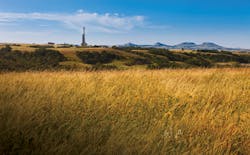
Williston Basin Photo by Jim Bletcha/Courtesy of WPX
OGFJ: Doesn't WPX have some gas assets in the Permian as well?
MUNCRIEF: Yes, we have some associated gas produced there. There is a strong market for it just across the border in Mexico. Our exports to Mexico continue to grow. We also have strong markets for natural gas in Arizona, Nevada, and California – all over the Southwest. When the LNG market fully develops, we have great access to the Gulf Coast. Global demand for oil products and natural gas will continue to expand with emerging markets in India and China because those folks want what we have. We need to get American crude oil and natural gas to those growing markets, so it was very important for us to lift the ban on crude oil exports.
OGFJ: As we discussed, earlier this year WPX exited the Piceance, previously a prized natural gas asset. Do you think you received a fair price for the asset during the downturn, and was it a difficult divestiture for the company?
MUNCRIEF: It was a challenging divestiture because we needed to move quickly on it. Natural gas prices softened up somewhat during that process. But our team did an extraordinary job and worked tirelessly in getting that deal across the line. There was a lot of competition, and we got a very solid price for the assets. I think most analysts will tell you the same thing. I think the company that bought it will find that the assets will work out fine for them. They seem very pleased with the deal as well. The Piceance is a very nice basin and we had a lot of inventory there, but for us the Permian was a good trade. To answer your question, we were very pleased with the price we received, what it did to our balance sheet, and what it did for our focus. It also allowed us to do a lot of other things related to our cost structure.


Clay Gaspar, Chief Operating Officer, WPXKevin Vann, Chief Financial Officer, WPXPhotos by Jim Bletcha/Courtesy of WPX
OGFJ: In October 2014, WPX rolled out its five-year strategy to increase oil volumes five-fold, which would have been a target of about 81,000 bbl/d by 2020. Later, however, you mentioned a goal of 100,000 bbl/d, which exceeds the previous target. Why did you increase the goal?
MUNCRIEF: When we added the Permian assets, that was a fundamental shift in our portfolio that allowed us to restate our production goals. While the 100,000-bbl figure is a milestone, it is not the principal thing that is driving us. That will be the outcome of some really nice assets we have now in the Permian, the Bakken, and the San Juan. Deploying our capital and our cash from this production will drive great returns for our stakeholders. That production growth will also allow us to further delever and get our balance sheet even stronger over time, which is really exciting.
OGFJ: Are you assuming we'll be living in a $50/bbl world?
MUNCRIEF: Yes. We laid all this out on our recent earnings call. If something changes, we'll simply do what's necessary and stay true to our disciplined approach. Our goals are aggressive, but we'll temper that with being prudent and flexible. The new strategy will have us at 60% crude oil. Add NGLs on top of that, and we're going to be 80% liquids. Over time, probably two to four years, the NGL markets will start coming back, and that will put us in a good spot.
OGFJ: How should we look at the WPX portfolio as we prepare to enter a new year? How will you allocate capital across the portfolio?
MUNCRIEF: At least half of our capital will go to the Permian Basin. The other two basins will get the remainder. We'll have a couple of rigs working in the Bakken, and then one out in San Juan. So it will be about 50% to the Permian, 30% to the Bakken, and 20% to the San Juan. We'll see growth in all three basins. We still have some dry gas in our portfolio, but we'll focus on oil.
OGFJ: In your view, how is WPX perceived by analysts? And what, if anything, do you think investors might be missing when it comes to the WPX story?
MUNCRIEF: I think we're perceived in pretty favorable terms. We have a number of "buy" ratings and "market outperform" ratings from analysts. You always have a few detractors, but overall we've been well received and the equity has performed very well this year. Our bonds have strengthened dramatically. In some cases, we may be a "wait and see," but we understand that. It's a show-me world, and we're ready to do just that. I would urge investors to think about how we can grow this company over the next five years. They should look at what this team has accomplished over the past two and a half years in a really tough market and also look at the quality of our assets and where they are located. This will really have a favorable impact on our balance sheet. We have the potential to really set ourselves apart from our peer group. It's hard not to get excited about our story. I certainly am.
OGFJ: If something were to happen and oil prices drop again as they did in late 2014, is WPX built to withstand this kind of blow?
MUNCRIEF: We're not as over-levered, and that certainly makes a big difference. As of a few weeks ago, we're nearly 70% hedged at $51 for 2017. And we're about 25% hedged at $57 in 2018. So I think we've done a pretty good job at protecting the downside and leaving some upside in 2017 and 2018. If crude goes to $60, that will set us up nicely in 2018 and 2019. If we were convinced that crude would trade in the low to mid $40s for an extended period of time, we probably would slow down our growth. But right now, we're ready to deploy our cash on hand and put it to work. We have a stack of very nice development opportunities, but we're prepared to slow down if the market demands it.
OGFJ: Oil is a global commodity, of course, so OPEC decisions have a lot to do with oil prices. North American shale producers seem to be the new swing players. Is this good or bad for the industry?
MUNCRIEF: I think the best thing for the industry would be a stabilized oil price between $50 and $60 for the next 12 months. Let's get some of our service companies and vendors healthier. At $60, that's when you start seeing real growth again. There has not been a lot of capital going into international projects lately. The number of rigs operating outside North America is way down. Eventually, that will have an impact. That's why it was so important for the crude oil export ban to be lifted. One day we will have a call on US shale, and we need to be prepared.
OGFJ: If that happens, how quickly can US suppliers ramp up production for export?
MUNCRIEF: That will be determined by the commodity price. It depends on what that profile looks like. Some basins, like the Permian, will be able to ramp up production more quickly than others.
OGFJ: Did we lose a lot of people during this downturn that will be hard to replace? Would that hinder a fast ramp-up scenario?
MUNCRIEF: Unfortunately, yes. Coming into the recent downturn, a lot of E&P companies were running leaner than they had been, say in the mid-1980s, or a couple of times in the '90s. It's not a question of inventory. With resource plays, you know you have inventory. It's just a matter of how quickly you can recover it, and you need people in order to do that. That's on the producer side. On the service company side, it's been very tough. So we've been focused on retaining a healthy relationship with them. They have helped us achieve incredible efficiencies in recent years. We now know exactly which bits work the best, which downhole motors work the best, and which stimulation techniques work the best. And that's a great thing for investors. I consider myself an investor, and I've gone out and bought a lot of our stock in the open market. I really believe in this team and what we're doing.
OGFJ: Is there anything you'd like to add that we haven't covered here today?
MUNCRIEF: Just that our overall game plan is solid. We have a session with our board every year in which we just talk about our strategy. We've done that for two years now. We like to get perspective from the investment community, so both years we've brought in an existing shareholder to talk to our board about why they own WPX. We also have brought in targeted shareholders – someone who has not yet pushed the "buy" button. I want our board to hear why they haven't bought in and to see if there are some common denominators that will help improve our strategy going forward. We have a very strong board, and this has been very well received by board members and from the investment community as well.
OGFJ: Thanks very much for your time today, Rick.