Total sees evolution in energy mix
COMPANY FOCUSES ON SAFETY, GAS, RENEWABLES, VALUE, AND AFRICA
BY ENERGYBOARDROOM - EXCLUSIVE TO OGFJ
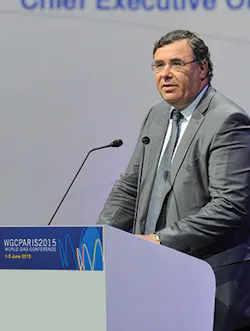
EDITOR'S NOTE: EnergyBoardRoom recently interviewed Patrick Pouyanné, the CEO of Paris-based Total, one of the world's largest energy companies. He joined Total SA in 1997 and assumed his current position as CEO on Oct. 22, 2014. From 1989 to 1997, he held several positions in the French Industry Ministry, then in the cabinet of the Prime Minister of France, and also in ministerial cabinets. In this exclusive interview, Pouyanné talks about Total and the energy future.
OIL & GAS FINANCIAL JOURNAL: You often recall four words as central to the execution of Total's mid-term strategy: Safety, Delivery, Costs, and Cash Flow. While Total has already announced severe cost reduction programs, the two that seem most difficult today are safety and cash flow, due to political unrests and low hydrocarbons prices. Out of those two, which is the one that worries you most?
PATRICK POUYANNÉ: Safety will systematically constitute a permanent key concern for Total, while our balance sheet is resilient enough to overcome challenges associated to cash flow.
We operate in countries like Yemen where security threats have arisen. Under no circumstances can a company like Total jeopardize its employees' safety. This is unacceptable to us. So, in Yemen, as rebellious forces approached the Yemen LNG facilities, we have not only cautiously evacuated our expatriates but also all our local staff after having a safe and orderly shutdown of our operations. Recently, we have also faced security threats in Kurdistan and in Libya, where we also chose to remove our staff.
We are aware that nowadays, safety may put the future of a company at stake as we have observed after the tragic Deepwater Horizon accident in the Gulf of Mexico five years ago. We are hence committed to ensure the highest safety levels for our operations. In our industry, we manipulate sophisticated technologies and are wary of the implications major accidents may have for the company's future development.
With regards to cost cutting, while this might seem obvious today, it was not the case a few years back for the industry. Actually things had escalated to the point that many in the industry had forgotten that when working with commodities, it is essential to carefully manage your expenses and your cash break-even. In that sense this "crisis" might be beneficial. However, we are seizing this opportunity to introduce spending cuts where we deem appropriate.
In regards to cash flow, our income is correlated to hydrocarbon prices, and Total is therefore more exposed when the barrel is at $55 than when it is at $120. We have consequently implemented the appropriate measures to respond to current market dynamics. Total has the financial capacity to weather the crisis and will not disengage from any major project.
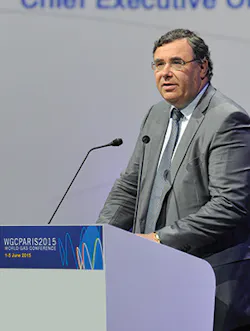
Photo by WGCPARIS2015
OGFJ: This may sound as if Total or other major IOCs are "too big to fail." Is this really the case?
POUYANNÉ: I refute the concept of "too big to fail!" The world of energy is changing very fast. Our size may prevent us from collapsing in the short term, but we must remain extremely cautious and acknowledge what economic signals are expressing. If you look at the 50 largest companies 15 years ago, half of them disappeared. The energy sector itself has undergone unprecedented changes in the last 15 years.
Price fluctuations, the unexpected advent of unconventional energies, and competition between various forms of energy have provoked structural changes. For instance, ultra-deepwater or shale oil and gas have undeniably emerged in response to high hydrocarbon prices.
Energy is the necessary condition of human activity. I believe that the world will still need fossil energy in the future. It is, however, our responsibility to solve the issues that we undeniably contribute to create with regards to carbon emissions.
The most obvious way is to continue developing gas. A gas-powered plant produces half the emissions of a coal-powered plant and significantly less than a plant powered by other fuels as well. As an oil and gas company, we can contribute by developing our LNG activities. The same factors explain why Total has invested in solar energy, with Sunpower.
The energy mix in 2040 will be different from what it is today, and the $3 billion invested in solar energy will definitively grow. We see it as our responsibility to embrace and participate in the evolution of the energy mix and to help define the notion of energy efficiency.
OGFJ: With regards to delivery, which are the main projects that will come onstream in the coming years?
POUYANNÉ: The notion of delivery is extremely important as we find ourselves in a heavy investment phase. From 2012 to 2016, Total's investments will have amounted to an average of $25 billion a year. Prospects for organic growth are thus very promising, which is why I insist on delivery.
Since the beginning of 2015, we have unveiled four new projects, including a gas venture in Russia, the onshore Termokarstovoye field, which will produce around 6.6 million cubic meters of gas and 20,000 barrels of condensate per day, with a combined production capacity of 65,000 barrels of oil equivalent per day.
Every project featured in our investment plan is critical.
The Laggan and Tormore field, located approximately 125 kilometers northwest of the Shetland Islands, are of high importance because Total controls 80% and has invested to further develop their potential. We faced dreadful weather conditions, which have provoked important delays, but those fields represent the future of the UK oil and gas industry.
We have also invested in the Gladstone LNG project in Queensland, Australia, designed to produce liquefied natural gas from coalbed methane. This project strengthens Total's foothold in the Australian market and rounds out our expertise in unconventional gas. We are also a partner in the Ichthys LNG project, as without a doubt, LNG is one of the strategic sectors for Total's future growth.
We are furthermore currently undertaking a series of deep offshore developments in Angola, Congo, and Nigeria, with respectively Kaombo, Moho, and Egina.
Overall, Total thrives in two major vectors for growth. On the one hand, deep offshore projects - in, for example, Africa or Brazil - and on the other hand, gas and LNG projects - in, for example, Australia or Russia with Yamal.
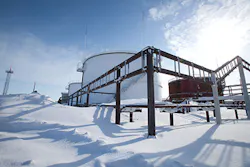
Photo by Pavel Kotlyar
OGFJ: As Safety, Cash Flow, Cost and Delivery are the words of today, what would be the four words of the Total of tomorrow?
POUYANNÉ: My answer is: Safety, Gas, Renewables and shared value.
Safety will always remain our main concern, without a doubt! I include gas because this market, which will represent a quarter of the world's energy mix, is growing faster than oil and still constitutes to this day the cleanest fossil fuel in terms of emissions. The world still hosts populations with limited or no access to energy. As a result, the demand for energy will grow and even if companies like Total invest in renewables, they will never satisfy global needs. At the moment, Total already produces equal amounts of oil and gas in contrast to a 65-35 ratio 10 years ago.
When it comes to renewables, our current investments in solar, amount to $3 billion, but that sum will steadily increase in the coming years. We are committed to remain pioneers in alternative energy in contrast to other IOCs. For many years, IOCs and NOCs adopted a conservative approach on new energies, and I believe it is Total's responsibility to recognize the challenge posed by climate change and provide its own solutions. By the way, we are not contradicting our commitment to produce highly profitable growth as the potential there is huge. Besides solar, we are also carefully examining opportunities in the field of biofuels.

Photo by Elodie Gregoire, Total
And Value, because creating added value to share it with our stakeholders is our ultimate objective, not only our shareholders but also our employees, the countries and communities where we work.
I would also like to add Africa to the list. I believe that the African continent symbolizes Total's future development and progress. Across the Mediterranean, Total excels in both upstream and downstream and I strongly believe that due to our history on the continent we will capitalize on Africa's promising demographics and growth forecasts.
Safety, Gas, Renewables, Value, and Africa are the five words for the future of Total.
OGFJ: Thank you very much for your time.
Total, a leader in solar energy
By becoming the majority shareholder of SunPower, in 2011, the world's second-largest solar company, Total has given new impetus to its development in renewable energies.
This year marks 30 years for SunPower, the Total's solar affiliate. Silicon Valley based -SunPower is a global technology and energy services provider that designs, manufactures, and delivers high-efficiency solar panels and systems for businesses, utilities, and government customers as well as for residential use.
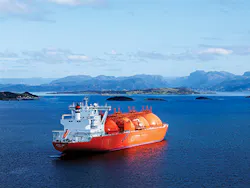
Photo by Tom Haga, Total
SunPower has pioneered many innovative technologies. The company's unique high-efficiency solar panels provide 38% more power over the same area when compared to competing solar technologies. To date, SunPower has successfully deployed over 6 gigawatts of power capacity worldwide. Its growing portfolio includes power plants in the United States, Chile, and South Africa. The world's largest solar power plant is Solar Star in California.
SunPower's 7,000 employees are using their expertise to build a global leader in the solar industry, as solar energy is progressing quickly toward competitiveness with conventional energy sources. Total believes the development of solar energy and the promotion of efficient energy use and conservation are complementary to oil and gas and that sustainable solar energy is needed to help meet the bulk of the world's future energy needs for generations to come.
Total in Africa
For more than 80 years, developing activity in Africa has been a part of Total's culture and strategy. In both upstream and downstream, Total has worked to achieve growth in the African countries where the IOC operates.
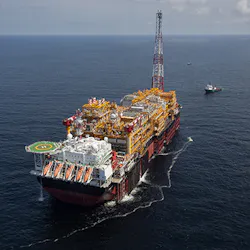
Photo by Thierry Gonzalez, Total
Today, the group is:
- The largest operator in Angola, where its presence dates back to 1953.
- The largest producer in Sub-Saharan Africa. Thanks to its positions in Gabon, Congo, Angola and Nigeria, Total is expected to increase production in Africa by 25% between 2011 and 2017.
- A leader in field marketing and services with a presence in 41 countries, 4,200 service stations under operation, and a market share that has increased from 15% to 18% in the last three years.
Africa accounted for more than 40% of Total's investments in 2014, around a third of its oil and gas production, and close to 30% of its worldwide service station network.
Total is actively pursuing technology-intensive projects, particularly in the deep offshore, notably in the Gulf of Guinea. In 2011, during the Pazflor project in Angola, Total became the first company to successfully implement the subsea separation of gas and liquids.
Total has consistently encouraged the production of local content to contribute to local economic development in Africa. The company trains and hires thousands of African engineers and professionals and has relied on a dynamic acquisition strategy to build lasting partnerships with growing and promising African companies.
Africa enjoys one of the highest growth rates in the world and Total seeks to offer as broad access to energy as possible by involving additional sources of energy and social business models. Awango by Total solar lamps, for example, aims to reach 25 million people by 2020.