Quantifying political risk

NEW PRIX INDEX ANALYZES POLITICAL RISK IN OIL MARKETS
THE PRIX INDEX is a new approach to analyzing political risk in oil markets. The new index number first published at prixindex.net on June 29 indicates that political developments will lead to higher exports from the world's 20 largest exporters during the coming months, putting downward pressure on the oil price.
As Oil & Gas Financial Journal prepares to go to press with the August 2015 issue, the US and other nations are meeting with the government of Iran in an effort to keep Iran from developing and deploying nuclear weapons. One of the final sticking points standing in the way of a historic nuclear deal with Iran is the wording of a United Nations Security Council resolution and the issue of a conventional weapons embargo. Iran has been struggling economically in recent years due to an international embargo on its petroleum exports, which presumably would end if an agreement on nuclear weapons is reached.
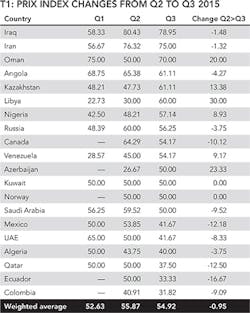
The PRIX country analysts presume that negotiations with Iran will be successful, which would release significant amounts of Iranian crude on world markets. In addition, the PRIX analysts expect Iraqi oil exports to rise in spite of the ongoing unrest in Iraq and Syria. They don't believe the rising tensions between Sunnis and Shias across the Middle East will significantly disrupt exports. Neither do they believe that OPEC will curb oil exports in an attempt to bolster prices.
Political events can have a powerful influence on the price of oil. Historical examples include OPEC's 1973 embargo in reaction to the Yom Kippur War and the 1979 Iranian Revolution. Analysts, traders, and academics have had few tools to handle such political events compared to what is available to them to study the economic aspects of oil price formation.
The PRIX index attempts to fill the gap. The index is similar to a purchasing manager index (PMI). PMIs are based on polls of purchasing managers in companies across a sector or an economy and are used to forecast business cycles and economic trends. The PRIX index is instead based on input from experts on the world's 20 largest oil exporters and forecasts how political developments will affect exports during the coming three months. The index was first published in January 2015 and is updated quarterly.
The PRIX index global value for 3Q15 is 55 (down from 56 in the year's second quarter), which means that the flow of oil to international markets is still expected to rise, though not quite as much in the last quarter. Rising exports will lead to lower oil prices, as long as demand does not fall. (The range of possible index values is 0-100, where 0 represents a maximum reduction in exports, 100 represents a maximum increase in exports, and 50 indicates no change.)
The index is based on input from 261 country analysts. According to their assessments, Iraq, Iran, and Oman are the countries where political developments are expected to be most conducive to rising oil exports. In the cases of Iraq and Iran, the numbers are quite dramatic with export surges anticipated by the PRIX country analysts. In contrast, the situation in Colombia, Ecuador, and Qatar is considered to be most conducive to falling oil exports.
The largest changes from the first to the second quarter of 2015 were in Libya, Oman, and Azerbaijan (which shifted towards expectations of rising oil exports), and Ecuador, Qatar, and Mexico (which shifted towards expectations of falling oil exports).
The index covers the following countries: Algeria, Angola, Azerbaijan, Canada, Colombia, Ecuador, Iran, Iraq, Kazakhstan, Kuwait, Libya, Mexico, Nigeria, Norway, Oman, Qatar, Russia, Saudi Arabia, the United Arab Emirates, and Venezuela. Each of the 261 country analysts is an expert on one of these countries, providing an inside view on political developments. The input is brought together to generate a single global number for the political risk to which international oil prices are exposed. For more information, see http://prixindex.net. The free PRIX index is independent of all governments, institutions, and companies.