Impact of oil prices on investors
Analyzing the sensitivity of investment and production levels at different prices
Per Magnus Nysveen and Leslie Wei, Rystad Energy
In the February issue of OGFJ, we examined the impact of $70/bbl oil prices to the production and investment levels for North American unconventional activity. Since then, the WTI oil price has fluctuated from $60/bbl in December to around $40/bbl in January and back to $50/bbl in February. In the current uncertain environment, price forecasts are hard to estimate, therefore it is important to analyze the sensitivity of investment and production levels at different price levels.
Compared to other sources of investments, shale activity is particularly flexible. At lower prices, operators can focus on core areas and decrease rig counts. BHP Billiton, for example, plans to decrease its 2015 onshore US rig count by 40% and drill mainly in its Eagle Ford acreage. This level of flexibility is not available for other types of projects, especially offshore, where project start-up has a long lead time.
On the macro level, rig activity was at a peak of over 2,000 rigs in October 2014 and has since dropped to ~1,500 as of the last week of January. In addition to decreasing rig counts, operators also have the option to delay completions until prices increase. Antero Resources reported in January that it plans to defer completions during the second and third quarters of 2015. This action reduces the capital spending during times of strained cash flow and allows for quick response in production once prices increase.
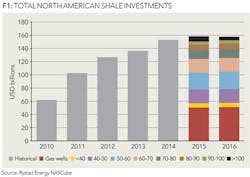
Figure 1 shows the shale investments going forward split by different wellhead break-even categories. The wellhead break-even price is the wellhead oil price used to obtain an NPV of zero. In the previous edition of the article, we assumed an oil price of $70/bbl going forward. This led to a ~15% drop in activity levels year over year from 2014 to 2015. If we assume a lower oil price of ~$50/bbl, the decrease in spending is then ~30%.

While investment levels show very strong reactions to the market, the resulting effect on production is limited.
Figure 2 shows the total production from the four largest shale plays: the Eagle Ford, Bakken, Permian, and Niobrara. The historical values are based on officially reported well data, and the forecasted values are based on assuming a further 20% to 30% rig reduction compared to December 2014.

In 2014, production volumes increased 19% and 16% during the first and second half of the year, respectively. In 2015, it is estimated that the production will continue to increase 9% during the first half of the year and taper off to 3% during the second half of the year.
The robust nature of the production can be attributed to the fact that companies will pull out of their less prospective areas first and maintain or even increase rigs in their most prospective areas. In addition, vertical rigs have experienced the largest decrease in rig counts, with nearly a 50% reduction since October 2014.
Since vertical wells are less productive than horizontal wells, the overall effect of dropping a vertical rig is smaller than dropping a horizontal rig. Lastly, there is also an average four- to six-month delay between drilling and completion. Therefore, wells that were drilled during the second half of 2014 will come online in 2015, and the effect of fewer wells being drilled will be more obvious in 2016.
The profitability of shale activity varies between different areas in a play depending on the combination of geologic factors (depth, thickness, thermal maturity). Hence, the economics of the wells also vary from less than $40/bbl to more than $100/bbl.
With lower oil prices, activity will be concentrated in the best areas, and the rig count in less prospective areas will decrease. Even if rigs decreased an additional 30% compared to December 2014 levels, production will remain steady through the remainder of the year.
About the authors

Per Magnus Nysveen is senior partner and head of analysis for Rystad Energy. He joined the company in 2004. He is responsible for valuation analysis of unconventional activities and is in charge of the North American Shale Analysis. Nysveen has developed comprehensive models for production profile estimations and financial modeling for oil and gas fields. He has 20 years of experience within risk management and financial analysis, primarily from DNV. He holds an MSc degree from the Norwegian University of Science and Technology and an MBA from INSEAD in France.

Leslie Wei is an analyst at Rystad Energy. Her main responsibility is analysis of unconventional activities in North America. She holds an MA in Economics from the UC Santa Barbara and a BA in Economics from the Pennsylvania State University.