The politics of tax reform in the 114th Congress

CONSIDERATIONS FOR THE OIL AND GAS INDUSTRY
JEFF KUMMER, WASHINGTON DC, AND TED MCELROY, HOUSTON, DELOITTE
WHEN VOTERS IN THE 2014 midterm congressional elections opted to consolidate control of the House and Senate with the Republican Party, they arguably gave the GOP a stronger hand in reforming the federal tax code- including provisions affecting the oil and gas industry-in the 114th Congress, which convened at the beginning of this year. But even though tax reform has generated considerable discussion on Capitol Hill in recent months, it has remained an elusive goal.
This article provides a high-level overview of how tax reform could reshape current-law energy tax provisions, some of the substantive and political barriers facing tax reform advocates, and why it would be a mistake to ignore the ongoing debate.

WHAT A REFORMED TAX CODE MIGHT LOOK LIKE
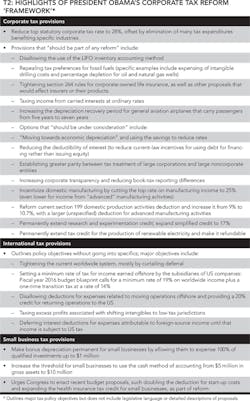
There is not a comprehensive tax reform plan currently moving through either of the two congressional taxwriting committees; but as they contemplate a tax code overhaul, lawmakers could draw from prior proposals such as the tax reform plan released by former House Ways and Means Committee Chairman Dave Camp, R-Mich., in 2013 or the comparatively brief corporate tax reform "framework" that the Obama administration unveiled in 2012. Both of these plans call for a significant rate reduction-a 25% top rate for corporations and individuals in the Camp plan and a 28% corporate rate in the administration's framework-offset by base-broadening proposals that would pare back or eliminate a number of current-law deductions, credits, and incentives. (See Tables 1 and 2 for a general overview.)

Potential impact on energy sector
On energy issues, Camp's draft would move the tax code in the direction of offering less support for alternative energy sources by eliminating the rate inflation adjustments for renewable electricity and refined coal production under the production tax credit (PTC). The draft also proposes terminating any further PTC benefits after 2024. A number of energy tax provisions, including the qualifying advanced nuclear power facility credit and the exception from the passive loss rules from working interests in oil and gas properties, would be repealed. Camp also proposes to repeal a number of temporary energy "extenders" provisions, including, among others, the deduction for energy-efficient commercial buildings and the credits for construction of energy-efficient new homes, energy-efficiency improvements to existing homes, and alternative fuel vehicle refueling property.
The administration's framework proposes to permanently extend the tax credit for the production of renewable electricity and to expand it by making it refundable. However, the framework would repeal tax preferences for fossil fuels-for example, expensing of intangible drilling costs and percentage depletion for oil and natural gas wells. The framework does not mention other similar proposals, such as repealing the section 199 domestic activities manufacturing deduction for oil and gas companies, which have been included in previous White House budget packages.
Lawmakers looking to rework current-law energy tax provisions also might look to the energy tax reform discussion draft released by then-Senate Finance Committee Chairman Max Baucus, D-Mont., in 2013. That draft would repeal or allow to sunset many current-law energy incentives and replace them with two tax credits, one for the production of clean electricity and one for the production of clean fuels. Each credit could be taken either as a production tax credit (claimed each year for the 10 years beginning when the facility is placed in service) or as an investment tax credit (claimed when the facility is placed in service). Baucus claims both credits would be technology neutral and performance based, and the draft proposes that each credit would expire when the cleanliness (measured in terms of carbon emissions) of the respective markets increases significantly. (See Table 3 for a comparison of energy proposals from Camp, Baucus, and the Obama administration.)
OBSTACLES AHEAD
Although one-party control of Congress arguably creates a smoother path for tax reform, lawmakers still face significant obstacles in getting a plan enacted into law.
Still no supermajority in the Senate
Republicans took over the Senate in the 2014 elections, but they only hold 54 of the 100 seats, short of the 60-vote supermajority needed to avert a filibuster and ensure the passage of major legislation in that chamber.
Limited presidential leadership
Although President Obama has expressed support for business tax reform he has not released a detailed, comprehensive proposal of its own, nor has he actively sought to negotiate a plan with congressional Republicans or engage the public on-and build a base of support for-his vision of a reformed tax code.
Difficult policy decisions remain undecided
The plans and discussion drafts that have been put forward in recent years provide useful building blocks for tax reform going forward, but they also reveal the hard choices that come with reforming the code. For example:
- Should tax reform produce more overall revenue for deficit reduction or other spending priorities or should it be revenue neutral?
- Should tax reform be "comprehensive" and encompass corporate entities as well as passthroughs and individuals or should it be limited to "business-only" reform that focuses on corporate rate reduction offset by elimination of key expenditures?
- Should tax reform be used to address income inequality or is the tax code already sufficiently progressive?
- Should the US adopt a territorial system for taxing domestic multinationals (with appropriate base-erosion safeguards) or should it retain the current worldwide system with more stringent rules?
- How might tax reform affect different industry sectors?
- What sort of transition rules would be necessary to prevent tax reform from creating economic shockwaves?
Competing legislative priorities
There are other key tax issues that Congress and the Obama administration must address in the near term, including reauthorization of the Highway Trust Fund and the extension of expired tax provisions, which are under the jurisdiction of the taxwriting committees and thus may consume time that taxwriters otherwise might prefer to devote to tax reform.
- Highway funding - Ironically, one of these competing priorities-highway funding-could provide an opportunity for Congress to pursue one component of tax reform-an overhaul of the international tax rules-in the near term. The latest "patch" for the Highway Trust Fund runs out at the end of October and there is bipartisan demand for additional funding to address infrastructure for the long term. Although a gas tax increase is consistent with the traditional "user pays" structure of the highway system, key congressional leaders, including House Ways and Means Committee Chairman Paul Ryan, R-Wis., have explicitly rejected it as a revenue-raising option for a long-term highway bill. That has left some lawmakers exploring other funding sources and a "deemed repatriation" levy on previously untaxed foreign-source income of US multinationals is among the few policy options capable of financing a multi-year highway bill that has at least some support on both sides of the aisle. Moreover, the staff at the taxwriting committees see continued inversion transactions, foreign acquisitions of US companies, and the Organization for Economic Co-operation and Development's efforts around perceived base erosion and profit-shifting (BEPS) strategies as evidence that international tax issues need to be addressed very soon. Although certain taxwriters in both the House and Senate would prefer that happen in the context of comprehensive reform, some are publicly making the case that the cost of inaction on international tax reform may be too high to delay. Others, however, including Senate Majority Leader Mitch McConnell, R-Ky., have expressed skepticism about negotiating a tax reform deal with President Obama and would prefer to leave tax reform out of the highway debate and defer it until after a new president is elected.
- Extenders - Congress will also have to decide how to address the dozens of temporary tax extenders provisions-including several significant energy incentives-that it renewed retroactively for one year in the Tax Increase Prevention Act of 2014 and that are now expired once again.
Impact of presidential politics
And of course this all takes place in the seemingly never-ending cycle of elections that cause some in Washington to focus more on the next campaign than on perhaps more pressing policy matters. The near-constant campaigning offers only limited windows for policymakers to dive deep into complex and contentious issues like tax reform.

IGNORING TAX REFORM WOULD BE A MISTAKE
Despite what many in Washington see as a pressing need for tax reform, there is at present no single roadmap or timeline for getting there. Nonetheless, there are several important reasons why it would be a mistake for taxpayers to ignore the ongoing debate, including the pervasive belief across the political spectrum that our current tax system is broken and in desperate need of reform. Our current tax rules are perceived as too complex for taxpayers to comply with and too difficult for the regulatory agencies to administer. Additionally, our high corporate statutory rate coupled with an outdated set of international tax rules results in a tax system out of step with many of our global trading partners. These ongoing pressures mean that tax reform is likely to remain on the congressional agenda until it is finally enacted-regardless of how long that takes. As the debate moves forward, businesses in the oil and gas industry would be well served by analyzing and understanding these developments as part of their efforts to prepare for a transition to a revised tax code.
ABOUT THE AUTHORS

Ted E. McElroy serves as director of the oil and gas industry practice at Deloitte Tax LLP. McElroy has extensive experience in both buy- and sell-side transaction support services in the upstream, midstream and refining and marketing segments of the energy industry. He has accumulated extensive experience with mergers, acquisitions, and common upstream. He received his BBA (summa cum laude) and MS in Accounting with Tax Specialization from Texas A&M University.

Jeff Kummer serves as director of tax policy, Washington National Tax, Deloitte Tax LLP. Kummer has over 20 years of experience in the tax policy arena and is currently responsible for communicating emerging tax developments in the US Congress, the Internal Revenue Service and Treasury Department, and the federal courts to Deloitte and its clients. His Capitol Hill experience includes working on tax and budget issues for former US Senator and Senate Finance Committee member Steve Symms, R-Idaho. Kummer holds a BS in Political Science from the University of Idaho and an MBA from Johns Hopkins University.