Selecting among dissimilar assets: A portfolio solution
Jim DuBois, Portfolio Decisions International LP, Houston
As a portfolio management consultant, I am often asked: How can a company compare and choose among investment opportunities that are fundamentally different in character, or that occur in different time frames? For example, when building an upstream portfolio, how do you compare resource plays with their large scales and low margins with deep water exploration, or conventional step-outs, or frontier exploration?
Historical methods
Earlier generations of analysts attempted to address this question by developing single value economic indicators that, to some degree, accounted for the time dimension in a cash flow profile. For example, net present value (NPV) uses the concept of the time value of money to reduce a cash flow stream to a single, discounted value. Internal rate of return (IRR) and investment efficiency (IE) are variations on this theme. Some measures like payout and breakeven price are more simplistic, but in the end, the goal was always to have criteria for comparing (and often ranking) dissimilar opportunities using a common measure. Unfortunately, that strategy often fell short when applied to real world situations.
The problem with single value indicators is that the time character of investments is, in fact, important, and factoring it out of the investment decision causes as many problems as it solves. A small project with a quick return and a larger project with a long lead time may have similar NPVs, but their effect on company performance will be markedly different. The first may be useless to a company bent on significant growth, while the second may be out of reach to a company with cash flow issues. One investment can be declared superior to another solely on the basis of a single value indicator only if we ignore context.
Portfolio management
How, then, should you compare and decide among dissimilar assets? Using a portfolio approach, we don't compare them one against the other in the conventional sense. We choose the sets of projects that, together, give us the best chance of achieving all of our goals in all of the time frames of interest. All projects compete for funds, but not as directly as a ranking would indicate. The competition involved in building a portfolio is much more like that in making a team than in running a race. Yes, players compete to see who will fill which rolls: some will be starters while others will end up as role players or back-ups, while yet others are cut completely. Still, every player does not compete directly with every other player. The coaches select the players that they believe, together, have the best chance of winning. And the selection is not the end of the process. The games still have to be played, and during the course of the season injured players are replaced, new starters will emerge, and the team wins and loses based on a combination of skill, planning, and chance.
In a portfolio system, we select investments on the basis of how they help us achieve our desired overall performance. Companies typically have a number of different performance expectations or aspirations over a number of time periods. It is not unusual, for example, to have performance goals that cover, say, earnings, cash flow, and production. There are also resource goals: capital spending limits must be honored, debt covenants maintained, etc. These goals generally must be met year by year; investors are wary of promised performance sometime in the future with no intervening milestones along the way. The trick of choosing among dissimilar projects is to choose the combinations of projects that allow us to maximize our chances of meeting all of our goals in every specified time period. Generally, this will mean a mix of projects that generate short, medium and long term results that aggregate into a cohesive and successful whole. Instead of thinking about projects falling into rank order by some single criteria, we instead think in terms of sets of projects that work together to most efficiently achieve the performance our stakeholders expect. Ultimately, the best combination is entirely dependent upon factors such as the performance expectations that the company has set with its stakeholders, the size and financial shape of the company, and the status of previous investments.
When we have a number of projects to choose among and are evaluating the results using a number of metrics over a number of years, it becomes quite difficult to perform the required balancing act without help from computational methods. Linear programming techniques allow us to vary a number of inputs to find the maximum (or minimum) value of one variable while placing constraints on a large number of others. This method is ideal for our portfolio exercise, where we want to vary which projects are chosen and when, in order to maximize value, subject to a number of constraints on performance and on resources. Linear programming allows us to approach portfolio management from the point of view of goal seeking: finding portfolio combinations that meet all of our goals in all time periods of interest.
We sometimes see resistance to the idea that ranking on value is not the best way to choose a portfolio; especially from recent MBA graduates. Perhaps some of this confusion comes from the doctrine that the firm's sole goal should be the maximization of shareholder value. While this is more or less true (within ethical and legal boundaries, of course) it does not follow that NPV and shareholder value are equivalent. Shareholder value is best measured by sustained stock performance (growth plus income). Certainly the value of the assets is an important component of stock price, but equally important is sustained performance over a number of different measures, in line with company promises and forecasts. There is usually little in an annual report that encourages or allows a traditional long-term cash flow analysis. Investors and analysts must look to other measures to infer value and management competence.
Simple example
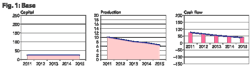
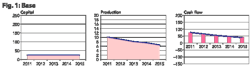
Let's assume that we have a base-level business that will decline over time. The predicted five year capital, production, and cash flow performance are shown in Figure 1. There are capital requirements to sustain the project, and production and cash flow are steadily declining. The NPV of the base is 75.
We have two types of projects in which we can invest: the first is an enhancement project with a low cost and a low yield. The second is a more ambitious extension project, which requires more capital but will eventually yield a higher value.

The Enhancement project is shown in Figure 2. There are two years of capital requirements, with some production starting in the first year, peaking in the third year, and then declining after that. The NPV of the enhancement project is slightly negative, with a value of -5.
The Extension project is shown next, in Figure 3. Capital requirements are high, peaking in the third year. There is no production until the third year, but production grows dramatically after that. Cash flow is negative until the fourth year. The NPV of the Extension project is 30.
Our company goal is to maximize NPV subject to two requirements: maintain 10% annual growth in production for five years and avoid negative cash flow in each of those same five years.
For the sake of clarity in this example, we will limit our investments to the first year only and will not consider risk. (Real investment programs analyzed usually cover a number of investment years and do consider risk and uncertainty). We have access to no other investment types, but we can invest in any number of Enhancement and Extension projects, including partial projects.
So, how shall we invest our money? The simplest "rank and cut" procedure requires us to rank projects by NPV and subsequently take as many of them as possible until capital limits are met. Since Enhancement has a negative NPV, the "winner" between the two new investments is clearly Extension. We can invest in 1.5 Extension projects before we use up the cash flow available in the first year. Figure 4 shows the capital, production and cash flow for a portfolio consisting of the base and 1.5 Extensions. The red bars on the Production graph show the 10% growth targets, while the red line shows the portfolio composite. The bars on the cash flow graph show the individual cash flow of the project types, while the red line, again, shows the portfolio composite. The colors are the same as in the graphs above: Base is shown in dark red and Extension in blue.
Note that the production goal and the cash flow goal are not met in the second and third years. The NPV of this portfolio is 120.
Alternately, we can get a little more sophisticated with our "rank and cut" and limit our investment in Extension so that cash flow remains positive during the entire 5 year period. This ends up being an investment in 75% of one Extension project. The performance of that portfolio is shown in Figure 5. Now the cash flow goal is met, but we miss the production goal in years 2-5. The NPV of this case is 98.
With the projects given, it is not possible to meet all of the goals unless we invest in the Enhancement project as well. Enhancement is quite different in its spending and performance profile than Extension, and this difference allows the two projects to work together so that all of the goals can be met, something neither project could have done alone. Figure 6 shows the portfolio results of investing in one of each project type. The NPV of this portfolio is 100. Notice that this NPV is actually a bit higher than that of the previous portfolio. By taking a project with a slightly negative NPV, we were able to use project interaction to improve the value overall.
This example is clearly over-simplified, but the lessons learned remain relevant when we add many investment choices, expand the years of investment, and consider uncertainty. The best portfolios are chosen not when we insist on finding the best individual projects, but when we consider which projects best work together.
As business has become more complex and companies more diverse, methods of assembling a portfolio of investments have had to evolve to keep pace. At one time, all that was necessary to make a good decision was to distinguish a good investment from a bad one, and the basic evaluation methods were born. Later, an ability to rank similar investments was needed, and the single value investment indicators were developed. Companies today must plan for sustained performance while investing in projects with long lead times and markedly different performance and risk profiles. Choosing "the best" investments while ignoring the timing of cash flows, the interaction of projects, and the multiplicity of important metrics that must be met simultaneously can result in disappointing corporate performance. More sophistication is needed, but not more complexity. Portfolio management techniques provide a more sophisticated way to deal with the decisions associated with complex issues. They allow us to decide among dissimilar projects based on context: what we want to achieve, when we want to achieve it, and how we want to measure it. OGFJ
About the author

More Oil & Gas Financial Journal Current Issue Articles
More Oil & Gas Financial Journal Archives Issue Articles
View Oil and Gas Articles on PennEnergy.com