Majors and foreign oil companies drawn to liquids-rich Eagle Ford
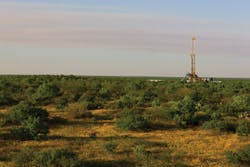
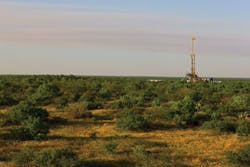
The Eagle Ford shale play in South Texas offers excellent economics due to the high liquids content. Photo courtesy of Anadarko Petroleum.
One of the most sought-after assets in North America these days is the liquids-rich portion of the Eagle Ford shale play in South Texas. Crude oil and gas liquids are fetching much higher prices than the dry gas found in the southern portions of the formation, and there is an abundance of the wet stuff in much of the Eagle Ford.
Another reason this is a desirable play is that it is close to existing transportation and processing infrastructure on the Texas Gulf Coast. However, there is currently significant midstream expansion occurring due to vastly increased production volumes from the many new horizontal wells that have been drilled.
A key trend in the Eagle and several other North American shale plays is the arrival of major integrated oil companies and foreign-owned oil companies, most of which have formed joint venture agreements with large- to mid-sized independents to share in the high cost of field development. This is a win-win for companies such as Anadarko Petroleum and Chesapeake Energy because their cash-rich partners, many of which are state owned, pay most of the development costs for the first few years. The benefit for the foreign companies is that they gain access to North American energy resources and also acquire expertise in shale drilling and completion techniques, which they can apply in their own countries and elsewhere.
Shale driving M&A activity
According to a recent report by PwC US, the total value of US oil and gas mergers and acquisitions increased significantly last year due to continued investment in US shale plays and related infrastructure, sustained interest from foreign buyers, and private equity entrants deploying capital in the energy industry. A major trend in the energy sector driving the increase in deal value throughout the year was a shift towards more investments in oil and liquid plays, such as the Eagle Ford, as natural gas prices remained depressed amid hitting a 10-year low in 2011.
In 2011, there were 191 deals in the US with values greater than $50 million, accounting for $186.5 billion, a significant jump in total deal value from the $138.5 billion during 2010, which had five more announced deals. Average deal size also increased in 2011 to $977 million, a 38% increase from $706 million in 2010, driven by 32 "mega" deals (deals with values of $1 billion or more).
"M&A activity in the US oil and gas sector was extremely active in 2011 as shale plays continued to attract the large multinational energy companies, foreign buyers, and private equity firms," said Rick Roberge, principal in PwC's energy M&A practice. "New drilling techniques in hydraulic fracturing are uncovering vast amounts of crude oil and natural gas in a very accessible environment to oil and gas reserves and this is what is contributing to the huge interest in shale plays. The low price of natural gas, partially due to the increase in supply, has also driven a shift toward more oil and liquid plays as companies and investors look to take advantage of oil prices, which is holding steady at $100 a barrel. We expect deal flow to remain active in 2012, despite continuing economic uncertainty, due to attractive commodity prices – which promotes exploration and development as well as upstream M&A activity."
Roberge added, "International players invested heavily in US shale plays through joint ventures in 2011, and we believe a trend to watch out for in 2012 is for foreign buyers to look to acquire entire companies that operate in shale plays so they can take more control of the assets through operatorship. We also saw major private equity firms making big bets in the energy industry in 2011 and we expect their activity may accelerate as favorable oil price outlooks provide an attractive investment rationale."
Recent Eagle Ford news
- ZaZa Energy LLC merged with Toreador Resources in February, creating an international resource-focused E&P company with 500,000 net acres of producing and exploration assets in the Eagle Ford and Eaglebine resource plays in Texas and the Paris Basin in France.
- TEAK Midstream LLC is constructing over 200 miles of natural gas gathering and residue delivery pipelines and an adjoining 200 MMcf/d cryogenic gas processing plant in South Texas to serve gas producers operating in the Eagle Ford Shale. TEAK has executed 10-year firm gathering and processing agreements with Talisman Energy and Statoil to support construction of the facilities. Cost of the project is about $280 million, and the facilities should be operational early in the third quarter of 2012. The new facilities will consist of two separate high-pressure gas gathering systems. One system will consist of 125 miles of 24-inch-diameter pipeline with a capacity of approximately 600 MMcf/d and another system will consist of 20 miles of 20-inch-diameter pipeline with a capacity of approximately 400 MMcf/d. The 125-mile system will originate on acreage jointly owned by Talisman and Statoil in La Salle County and will move rich gas production to TEAK's new gas processing plant in Bee County, near the community of Pettus.
- Copano Energy LLC will extend its wholly-owned 96-mile, 24-inch DK Pipeline in the Eagle Ford shale play by adding approximately 65 miles of 24-inch pipeline southwest into McMullen County. The DK Pipeline extension is expected to begin service in the first half of 2013 and is projected to cost approximately $120 million. The pipeline extension will follow the same route as Copano's recently announced condensate pipeline, Double Eagle Pipeline LLC, a joint venture with Magellan Midstream Partners in the rich gas window of the Eagle Ford Shale. The DK Pipeline extension is supported by a new long-term agreement with Petrohawk, a subsidiary of BHP Billiton and a leading operator in the Eagle Ford.
- Southcross Energy began construction in February of a fractionator and natural gas liquids and residue pipeline outlets in South Texas, which will create a sizable natural gas processing and fractionation complex serving customers in the Eagle Ford shale play. The midstream company will have the capability to process 335 MMcf/d and fractionate 16,300 barrels per day of NGLs when all facilities are operational in July 2012. Southcross also is constructing pipelines that will interconnect the Woodsboro, Gregory, and Bonnie View facilities, as well as NGL and residue gas outlets. When all planned facilities are completed, Southcross will have the ability to coordinate the transportation of natural gas and NGL volumes between the Woodsboro and Gregory plants and market residue gas, NGL products and y-grade NGLs.
- Global NuTech Inc. has acquired 100% of the stock of Texas Gulf Oil & Gas Inc. The acquisition from private equity firm Corporate Strategies Merchant Bankers includes individual oilfield producing assets and options throughout the Austin Chalk and near the Eagle Ford shale play. These assets include leases, options, and and working interests in 19 oil wells throughout the area and additional options to invest in wells to be drilled or re-entered in three leases identified as the Tilmon, Lay, and Rodenberg. OGFJ
More Oil & Gas Financial Journal Archives Issue Articles
View Oil and Gas Articles on PennEnergy.com