TECHNOLOGY California refinery meets seismic codes using new wrapping technique
Thomas T. Hwang
Fluor Daniel Inc.
Irvine, Calif.William C. Wehnes
Wejak Inc.
San Diego
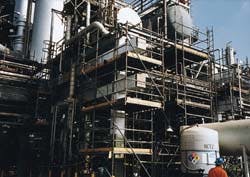
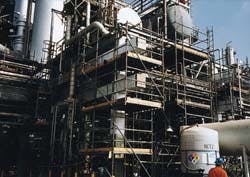
Seen on this support column at the Ultramar refinery is a textured, composite fiber material saturated with epoxy. This photograph shows the column before application of a white fireproof coating.This pipeway support at Ultramar Diamond Shamrock Corp.'s Wilmington, Calif., refinery had to be modified to accommodate a larger heat exchanger and additional equipment. The composite wrapping technique was used to strengthen the columns and beams.
Ultramar Diamond Shamrock Corp. used a new technique called composite wrapping to strengthen support columns at its 68,000 Wilmington, Calif., refinery. The process was completed without shutting down the units involved.
Installed costs for this new technique are about half those of the traditional steel jacketing method.
Background
Almost all supports in California refineries must be upgraded to meet new seismic standards. The addition or modification of refinery equipment triggers the need to retrofit these support column.
When Ultramar upgraded its Wilmington, Calif., refinery to make reformulated fuels, the refinery had to perform support retrofits in order to meet California seismic standards. The new seismic standards result from revisions to the Uniform Building Code (UBC).
Revisions to the UBC in 1992 included increased strength and ductility requirements for support columns. These requirements differ by location. For example, most of northern California is in Seismic Zone 4, while San Diego is in Zone 3.
Support structure
Support columns such as those at the Ultramar Diamond Shamrock refinery have steel interiors and concrete exteriors. They are designed to have certain load-bearing characteristics, including the ability to support weight and withstand lateral forces.
A typical strengthening method is to add steel jackets around the columns and encase the jackets in concrete. This makes the columns thicker and stronger, but also stiffer. These stiffer columns will attract seismic forces. When the entire structure is subjected to stress, those columns will be the first to crack.
When stiffness, rather than flexible strength, is added to a structure, the entire structure must be reanalyzed from a structural engineering standpoint. Even if the added stiffness does not have a structural effect, the owner of the structure must pay for the engineering analysis.
Because the composite wrapping adds flexible strength, this reanalysis is not necessary and design costs are minimized.
The Ultramar project
Ultramar modified a number of existing refinery units for its clean fuels project (OGJ, Sept. 23, 1996, p. 78). Some of these units were built on supports made of steel-reinforced concrete pipe.
One such unit was the fluid catalytic cracking unit (FCCU), which was supported by two columns with pier caps. In addition to the FCCU, 12 columns and four cross-beam pipe supports in a two-story structure had to be retrofitted to accommodate new equipment and a bigger heat exchanger.
To meet the new seismic requirements, Ultramar had to strengthen the support columns.
The refiner considered several methods of strengthening the columns, including wrapping the columns in steel sleeves and injecting epoxy behind the sleeves. Ultramar rejected this idea because it is an expensive and involved process.
Fluor Daniel, the engineering contractor on Ultramar's clean fuels upgrade, came up with the idea of wrapping the supports in a composite material. Ultramar investigated the process and determined that it was easier to install and more economical than steel-sleeve encapsulation.
Ultramar also could have chosen to thicken the concrete columns, but this is also more expensive and difficult than composite wrapping.
Installation
After the plans and bids were approved, Hexcel-Fyfe's installations division performed the retrofit work using a product called Fibrwrap. The engineering contractor, Fluor Daniel Inc., and Hexcel-Fyfe Co. engineered the support retrofit.
The existing structure was analyzed with respect to:
- The size and shape of the columns
- The degree of strengthening required
- The height of the wrapping that should be applied to each column
- The number of layers required
- The degree of overlap necessary.
For Ultramar's project, Nigel Priestley of the University of California at San Diego performed a special analysis. Dr. Priestley was one of the original testing and development engineers of the composite wrapping process.
Following the planning stage, a detailed plan was submitted to Ultramar. The plan outlined the wrapping process, step by step, including quality control procedures. Ultramar approved the submission.
Fig. 1 [126334 bytes] shows an example of engineering plans for wrapping a support column.
The columns were prepared and scaffolding set up. The corrosion-resistant composite fiber material was saturated with an epoxy at the installation site. Workers then wrapped the wet material around the column according to predetermined layering specifications.
Hexcel-Fyfe collected and tested four samples of epoxy-saturated composite each day. Ultramar sent one sample per day to an independent laboratory for verification purposes. The laboratory reported whether the epoxy had set properly, and that the tensile strength, elongation, and modulus of elasticity were within specifications set during the planning stages.
Ultramar supervised the execution. No piping had to be removed during the application. After drying for 48 hr, a protective, fire-resistant coating was applied.
The size of the column determines the time required for the work. In Ultramar's case, several days were required to wrap one large column. The entire project was completed in 4 weeks.
A 10-year warranty was written into Ultramar's contract. Hexcel-Fyfe will inspect the retrofit every 2 years to certify its integrity.
Results
The work was performed while the unit was operating. Eight installers worked four 10-hr shifts per week.
The process is extremely economical and effective. Typical installation costs for composite wrapping are $30-40/sq ft for applications in Seismic Zones 3 and 4. Applications involving only corrosion resistance cost about $20/sq ft.
In contrast, traditional reinforcement via steel jacketing costs $60-80/sq ft. And this type of work has to be done during unit turnarounds, thus increasing the complexity of scheduling the work and, potentially, the costs involved, if the work is not completed on time.
Another advantage of composite wrapping is the material's ability to resist chemicals. A layer of fireproofing material is applied on top of the composite wrapping. Because there is no torching or heating used in the application, it is especially suitable for preshutdown work in refineries.
The increase in the ductility that this method imparts to the structure has been tested extensively. The technique has been used in supporting freeway overpasses.
The Authors

Thomas T. Hwang is a principal structural engineer for Fluor Daniel Inc., Irvine, Calif. He has worked for Fluor Daniel for 22 years on various petrochemical and refinery projects.Hwang has an MS in civil engineering from San Jose State University and is a registered civil and structural engineer in California.

![Fig. 1 [126334 bytes]](http://images.pennwellnet.com/ogj/images/ogj2/95137101.gif)
The late William C. Wehnes, president of Wejak Inc. acted as sales representative for the Ultramar project on behalf of Hexcel-Fyfe Co. , San Diego. He worked on a number of refinery installations of composite wrapping. He had a degree in electrical engineering from Fenn College, Ohio.