U.S. Caspian Area Foreign Policy In Conflict With Resource Plans

John H. LichtblauAdapted from a recent presentation at the First Annual Conference on Caspian Oil, Gas, and Pipelines in New York.
Chairman
Petroleum Industry Research Foundation Inc.
New York
The U.S. really has two contrary policies on the development of the Caspian Sea region's oil and gas resources.
One policy is highly supportive of their development and eager to have U.S. companies participate in it. The other is directed against one single Caspian Sea country, Iran, and is designed to curtail its oil and gas development as much as possible.
Although Iran has no Caspian Sea production, U.S. sanctions' policy on Iran is likely to affect U.S. investments in the oil and gas sectors of other Caspian Sea countries and, hence, will reduce U.S. participation in the Caspian Sea and perhaps the speed of the development of the region's oil and gas potential.
Pro-Caspian Policy
Let us first look at our positive Caspian Sea policy.
It is based on several solid factors. The first is U.S. oil import dependency. Approximately half our oil supplies are imported, and all forecasts predict a growth both in volume and share over the next 10-15 years.
Thus, like all importers of essential commodities that cannot be readily substituted, the U.S. favors a continuing diversification of world oil supply sources, both for competitive reasons and to reduce the effects of a disruption from any one source on total world supplies.
The Caspian Sea is an excellent target for this policy. A recent U.S. Administration report to Congress states, "With potential (recoverable) reserves of as much as 200 billion bbl of oil, the Caspian region could become the most important new player in world oil markets over the next decade."
The U.S. Department of Energy's Energy Information Administration estimates that by 2015 Caspian region oil exports will be in the 2-4 million b/d range. Given the region's reserve potential, this level is likely to keep rising beyond that period.
Thus, as the world's largest oil importing nation, the U.S. has a rational interest in the development of the Caspian Sea oil resources and has stated so on several occasions. Federico Pe?a, U.S. energy secretary, said in a recent speech that one of several U.S. strategy goals to reduce what he considers the "unacceptable trend" of growing concentration of world exports on the Middle East, is "to diversify world oil supply options in other areas, such as in central Asia and the Caspian Sea."
Another indication of the U.S. government's high-level interest in Caspian energy is the formation of an inter-agency working group for Caspian Energy, chaired by the National Security Council.
Caspian vs. Middle East
While development of Caspian Sea oil resources, together with similar developments in other areas such as Latin America, will reduce the growth in the Middle East's share of world oil exports, it is unlikely to reverse or even arrest it.
The Caspian Sea and other new developments may prevent the Middle East's share from rising to "more than 70% of world oil exports by 2010," as Sec. Pe?a predicted. But the Middle East's share will still be significantly higher in 2010 than its current level of about 50%.
Thus, the growth in Caspian or any other regional exports will not dislodge the Middle East from its unique position as the world's prime oil exporter.
But at the margin, where prices are determined, the incremental supply from these new supply regions will have a disproportionate positive impact on the world market.
Geopolitics
There are also geopolitical reasons for the U.S.'s support of the Caspian Sea region's oil and gas developments.
The U.S. wants the region's newly independent states (NIS) to survive as sovereign political units. This requires a viable economic base and that other nations have an economic stake in the continuing independence of the Caspian NISs. Oil and gas production and exports provide such a base and such a stake.
Finally, there is the publicly pronounced interest by the U.S. government in the participation of U.S. companies in the development of the region's oil and gas resources.
There are technical, commercial, and strategic reasons for this interest. But it is clear that the Clinton Administration wants American companies to play a role in the commercial development of the Caspian oil and gas resources.
On all accounts, the U.S. government favors the development of the Caspian Sea oil and gas potential and expects to be diplomatically and commercially involved in it.
U.S. sanctions on Iran
How will U.S. sanctions' policy on Iran affect the development of Caspian Sea oil and gas reserves?
Iran is a Caspian Sea littoral country, but it has no production and apparently no known reserves in its Caspian Sea coastal area. All of its current oil and gas reserves and operations are onshore or in the Persian Gulf, and all foreign oil and gas investment projects are targeted for the Persian Gulf.
The objective of the U.S. sanctions' policy is to curb these investments. However, the Presidential Executive Order that bars U.S. firms from doing business with Iran and Iranians does extend to the Caspian Sea. As described by the Administration in a report to Congress:
"U.S. persons are prohibited from engaging in (or facilitating) trade and investment activities in any territory or marine area over which Iran claims sovereign rights or jurisdiction, if Iran derives a benefit from economic activity in the area pursuant to international arrangement, or otherwise exercises partial or total de facto control over the area. Prohibitions specifically include entry into contracts in Iran or in areas over which Iran lays claim and/or derives economic benefit."
Under the executive order, U.S. companies could be precluded from participating in any hydrocarbon exploration or development contracts in the Caspian Sea basin, which involve Iran or Iranian companies, including joint-use arrangements in the Caspian.
In other words, our policy prohibits U.S. and Iranian investments or other forms of participation mutually exclusive in the same project or activity.
Iran deals
So far, there have been two recent Iranian investment in oil and gas projects in the Caspian Sea, both involving Azerbaijan.
A private Iranian firm, OIEC, has been given a 10% stake in both projects. Elf and Total are the principal participants in one project and BP in the other. According to press reports, U.S. firms were deliberately excluded from both projects because Azerbaijan wanted to bring in an Iranian participant. (The sanctions imposed on non-U.S. companies under the Iran and Libya Sanctions Act of 1996 extend only to development in Iran's Caspian territory, not to Caspian development projects located in the four other littoral states in which Iranian companies participate.)
A further illustration of the difficulties presented by sanctions is the U.S. prohibition on government-to-government assistance to Azerbaijan, a measure imposed in the Freedom Support Act of 1992 in support of Armenia in its dispute with Azerbaijan over Nagorno-Karabakh. Some U.S. officials have opposed the measure and seek its repeal. While not aimed at oil and gas development, the prohibition has created friction between Azerbaijan and the U.S. and put U.S. companies seeking to invest there at a disadvantage.
Iran's next moves
Will Iran try to expand its investments in the Caspian Sea? Possibly, as retaliation against U.S. policy by trying to turn our sanctions weapon against us. Will Caspian countries permit such a policy? Iran is a strong country in the region and the Caspian NISs have indicated their desire to have good relations with it. Furthermore, Iran has a long record of offshore production. Within limits, the three NISs may, therefore, accommodate Iranian requests for further participation in the development of their oil and gas resources. Each such participation would shut out U.S. participation in the project under current U.S. policy.
There are still other potential risks under our Iranian sanctions policy for U.S. oil and gas investment in the Caspian Sea. Russia, Iran, and Turkmenistan are demanding that all Caspian Sea production beyond an agreed coastal zone be treated as a "condominium" for all five littoral countries, so that all would share in their revenue. Azerbaijan and Kazakhstan are opposed to the concept.
But if adopted in some modified form, it could disqualify U.S. companies under our existing executive order from participating in any Caspian Sea condominium project beyond the territorial coastal zone because it would generate oil and gas income for Iran.
Perhaps the Clinton administration would rule that our sanctions on Iran don't apply to these multinational condominium projects. But under existing policy they will apply, and this gives foreign companies a competitive advantage over U.S. companies in the Caspian region.
Pipelines
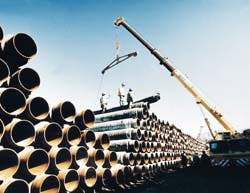
Then there is the question of pipeline transportation from the Caspian region.
Clearly, the region needs multiple pipelines to carry the oil to seaports where it can be loaded into tankers. Under present plans, most of the oil will go to Russian Black Sea ports or to Turkish Black Sea or Mediterranean ports. While most of these projects are doable-and some are already under way-they all have inherent problems, such as the crossing of politically and militarily insecure areas (Chechnya and Armenia) or increasing the flow of oil through the Bosporus Strait, which Turkey views as a major environmental and safety problem.
Thus, a pipeline south across Iran to the Persian Gulf, as part of the Caspian Sea oil delivery system, is logistically and strategically compelling.
A Persian Gulf port would not only avoid the problems mentioned above but also provide the closest location for delivery to Southeast Asia, the world's fastest growing oil import market. The construction of such a pipeline is currently under active consideration between Iran and some Caspian Sea nations.
In the natural gas sector, Turkmenistan has already agreed with Iran on a project to supply gas to Turkey through an Iranian pipeline project that will also carry Iranian gas to Turkey.
Under existing U.S. policy, U.S. firms would not be able to participate in any project that uses Iran as a transit route. This again could clearly make U.S. companies less desirable partners in some Caspian Sea projects than their foreign competitors.
In other words, U.S. policy is less likely to prevent the eventual transmission of some Caspian Sea oil and gas exports through Iran than it is in preventing U.S. companies from participating in both the construction and the utilization of the pipeline.
Sanctions, ramifications
The Iran and Libya Sanctions Act's provisions would be triggered for any non-U.S. company investing in the pipeline but would not inhibit these foreign firms from shipping through or receiving from the pipeline.
The sanctions currently affect U.S. company participation in four ways:
- U.S. companies cannot, under Executive Order, participate in the oil and gas development of any of Iran's littoral territory in the Caspian. This restriction is moot, since none of the area is in production nor hotly prospected.
- U.S. companies cannot participate in any project in any of the other four littoral states, if an Iranian firm is a joint investor. Potentially, this is a significant restriction on U.S. firms, and allows Iran to enter into projects to block U.S. participation.
- U.S. companies may be blocked from participation in any project for Caspian development if the littoral states adopt the so-called "condominium" approach to ownership of Caspian's resources.
- U.S. companies will be blocked from investing in or utilizing any pipeline that traverse Iran from the Caspian, even though the trans-Iran route may be the most attractive.
Each company assessing the profitability of competing projects will assign risk factors to various components of the deal.
As illustrated by this discussion of sanctions, the U.S. has introduced home country risk, to the detriment of U.S. competitiveness abroad.

John H. Lichtblau
Chairman, Petroleum Industry Research Foundation Inc."The U.S. wants the region's newly independent states (NIS) to survive as sovereign political units. This requires a viable economic base and that other nations have an economic stake in the continuing independence of the Caspian NISs. Oil and gas production and exports provide such a base and such a stake."
Copyright 1997 Oil & Gas Journal. All Rights Reserved.