IPAA: Industry campaign to spruce up image

Patrick Crow
Energy Policies Editor

IPAA Pres. Denise Bode
IPAA lobbying helped win passage of major bills in the last Congress, including federal laws changing insurance requirements of the 1990 Oil Pollution Act, limiting the statute of limitations for royalty payments, and permitting royalty relief for deepwater production.
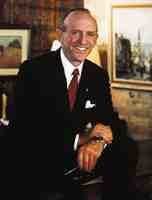
IPAA Chairman Lew WardIndependent Petroleum Association of America expects the U.S. petroleum industry will proceed with a public education program to improve its image.
"I'm confident we're going to make a national (education program) a reality. We have never been this close to putting words into action. This mission is paramount, if we hope to continue to do future business in the U.S."
IPAA had proposed that American Petroleum Institute cooperate in the campaign, which would cost $25 million/year for 5 years (OGJ, July 29, p. 49).
At IPAA's annual meeting last week in San Antonio, IPAA Chairman Lew Ward said IPAA's board of governors has voted for independents to pay half the cost.
The governors also gave Ward the authority to investigate all funding options, including a voluntary levy on production volumes.
API decision next
Ward, who is chairman of Ward Petroleum Co., Enid, Okla., said an API panel has forwarded the issue with "favorable comments" to its management committee, which will consider funding mechanisms at a January meeting.
He said, "Major oil companies indicated they are also committed to this effort. I'm confident we're going to make a national program a reality.
"We have never been this close to putting words into action. This mission is paramount if we hope to continue to do future business in the U.S."
Ward warned IPAA members that the joint program is at a preliminary stage and much work remains.
But an IPAA-API task force selected two firms to develop a long-term advertising and public relations program. They are the Austin, Tex., advertising firm of GSD&M and the St. Louis public relations firm of Fleishman-Hillard.
Oklahoma model
IPAA is modeling its program after one that the Oklahoma Energy Resources Board operates.
At the IPAA meeting, the OERB touted a commercial that it aired during a Nov. 15 airing of a television movie based on the defunct "Dallas" television series. It stressed that independent oil and gas executives were nothing like the J.R. Ewing character on television.
Pete Brown, OERB chairman and head of Pete Brown Exploration Inc., Kingfisher, Okla., said, "The average person had no idea about the value of the oil and gas industry to Oklahoma. We had to reposition ourselves and tell our story."
He said U.S. oil companies must define themselves in the public's mind. "If you don't define yourself, someone else will do it for you. We've been letting someone else define us for too long, perhaps as much as two generations."
Oklahoma Gov. Frank Keating said the Oklahoma program "tries to put out the facts to the American public so they will know just how critical this industry is. It is important for us to get away from the J.R. Ewing vision of petroleum.
"This is an industry that will be with us far into the 21st century-look at all the products provided by petroleum," Keating said.
Dick Cheney, former Defense Secretary in the Bush administration and now chairman, president, and CEO of Halliburton Inc., told the IPAA gathering, "I will say it bluntly and directly-we're not loved."
Cheney, also a former member of the U.S. House of Representatives, said it is probably more important for oil and gas executives to work on their image with their congressmen, establishing good communications "now, before there is a crisis."
Legislation, regulation
IPAA Pres. Denise Bode cited the achievements that IPAA-and other oil associations-made during the past year.
They included federal laws changing insurance requirements of the 1990 Oil Pollution Act (OPA90), limiting the statute of limitations for royalty payments, and permitting royalty relief for deepwater production.
IPAA committees unveiled agendas for 1997 that include efforts to ensure those laws are implemented favorably.
Tax committee chairman Mike Linn, president of Meridian Exploration Corp., said his panel would work for deductions for geological and geophysical expenses, correcting an Internal Revenue Service decision to consider gas in the ground as inventory, and expanding the definition of enhanced recovery to include horizontal drilling and carbon dioxide injection.
Lucy Querques, a Minerals Management Service associate director, said her agency would be working on rules implementing the OPA90 changes and royalty reform.
She said MMS will complete a study on blowout preventers Dec. 20 and propose new regulations in February.
Querques said a pilot program in which MMS took offshore royalty gas in kind resulted in a loss of revenues for the federal government compared with what they would have been had MMS taken cash payments from producers.
"That's not going to stop us from looking for alternatives to royalty payments," she said, explaining MMS believes much of the loss was due to its own administrative procedures.
Kyle Simpson, associate Energy Department deputy secretary for energy programs, said that next year, "The coming global debate about global climate change mitigation will necessarily draw the nation into a debate over an energy policy."
He urged the oil industry not to overreact to climate change proposals: "It is a problem we need to do something about, but we don't want economically unsound solutions that might cost us 2-3% of GNP."
He predicted the administration would try again to provide tax relief to keep marginal oil and gas wells in production. "We thought we had a solution last year, but it was too expensive."
Copyright 1996 Oil & Gas Journal. All Rights Reserved.