Oil, gas issues forgotten in U.S. presidential election campaign
Patrick Crow
Energy Policies Editor
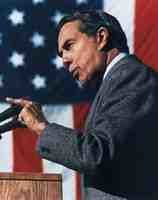
As major presidential candidates Bill Clinton (left) and Bob Dole (right) square off for the November elections, issues of importance to the U.S. petroleum industry have faded into the background.Energy is a forgotten issue in the lackluster 1996 U.S. presidential election campaign. While as recently as last May some U.S. consumers and politicians were incensed about gasoline price increases, that issue faded as prices ebbed (OGJ, May 20, p. 39).
And despite the fact crude and products imports are a record 50% of domestic consumption (OGJ, June 17, p. 16), there is little public awareness or concern.
Washington oil lobbyists are similarly apathetic about the choice between President Bill Clinton and Republican challenger Robert Dole. Neither has proven particularly friendly to the oil industry.
In the last 4 years, the Clinton administration has frustrated the industry with its inaction on energy issues. Under pressure, it drafted a 49 step program to help the industry, but few concrete steps were taken (OGJ, Dec. 20, 1993, p. 21).
When the administration finally supported energy bills that others promoted, it was after much delay and often with much reluctance.
And the oil industry has not forgotten it had to fight and defeat Clinton's proposal for a punishing BTU tax. Recently the administration has advocated international measures to control carbon dioxide emissions that could lead to a fresh BTU tax proposal next year.
Although Dole long was a senator from Kansas (the eighth largest producing state), he has never been a particular friend of the industry. During his tenure as Senate finance committee chairman in the early 1980s, he was not reluctant to target the industry for tax increases.
Both candidates have declared the need for strong domestic oil and gas industries. But both have spent more effort to cloak themselves in the green flag of environmentalism.
Lobbyists say that in this election, industry may be affected more by who controls Congress than who controls the White House.
Five weeks before the Nov. 5 election, it appeared Republicans would retain control of the Senate, but Democrats stood a good chance of regaining control of the House of Representatives, which they lost 2 years ago for the first time in 40 years.
But Republicans remain optimistic. One strategist said, "We feel the race is closing, and it's going to get closer."
DOE breakup
Clinton and Dole are diametrically opposed on only two points of energy policy: abolishing the Department of Energy and exploration of the Coastal Plain of the Arctic National Wildlife Refuge (ANWR) in northeastern Alaska.
Major oil firms care little whether DOE is retained. Independents would like to see at least a continuation of some R&D programs that may help them.
Eliminating DOE-and with it the Commerce Department-has been a pet issue for Republican freshmen in the House. Dole has latched onto it, partly because of the perceived budgetary savings.
Dole has said eliminating DOE would save $32 billion and Commerce $15 billion, money he would use to help pay for his package of individual income tax cuts.
President Ronald Reagan proposed eliminating DOE in his 1979 campaign but dropped the idea after he was elected when studies found there would be no significant savings, because DOE's programs are mostly mandated by law and would have to be shifted to other agencies.
Critics say the $16 billion/year department should be broken up, because the bulk of its activities are nuclear weapons stockpiling and environmental cleanups that could be transferred to other agencies. They propose phasing out energy research and development programs.
Supporters say the nation needs a cabinet level agency with energy expertise and claim their point was demonstrated last spring when DOE attributed gasoline price increases to the normal functioning of a free market.
On the campaign trail, Dole has qualified his anti-DOE position. He reassured New Mexico voters in August that he would close DOE but not DOE's Los Alamos and Sandia national laboratories in New Mexico.
"When I talk about getting rid of the Energy Department, I'm talking about getting rid of the micromanagement from Washington, abolishing the bureaucracy in Washington.
"That does not mean eliminating the labs in New Mexico. When I'm president of the United States, the labs are going to remain open, because they have an important job to do," Dole said.
Dirk Forrister, assistant DOE secretary for congressional, public, and intergovernmental affairs, said the Clinton administration believes DOE still has a major role to play in the federal government, and the government should not discard the "expertise and talent" of DOE employees.
Forrister said, "The Clinton administration is for having a strong DOE, but a leaner and meaner DOE."
Drilling ANWR
The ANWR issue won't go away because the Coastal Plain-close to the Prudhoe Bay area and Trans-Alaska Pipeline System (TAPS) infrastructure-is considered the nation's best remaining prospect for major oil discoveries.
There are 26 large geologic structures in ANWR's Coastal Plain, some of them seeping oil, and discovery of fields there could keep TAPS in operation for years to come (OGJ, Aug. 28, 1995, p. 33).
Environmentalists say ANWR's Coastal Plain is a special arctic ecosystem; but those who favor exploration say it is a vast tundra that is hardly unique and has supported human activity for many generations.
Clinton adamantly opposes ANWR exploration and has pledged to veto any bill that allows it.
In December 1995 Clinton vetoed a massive budget reconciliation bill that would have allowed Coastal Plain exploration, although not for that reason alone.
Dole supports ANWR exploration. The Republican platform called ANWR "the largest known onshore or offshore petroleum reserve in the nation" and said it should be opened because developing ANWR oil would raise tax revenues and create jobs while moving the added production through TAPS.
Offshore oil exploration has been a contentious issue in the past but has faded because the Bush and Clinton administrations have restricted leasing to the Gulf of Mexico and Offshore Alaska.
Clinton opposes exploration except in those areas. The Dole campaign says he supports offshore drilling, except off Florida.
Environmental harmony
Although they cannot admit it, the two candidates are not that far apart on environmental issues. Both political parties have been edging toward the center on environmental rules.
Democrats have supported changes to make environmental regulations more reasonable and cost-effective; Republicans have relented on demands for total repeal of rules.
Clinton has tried to seize the high ground, as he did successfully 4 years ago, promoting himself as the candidate for environmentalists. Republicans have been fighting back, saying they, too, are for environmental protection.
The Republican platform says, "We support environmentally responsible energy extraction from public and private lands. We will not tolerate poor reclamation or pollution from mining or drilling."
William Scherman, a former Federal Energy Regulatory Administration official now with the Skadden Arps law firm in Washington, D.C., is an informal energy adviser for the Dole campaign.
He said, "Bob Dole has supported every major piece of environmental legislation in the last 25 years."
On the campaign trail, Dole said, "I don't believe we need to choose between a strong economy and a safe environment. It's a false choice. We can have both in America. If you don't want to have both, you're not going to have both. In a Dole administration, we will make it work."
DOE's Forrister says the nation has made real progress in environmental protection under the Clinton administration.
In late August, Clinton upped the stakes. He proposed a $1.9 billion/ year program (for which Congress would have to appropriate money) to give the Environmental Protection Agency more money and more powers to investigate and prosecute polluters, expand the "right to know" program that gives citizens information about chemicals used in nearby plants, and enlarge the Superfund program for cleaning toxic waste sites.
Dole favors cost/benefit tests for new federal regulations and thinks businesses and property owners should be compensated if federal rules depress their property values. Clinton disagrees on both issues.
Other issues
Clinton and Dole differ somewhat on international trade.
Clinton claims to take a free trade stance and supports the new World Trade Organization. However, that conflicts with his support of trade sanctions against Iran, Libya, and Cuba, with the oil and gas sectors of the former two nations a particular target.
Dole has criticized the North American Free Trade Agreement and has declared the U.S. should "not let our national sovereignty be infringed by the WTO."
As befitting a senator from corn-growing Kansas, Dole has worked to maintain subsidies for the ethanol industry. One of his major supporters has been Dwayne Andreas, chairman of Archer Daniels Midland Co., which dominates the ethanol industry.
The Clinton administration has agreed to a United Nations plan for the limited sale of crude oil from Iraq, although that sale has been delayed-partly by the administration's efforts and partly by Iraqi President Saddam Hussein's military moves against the Kurdish minority in northern Iraq.
U.N. Security Council Resolution 986 would allow Iraq to sell $2 billion worth of oil in a 6 month span to buy food and medicine for its people.
Dole has urged no relaxation of the ban on Iraqi oil sales because of that nation's actions to suppress its Kurdish people and thwart U.N. inspections of its nuclear facilities.
He said Iraq's actions "reinforce my belief that the move to relax sanctions on the sale of Iraqi oil was premature and ill-advised and should not be implemented."
Scherman said Dole wants "a strong, robust energy sector" and believes "a growing economy has to include a growing energy industry."
He said Dole wants to reduce federal regulations, rely more on the marketplace, and promote "environmentally responsible" energy development.
On tax issues, he said Dole would support deduction of intangible drilling costs, repeal of the alternative minimum tax, freezing the percentage depletion rate at the present level, and the expensing of geological and geophysical costs.
Forrister said Clinton wants to foster a "diverse portfolio of energy resources that are reliable, competitive, and meet environmental principles." He notes that Clinton has reduced regulations and has made royalty reforms. And he said the President has supported bills to reduce insurance requirements for offshore operations, permit exports of Alaskan North Slope oil, and promote development of deepwater and marginal production.
House outlook
For the oil industry, the major result of the November elections could be whether that gives control of the House of Representatives to the Democrats.
Currently, Republicans hold a 235-198 majority in the House. One seat is held by an independent, and one is vacant.
The latest polls indicate voters favor Democrats over Republicans for House seats by a 42% to 36% margin, and Democrats have a good chance of seizing the 20 seats they need for control.
That edge could be magnified if Republican voters think Dole will not be elected and stay home from the polls, thus reducing votes for GOP congressional candidates.
Although all House seats are up for reelection, the most vulnerable always are those of the freshmen, and most of the 73 freshmen are Republicans. But Republicans have the edge in another key category. Of the 53 seats being vacated by retiring lawmakers, 30 are Democratic.
Republicans are warning that if the Democrats regain control of the House, extreme liberals will once again head all the key committees.
House minority leader Richard Gephardt (D-Mo.), who likely would be elected majority leader if the Democrats sweep the House, disagrees.
He said the new House chairman would reflect the more conservative nature of the overall House. And he noted that Democrats likely would have only a slender majority, requiring them to compromise with Republicans in order to pass legislation.
If the Democrats are successful, Rep. Tom Bliley (R-Va.) would surrender the chair of the Commerce committee, which handles most energy legislation, to veteran John Dingell (D-Mich.).
Don Young (R-Alas.) would surrender the Resources committee, with responsibility for leasing issues, back to George Miller (D-Calif.). And Bill Archer (R-Tex.) would cede the tax-writing Ways and Means committee to Charles Rangel (D-N.Y.).
Oil lobbyists consider Dingell to be more reasonable now than he was 10-15 years ago but say Miller and Rangel are definitely unfriendly.
Senate prospects
Republicans had hoped to expand their 53-47 seat majority in the Senate to 60 seats in the November elections, which would give them the bare majority needed to shut off filibusters against major bills.
But President Clinton's early strength in the polls has given Democrats hope that they can ride Clinton's coattails and either gain some seats or, at a minimum, maintain the current ratio. Democrats appear unlikely to seize control of the Senate.
About a third of the Senate seats are up for reelection. Of those 34, there are 14 vacancies due to retirements.
In the 1994 election, Republicans won all nine of the open seats, including six formerly held by Democrats. But this year, only one of the seats held by a Democrat appears to be leaning Republican.
If the Senate turned over, the Energy committee chair would shift from Frank Murkowski (R-Alas.) to Dale Bumpers (D-Ark.). Murkowski is considered a staunch friend of the industry, but Bumpers opposes oil measures more often than not.
Bill Roth (R-Del.) would surrender the Finance committee to Daniel Patrick Moynihan (D-N.Y.), who seldom votes with the industry on tax matters.
And the Environment committee chair would revert to Max Baucus (D-Mont.) from John Chafee (R-R.I.), but there would be little difference in its legislative product.
1997 agenda
Of course, the agenda for the 105th Congress will depend very much on who controls the White House, Senate, and House next January.
ANWR is one such issue. If Clinton wins, and Democrats seize control of either house, ANWR will be a dead issue for at least 2 years.
But there are many key bills, held over from the current Congress, that will be up for consideration again no matter which party is in control.
Legislation will be introduced to relax some of the more stringent provisions of the 1990 Clean Air Act Amendments, particularly requirements for alternative fuel vehicles.
Congress also will be asked to relax insurance requirements for offshore operations if a bill does not pass in the final days of the current Congress.
The 1990 Oil Pollution Act required offshore oil operators to carry $150 million worth of insurance in case of major oil spills. Industry has complained that it is too high, and both houses reduced it to $35 million in U.S. Coast Guard spending bills.
The next Congress will be asked to reauthorize the Clean Water Act, last updated in 1987. The House passed a CWA bill in early 1995 requiring clean water rules to meet risk assessment and cost benefit criteria and lowering wetlands development restrictions. But the Senate did not move a bill.
Legislators again will attempt to reauthorize the Comprehensive Environmental Response Cleanup and Liability Act (Cercla, or Superfund), which has failed to make much progress toward cleaning up the nation's hazardous waste sites. Industry wants Superfund's retroactive liability provisions changed.
Also, Congress may consider trade sanctions against Nigeria, similar to those against Iran and Libya.
The players
The outcome of an issue in Washington often depends more on the personnel involved than their politics or the policies themselves.
At this point, not even Dole knows who would serve in his cabinet. But as one industry observer said, "Dole's orientation would be more pro-business, while the Clinton team still hasn't gotten over the mindset of command-and-control regulations, although there are some good people in the administration. And you've got to remember you don't just buy the candidate, you buy the whole package of people who come with him."
But oil lobbyists wonder how Clinton would change his cabinet in a second term.
Energy Sec. Hazel O'Leary initially said she would serve only one term and then hedged on that. But her frequent overseas trips have been an embarrassment to the administration.
If she leaves, her replacement logically would be someone experienced in the nuclear industry. But that person also might place more emphasis on fossil energy production.
Interior Sec. Bruce Babbitt appears secure in his job, but he is no friend to the oil and gas industry, which would welcome his departure.
Carol Browner, EPA administrator, is regarded as being fairly reasonable. Lobbyists say she is probably better than her replacement would be.
And a second term would mean even greater influence for Vice President Albert Gore, who already is preparing for a run at the presidency in 2000. Gore has elevated the status of the vice presidency from a ceremonial position to that of an influential adviser to the President.
He is a long-time nemesis of the oil industry, an unrelenting environmentalist who opposes offshore drilling anywhere off the U.S.
Gore has advocated BTU taxes on fossil fuels in the past and currently is pushing the administration to support limits on carbon dioxide emissions because he believes they contribute to global warming.
Copyright 1996 Oil & Gas Journal. All Rights Reserved.