Segmented mapboard replaces drawing for pipeline control
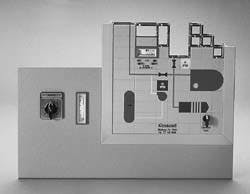
Personnel in Alabama-Tennessee Natural Gas Pipeline's control room in Sheffield, Ala., are monitoring operations by viewing a mosaic mapboard that supplants a less realistic schematic drawing.
The mapboard allows replacement of tiles representing parts of the line (Fig. 1) as required by rehabilitation or expansion of the actual pipeline in the field.
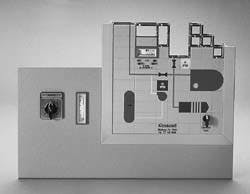
Alabama-Tennessee Natural Gas' mapboard uses sections that resemble this portion which illustrates the "snap-in" construction and the mapboard's ability to house instrumentation, switches, and pushbuttons in an interchangeable tile (Fig. 1).
The pipeline's 1,500 sq ft control center in Sheffield, Ala., displays a 13 ft 4 in. x 6 ft 4 in. mosaic mapboard produced by Mauell Corp., Dillsburg, Pa. In the control center, system operators monitor activities from a console in front of the mapboard.
The dynamic mosaic mapboard provides operators with a detailed graphical interface that represents more than 300 miles of the gas pipeline's activities.
Key controllers
Controlled by a host computer, the mapboard graphically depicts Alabama-Tennessee's industrial customers, compressor stations, and local distribution centers located along the entire length of the gas pipeline, as well as highways and the boundaries of counties, from the line's starting point in Selmer, Tenn., through Mississippi, to its terminus in Huntsville, Ala.
Operators use the mapboard to monitor receipt and delivery volumes, compressor suction and discharge pressures, and line volumes. Temperatures, valve positions and indicators, and main line pressures are also monitored from the mapboard.
This field information is dynamically displayed on the mapboard by discrete light-emitting diodes (valve position indicators) and numerical LEDs (readouts). The modular LED units manufactured by Mauell are integrated within the mapboard graphics to depict Alabama-Tennessee's natural-gas system.
Mauell says that since the data received from the supervisory control and data acquisition (scada) system have already been converted to digital values, DO128 and BCD32 controllers which do not process or manipulate data a second time ensure the accuracy of the information displayed on the mapboard.
Each DO128 output controller can drive 128 output points. With the BCD32 controller eight, four-digit displays can be configured from one controller.
Because analog information is received on a single cable, the cable can be used to drive several controllers. This makes mapboard wiring simple and easy, says Mauell. If the DO128 and BCD32 controllers were not used to drive the display, a more complicated system with more wiring would be required.
In addition, because the mapboard system runs at low voltage, danger to the people maintaining mapboard electronics is minimized.
Flexibility
As Alabama-Tennessee's system is expanded or updated, the mosaic board can be reconfigured with inexpensive replacement tiles. To change the panel, tiles simply pop out from their positions and new ones snap in their places.
Unlike sheet-metal mapboards which lose their visual integrity when modified, says Mauell Corp., this system's modular "snap-in" construction always maintains the board's continuity and aesthetics.
Alabama-Tennessee Natural Gas says this flexibility is the major benefit of this system. No matter what changes are made along the pipeline, the board can easily be modified without invasive or destructive means.
The manufacturer, while revealing no numbers, admits that the cost of the system is slightly higher than a comparable sheet-metal operator interface. But Mauell Corp. also says that obsolescence of mosaic systems has extended beyond 20 years, thus providing a far greater cost advantage.
Simplified maintenance minimizes downtime and reduces cost. Replacements of components such as tiles, push buttons, and LEDs are also inexpensive and can be performed without special training or equipment.
Mauell Corp. provides control-center equipment, design services and mosaic mapboards that monitor process-control in electric and gas transmission and distribution systems, mass transit networks, material-handling operations, wastewater-treatment facilities, powerplant generation, and public-water distribution.
Copyright 1996 Oil & Gas Journal. All Rights Reserved.