NorFra line boosts France's gas hub position
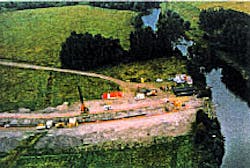
The 185-km Artère des Hauts-de-France gas pipeline links the Dunkirk terminal to Gaz de France's underground storage terminal at Gournay-sur-Aronde, France. (Photo by BDL Communication SA, courtesy of Médiathèque Gaz de France.)The new NorFra offshore gas pipeline is France's first direct link to a foreign producing natural gas field and bolsters the country's position as a major distribution hub in Europe's newly liberalized natural gas market.
![The new NorFra pipeline is now delivering natural gas from Norway's giant Troll field in the North Sea to Dunkirk, France. Shown is the NorFra landing at the Dunkirk terminal. (Photo by Thierry Dalban, courtesy of Médiathèque Gaz de France.) [11,531 bytes]](http://images.pennwellnet.com/ogj/images/ogj2/9643jnn04.jpg)
The 850-km, 5.6 billion franc NorFra pipeline was put into commercial use early in October (OGJ, Oct. 19, 1998, p. 44).
The line links giant Troll gas field in the Norwegian North Sea to the French natural gas grid at Loon Plage, France, near Dunkirk (see map above, right [121,351 bytes]).
![see map above, right [121,351 bytes]](http://images.pennwellnet.com/ogj/images/ogj2/9643jnn02.gif)
NorFra has a diameter of 105 cm and is said to be the world's longest subsea pipeline. It is owned by an 11-member group comprising operator Statoil, Norsk Hydro AS, Norske Shell AS, Esso Norge AS, Elf Aquitaine, Saga Petroleum AS, Norske Conoco AS, Total, Neste Oy, Mobil Exploration Norway AS, and Agip SpA.
Gas grid expansion
Troll gas is imported through the NorFra pipeline at a receiving terminal at Dunkirk (see photo).The terminal is owned 65% by the NorFra group and 35% by Gaz de France (GdF). It has a gas treatment capacity of 50 million cu m/day.
In order to distribute the additional gas supplies now entering France through NorFra, GdF has invested 1 billion francs to construct one of France's largest gas pipelines, the 185-km, 110-cm Artère des Hauts-de-France (see photo). This pipeline links the Dunkirk terminal to GdF's transmission system near the underground storage terminal at Gournay-sur-Aronde, France (see map above, left [113,888 bytes]).
![see map above, left [113,888 bytes]](http://images.pennwellnet.com/ogj/images/ogj2/9643jnn01.gif)
During 1997-99, GdF will invest 17 billion francs to develop its gas supply network in France alone.
France as a conduit
Norwegian natural gas bound for Spain has transited France since 1987. But NorFra is now providing additional quantities of Norwegian gas to France, necessitating an expansion of France's gas pipeline system.A planned gas pipeline called Les Marches du Nord-Est will traverse Switzerland on its way to Italy, where Snam SpA will take the gas shipments.
"Half the gas coming from Norway will transit through GdF's network to Spain and Italy," said GdF Pres. Pierre Gadonneix.
By 2005, France will be receiving an estimated 15 billion cu m/year of gas from Norway-an amount equivalent to about one third of French gas demand.
At that time, Norway will be France's leading natural gas supplier, ahead of Russia and Algeria. And, conversely, France will become Norway's second largest gas importer, behind Germany's Ruhrgas.
Norway's gas exports
Norway has developed an aggressive plan to increase gas exports. By 2005, it will be exporting to continental Europe an estimated 75 billion cu m/year of gas, up from 42.3 billion cu m in 1997.Statoil Pres. Harald Norvik said that Norway would adapt to Europe's newly liberalized gas market, but that projects like NorFra, or Europipe 2 from Norway to Germany, "can be achieved only on the basis of long-term relationships." He said that his firm is holding talks with potential partners for developing new gas export schemes.
Norvik added that, if needed, Norway's five gas pipelines could be expanded to ship 100 billion cu m/year by installing additional compression.
Copyright 1998 Oil & Gas Journal. All Rights Reserved.