Enron Looking To International Arena For Growth Via Hydrocarbon/Power Schemes
Bob Williams
Managing Editor-News
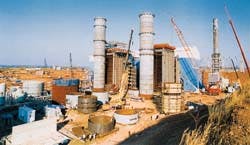
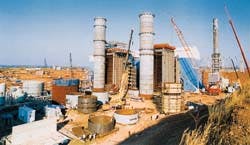
The first phase of India's Dabhol power project, shown under construction, is about a month from start-up trials. To be fed by Qatari LNG, the two-phase project endured political wrangling that nearly derailed what energy industry observers saw as a litmus test for integrated energy companies such as Enron Corp. in their efforts to market hydrocarbons and electricity in developing countries. Photo courtesy of Enron.
- Joseph Sutton, Enron International Pres. and CEO - "A large part of Enron's future growth lies with Enron International. That's because markets are tightening up in the U.S.-and eventually in Europe-so you have to look at the markets that we are in, for long-term growth. Our internal goal, quite simply, is to become Enron's largest net income providerellipseand we'll take a good crack at that this year." [12,920 bytes]
- Enron international's portfolio of hydrocarbon/power projects [40,478 bytes]
![Joseph Sutton, Enron International Pres. and CEO - "A large part of Enron's future growth lies with Enron International. That's because markets are tightening up in the U.S.-and eventually in Europe-so you have to look at the markets that we are in, for long-term growth. Our internal goal, quite simply, is to become Enron's largest net income providerellipseand we'll take a good crack at that this year." [12,920 bytes]](http://images.pennwellnet.com/ogj/images/ogj2/9626jsub.jpg)
![Enron international's portfolio of hydrocarbon/power projects [40,478 bytes]](http://images.pennwellnet.com/ogj/images/ogj2/96266301.gif)
Following its successes emanating from opportunities created by the deregulation of the natural gas industry in the U.S., Enron has ventured into a new area: the wholesale electricity market, which is in the process of deregulating in the U.S. and in Europe. Enron has gained an edge here by transferring its wholesale gas market expertise to the evolving new electric power market.
With its wholesale strategy in place, Enron has trained its sights on the deregulating retail natural gas and electricity markets in the U.S. and Europe.
The company's efforts in developing countries, however, are focused more on an integrated approach, seizing opportunities created by the global trend toward privatization, deregulation, demonopolization, and economic reform. The object here is to create markets to better serve local energy customers.
In such circumstances, Enron is developing projects that address substantial energy needs and contribute to the overall energy infrastructure of the target country, according to Joseph Sutton, president and CEO of Enron International (EI), the international developing markets arm of Enron. That, in turn, sets the stage for further expansion in that country into such areas as retail sales, wholesale marketing, trading, and arbitrage.
International arm
EI used its parent's experience in the upstream end of the energy marketing business as a springboard for growth outside the U.S. and Europe."What we've seen in the last 5 or 6 years is that we have had great success internationally on asset-type transactions: power plants, pipelines, things of that nature," Sutton said in an interview with OGJ. "ellipseWhat we thought was and were starting to prove that, in fact, was true was that if you have those types of positions in the developing and emerging countries, you can also take those positions and leverage off them and move into the area of gas and power marketing.
"A lot of that is regulatory in nature, and most of these countries right now see the more-developed countries are moving that way. They want to do the same thing, so we're in a great position to not only grow our market but also shape our market in these developing countries because of our asset positions there, primarily."
Often, what EI sees as the best way to resolve a chicken-or-egg dilemma-whether to develop a country's fuel supply or its power infrastructure first-doesn't match what the country prefers.
Sutton said that "ellipsecountries would be better off getting fuel supply development lined up first in order to care of their energy needs, because certainly you can't have the power generation lag that. Unfortunately, most (developing) countriesellipsetoday have looked first at the power needs from a bricks-and-mortar perspective-If you look at energy as a whole, that's sort of a sexy part of the equation, because you can build a big power plant, you can take a picture of it, it looks goodellipse.
"On the other hand, what you end up needing in every case with these power plants is a good, dependable fuel supply first, and probably the country would be better off developing a fuel infrastructure first. That would bring in more reasonably priced power in the long run. So I think we like to look at fuel supply first, but most countries don't do that; most countries look at the power plants first.
Establishing a foothold
Nevertheless, once EI is established in a country, usually with an independent power project, that gives it a foothold from which to expand into fuel supply development and energy marketing, Sutton said."A good example of that is in Argentina, where we own a large part of and operate the TGS pipeline system, which puts us in the gas transportation business there. Now we have expanded that and haveellipsethe Transredes pipeline in Bolivia, and we're going to tie that into the Bolivia-Brazil pipeline. As a result of those efforts, we've been able to establish a trading office in Argentina, where we're trading in gas and power."
Noting that Enron recently was awarded the first power trading license in Argentina, Sutton said, "That allows us to take that margin now and become an energy marketer. So by taking one position, learning the country, it allows you to grow that position. That's what we're doing now, and I think that's one example of what we're going to be doing in Brazil, India, and other parts of the world.
Even at that, EI emphasizes the profitability of each project or part of a project on a stand-alone basis; it would not be willing to undertake a project with marginal returns simply to develop or maintain a foothold in a country.
"At the same time, we are very careful not to overprice anything we do in these countries. If we've learned one thing, it's that your power price has to be a competitive power price; so we're very competitive that way, but we also don't do projects that lose money. I think that's important for us and the country we're working in."
Fuel choices
The largest part of this energy equation, then, is developing the fuel supply source, which, in turn, drives the price of power.Enron's emphasis is on getting natural gas established in a developing country and producing cost-effective power there. But natural gas, while usually preferred from an economic and an environmental standpoint, is not always an option (see table, next page).
"If you look at where we have diesel plants or No. 6 oil plants, they're in parts of the world were there really is no alternative fuel supply, and the customer's requirements drove it," Sutton said. "For example, before we did our projects in the Philippines, they were in a blackout 18 hr/day because they don't have enough power.
"There is some hydro there, and a little geothermal, but in the end they had to go to an oil-burning plant, and the plant we did do is probably the most environmentally efficient plant in the Philippines burning No. 6 oil. It can also be converted to natural gas if and when natural gas comes on line in the Philippines."
Another example of this approach is EI's efforts to enhance its 500-MW Puerto Rico power project by adding a small-scale regasification terminal in order to bring in liquefied natural gas into Puerto Rico.
"It is our hope that we can expand, through that regasification terminal, the gas flow into Puerto Rico and then be able to gasify a large portion of Puerto Rico."
Indian experience
EI's biggest challenge to date in taking this integrated approach to a developing country's energy needs was in India, where its embattled Dabhol project was seen as a litmus test for future energy investment in that vast country."It certainly was a litmus test for us,"Sutton said. "We looked at the west coast of India about 6-7 years ago. If you looked then at the population of India and how they were performing economically, how well educated they are, and how they wanted to expand their markets and their economyellipse(and realized) that one of the things holding them back was a lack of energy, especially electricity."
It made sense to bring LNG to the western coast of India, Sutton added, because the economic growth in that heavily populated region was being constrained because of a lack of fuel supply.
But EI stumbled over some roadblocks with Dabhol, ensnared by the local politics of Maharashtra state to the extent that the project was delayed for about 20 months. After new negotiations that resulted in the two-phase project being expanded to 2,450 MW from 2,015 MW, construction resumed in December 1996, and trial production is expected in July, with full commercial production to be achieved by this December. Construction of Phase II is to begin in the third quarter of this year on the combined cycle power plant, which will burn naphtha or distillate in Phase I and natural gas once Phase II is on line.
EI is also building its own LNG receiving and regasification terminal at Dabhol, fed by LNG from Qatar and other sources. It will be, Enron claims, the biggest LNG-fueled facility outside Japan, taking as much as 5 million metric tons/year.
"The real benefit here is bringing natural gas supply to the west coast of IndiaellipseIt will unlock that part of India both from an industrial and from an electricity standpoint in the long term.
Still, EI's political problems in India may just be beginning, given the recent decision by the administration of President Bill Clinton to impose U.S. sanctions on that country as a response to India's recent test detonation of nuclear weapons.
"Like any other company, we have concerns, but we're fortunate in the fact that the first phase is not impacted at all by it and it should come on line this year...We're also fully satisfied that we can get the second phase of the project done on or by the time expected without being fully dependent upon the agencies impacted by the sanctions."
Outlook
Sutton sees few things on the horizon that will cloud EI's outlook for international marketing of hydrocarbons and electricity.He remains unconcerned about the proliferation of LNG projects and the recent flurry of developments in lowering the cost of LNG technology: "It's sort of like a flavor of the month thing, where everybody suddenly wants to try LNG, but these are very complex projects, and, at the end of the day, there will be very few that are actually done."
Low oil prices are currently more of a boon than a bane for Enron International's strategy: "In each project that we're operating right nowellipsethe fuel price risk is a passthrough, so that benefits the utility; in the case of low oil prices, that makes for a lower power price and, therefore, actually proves to be a benefit. We were very careful in how we indexed these things; we have to make sure that we don't index them so that it could become a negative."
EI sees itself as the locomotive of future growth for Enron, Sutton said: "A large part of Enron's future growth lies with EI. That's because markets are tightening up in the U.S.-and eventually in Europe-so you have to look at the markets that we are in, for long-term growth.
"Our internal goal, quite simply, is to become Enron's largest net income providerellipseand we'll take a good crack at that this year."
Copyright 1998 Oil & Gas Journal. All Rights Reserved.