Special Report: European LNG demand trends unclear amid continued global economic turmoil
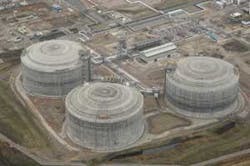
The last couple of years have proven to be dramatic for the global LNG industry, matching few of the industry’s expectations of only a few years ago. From early 2007 until the end of 2008, the global LNG market has been supply constrained with strong Asian demand attracting an increasing number of cargoes from the Atlantic Basin.
During this time Asian buyers have shown a willingness to pay a premium for spot, flexible supply, and global LNG trade flows have responded accordingly. This situation is unlikely to prevail for much longer, however.
As the global economic situation continues to deteriorate, the outlook for the LNG industry, as is the case for many other resource-based industries, is uncertain. Apart from the potential for reduced gas, hence LNG demand, there is considerable supply expansion under way with nearly 85 million tonnes of new gas liquefaction capacity scheduled to be commissioned over the next 2-3 years, increasing global production capacity by yearend 2008 by nearly 40%.
With Europe expected to be as badly affected by the current economic crisis as any other region of the world, the outlook for LNG imports into the continent is unclear, especially over the near term. Without doubt, from the second half of this year there will be sufficient global LNG supply to meet near-term European demand, but the real question is the magnitude of LNG demand pull from European buyers and the degree of competition from pipeline gas that is the main source of European imported supply.
While the dispute earlier this year between Russia and the Ukraine, which resulted in curtailed gas supply into southern and central Europe, presents a strong case for expanded LNG imports, any policy changes in that direction are unlikely to be made and implemented for years to come.
Increasing demand
After 2 years of flat LNG demand, imports into Europe increased in 2008 to 44.8 million tonnes of LNG. This represents a 9% increase over 2007 imports of 41.1 million tonnes and a 6% increase over 2006 imports of 42.3 million tonnes. Spain has increased its share of total imports and in 2008 accounted for more than half of the total volume. Spain’s imports of LNG have increased to 23.6 million tonnes in 2008 from 18.3 million tonnes in 2006.
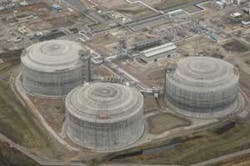
France remained the region’s second largest importer although its share decreased to 20% in 2008 from 25% in 2006. French imports decreased to 9.1 million tonnes in 2008 from 10.7 million tonnes in 2006. Of the remaining countries, imports into Belgium declined by 0.8 million tonnes over 2006-08 to 2.3 million tonnes, and imports into Greece and Portugal increased by around 0.3 million tonnes each to reach 0.7 million tonnes and 2.1 million tonnes, respectively.
LNG imports into Italy have remained relatively constant in the region at 2.1-2.3 million tonnes, while those into Turkey increased by 1 million tonnes to 4.3 million tonnes. Since start-up of the UK’s Isle of Grain LNG import terminal in mid-2005, imports have been on a declining trend falling to just 0.8 million tonnes in 2008 from 2.5 million tonnes in the first full year of the terminal’s operation in 2006.
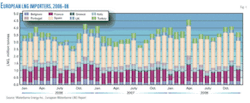
Not unsurprisingly for a seasonal market, imports of LNG into Europe exhibit some variation throughout the year with imports tending to peak in winter months and be at their lowest in summer months (Fig. 1). Over the last 3 years, LNG imports have averaged 3.8 million tonnes/month during winter (October to March) and 3.3 million tonnes/month in summer (April to September).
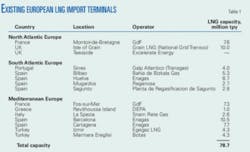
As of yearend 2008, Europe had total LNG import and regasification capacity of 78 million tonnes/year (tpy; Table 1). Thus, throughput in winter equates to average capacity utilization of nearly 58%, while summer capacity utilization has averaged slightly more than 50%.
Primary source
Imports into Europe have come mainly from within the Atlantic Basin, although its share of total supply has declined to 86.5% in 2008 at 38.8 million tonnes from 88% in 2006 at 37.1 million tonnes (Fig. 2). As there have been no imports from the Asia-Pacific region over this time, the remaining imports have come from the Middle East, increasing by 1 million tonnes to 6.1 million tonnes in 2008 from 5.1 million tonnes in 2006.
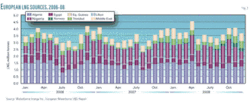
Over the last 3 years, around 70% of Middle East supply has been sold into Spain, although increasing volumes have been sold into Belgium with start-up of a supply agreement from RasGas in early 2007 and a small quantity has also been sold into France.
Middle East supply into Europe has been fairly constant in terms of seasonality, which means that Atlantic Basin supply has taken most of the seasonality swing.
Within the Atlantic Basin, the main suppliers have been Algeria, Egypt, Nigeria, and Trinidad that collectively have accounted for more than 96% of supply. The small amount of LNG produced by Libya is sold into Spain under a long-term agreement, while BG, as sole lifter of LNG from Equatorial Guinea, has either sold its entitlement to higher priced Asian markets or retained it for direct sale to its own downstream customers.
Since start-up of the Snohvit LNG plant in late 2007, Norway has started to emerge as a supplier to Europe, although the volumes have been relatively small to date.
Of the main suppliers, Algeria is the largest accounting for more than 40% of total Atlantic Basin supply to Europe, although Algerian exports have fallen to 15.8-15.9 million tonnes in the last 2 years from 16.6 million tonnes in 2006. In part this drop has been due to some Algerian output being sold into Asian markets but also because of technical problems with the country’s gas liquefaction plants that restricted output during the second half of last year.
Nigeria has been the second largest exporter to Europe with its share of total rising to nearly 35% in 2007 and more than 32% in 2008 from 30% in 2006. This has been due mainly to start-up of Trains 4 and 5 at the Bonny LNG plant through 2006 and of Train 6 in the early part of last year. Again Nigeria has also been a significant seller of LNG into higher priced Asian markets over the last 2 years with exports to Europe remaining around 12.5 million tonnes in 2007 and 2008.
Exports from Egypt to Europe have declined over the last 2-3 years in both market share and absolute terms. The country’s share of total Atlantic Basin exports has fallen to less than 12% from nearly 16%, while the volume has declined to around 4.4 million tonnes in each of the last 2 years from 5.9 million tonnes in 2006. Again one of the primary reasons for this is that some output from the two Egyptian LNG plants has been sold into the premium Asian market.
The remaining supplier of note, Trinidad, has seen its exports to Europe increasing in both market share and absolute terms over the last 3 years, the former increasing to 11.4% from 8.3% and the latter to 4.4 million tonnes from 3.1 million tonnes.
Flexible supply from Trinidad has proven to be responsive to regional price variations, the price premium over Henry Hub in both Asia and Europe from the middle of 2007 being sufficient to draw cargoes away from the “natural” outlet for Trinidadian exports, i.e., the US.
One of the emerging characteristics of the global LNG market has been an increase in the amount of supply that has a degree of diversion capability or destination flexibility. While most global LNG trade continues to occur as dedicated or fixed-destination supply governed by long sales-and-purchase agreements that prevent diversion, an increasing number of contracts have come into force in recent years that contain provisions to enable diversion.
These may either come in the form of larger credit-worthy companies willing to take total market and price risk or sales-and-purchase agreements that allow the offtaker to seek the market of highest return with some form of profit-sharing mechanism contained in the pricing provisions.
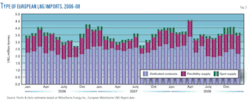
The quantity of LNG supply imported into Europe as dedicated or fixed supply has increased to 29-30 million tonnes in each of the last 2 years from an estimated 26.7 million tonnes in 2006, and its share of total supply increased to 73% in 2007 from 63% but declined back to 65% in 2008 (Fig. 3). By comparison, the share of dedicated or fixed trade on a global basis has declined to 70% in 2008 from an estimated 75% of the total in 2006.
Flexible trade into Europe has experienced considerable volatility over the last 2-3 years. In 2006, flexible trade amounted to an estimated 13.5 million tonnes accounting for 32% of total European imports, but both share and absolute volumes declined in 2007 to 8.9 million tonnes and 22%, respectively, only to rebound in 2008 to 13.2 million tonnes and nearly 30%, respectively.
By comparison, the share of flexible trade on a global basis has increased to 25% in 2008 from an estimated 20% in 2006. Spot LNG imports have remained around an estimated 5% of total supply over the last 3 years, which is comparable with the global average.
Increasing complexity
These data are the results of both the dynamic complexity of supply and demand fundamentals in the European gas market and its increasing influence on global LNG trade. Structurally, Europe has been a net importer of natural gas, and this situation will only deteriorate in the future as indigenous regional production declines and demand continues to grow.
Most of the main gas markets in Northern Europe are now mature with limited growth potential from the industrial and residential-commercial sectors, while some growth potential exists from power generation. Consequently, there are likely to be different factors to influence future gas demand in these countries.
Over the longer term, economic and population growth as well as the relative price of gas to the end-user compared with such competing fuels as oil and coal will mainly drive demand. These factors will tend to affect demand from the industrial and power generation sectors.
Over the shorter term, weather will be a major influence on demand as the severity of the northern European winter will translate into more significant month-on-month demand changes as the effect of the underlying growth trend has become less influential due to the maturity of the gas market.
Factors affecting demand in southern Europe are a little more diverse, as there is greater variation in the maturity of the markets in this region. Italy has a well developed gas market, while those in the Spain, Portugal, Greece, and Turkey are less well developed with all sectors having the potential for future growth. Seasonality of demand in these countries tends to be less significant than in Northern Europe although it does exist.
From an LNG perspective and apart from Italy, there is limited gas storage capacity in these Mediterranean European countries with the result that LNG is often the source of balancing supply during times of crisis. This was evident in the early part of 2009 when both Greece and Turkey sought additional supply from the flexible, spot market as pipeline supply from Russia was curtailed as a result of its dispute with the Ukraine.
Another major factor that will impact future European LNG imports is the hydropower reserve in Spain. Because hydropower contributes to around 15% of Spanish power supply, during times of low rainfall thermal, mainly gas-fired, power is called upon to make up the deficit.
With very limited storage capacity, Spain has limited ability to meet such demand shortfalls. It therefore tends to make up any shortfall with increased purchases of LNG. This was evident in the early part of 2008 as precipitation in second-half 2007 had been well below average with the result that hydropower availability was severely restricted in the early part of the following year.
Pipeline vs. LNG
From a gas supply perspective, some European gas traders and marketers have a unique opportunity to arbitrage between pipeline supply and LNG supply. Typically pipeline gas supply contracts are priced by indexation to heating oil and residual fuel oil with a 6-9 month time lag. This provides a certain degree of predictability over the near-term price of future pipeline gas supply.
With gas trading hubs starting to emerge throughout Europe and a futures market developing, those traders who have access to LNG supply have the opportunity to arbitrage between imported pipeline and LNG supply. Furthermore, with a spot LNG market starting to emerge in Asia with prices that are compared with either crude oil or refined products, these traders can also exploit any regional prices difference that may emerge.
During 2008 the amount of gas imported by pipeline by major LNG importing countries increased on a comparable basis relative to the previous year, although diverging trends existed throughout the year. Until third quarter, pipeline imports were higher than in the previous year. During this time oil prices were rising, with the result that pipeline border prices were lagging oil prices while spot LNG and traded gas hub prices tended to reflect prevailing oil prices.
During the last quarter of the year, however, pipeline imports were lower than the previous year as the peak oil prices of the middle of the year resulted in higher pipeline border prices, yet spot LNG and traded hub gas prices reflected prevailing lower oil prices with the result that LNG imports increased.
Anther interesting supply dynamic is that around LNG imports into the UK, which have been far lower than envisioned since start-up of the Isle of Grain import and regasification facility in mid 2005. While initial imports were at reasonable levels, they have since declined.
The prime reason for this has been start-up in late 2006 of the Langeled and Balgzand Bacton Line (BBL) pipeline from Norway and the Netherlands, respectively. The Langeled pipeline gives Norway considerable influence over gas prices at the UK’s gas trading hub, the National Balancing Point (NBP), as the existence of this pipeline and other pipelines to continental Europe enables it to exploit any arbitrage opportunities between prices in the UK and the continent.
Thus far, the Norwegian strategy appears, in the summer months, to be to push gas into the NBP market that is then reexported to continental Europe for injection into storage and, in the winter months, to keep supply at levels that prevent imports from continental Europe via the UK Interconnector pipeline. Thus, NBP tends to be at a discount to continental European prices in the summer months and at a premium in the winter.
Increasing response
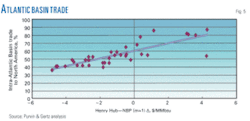
Over the last few years it has become increasingly apparent that LNG trade within the Atlantic Basin responds to price differences between Europe and the US. Comparison of the difference in Henry Hub price and the month ahead (m+1) NBP price (as a proxy for European prices) and the flow of intra-Atlantic Basin flexible LNG trade (i.e., flexible trade that remains within the Atlantic Basin that excludes trade that flows out of the Atlantic Basin to Asia) shows good correlation (Figs. 4 and 5).
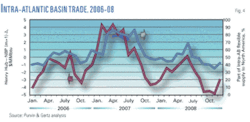
This, therefore, suggests that the direction of LNG trade responds to price differences between markets. A similar analysis compares the amount of flexible LNG trade that leaves the Atlantic Basin for Asia vs. the price difference between Japanese spot LNG prices and Henry Hub. It shows similar results, although the degree of correlation is not as high or the slope as steep. Interestingly enough there does appear to be a $2/MMbtu price difference between Japanese spot prices and Henry Hub prices that will trigger exports out of the Atlantic Basin to Asia.
Outlook uncertainty
So what does the future hold for LNG supply into Europe?
Probably the single biggest challenge facing sellers of gas into the European market is the deteriorating economic situation. Evidence has started to emerge of declining gas demand in the industrial and power generation sectors of the main LNG importing countries during the end of last year, particularly in Italy, Spain, and the UK. With the economic downturn expected to be more severe and more prolonged than many had forecast last year.
Purvin & Gertz’s current forecast is for the rate of gas demand growth to slow sharply this year and be stronger in 2010. Within this forecast, however, there are many diverging trends with flat or declining industrial demand in France, Italy, and the UK and declining or flat power generation demand in Italy, Spain, and the UK.
Power generation demand in France will increase marginally due to commissioning of a new gas-fired power generation capacity. This forecast is based on winter temperatures to be equal to the average for the last 5 years. Should this not be the case, then residential-commercial demand, which accounts for around 50% of total demand, could be substantially different from that forecast.
On the supply side, UK natural gas production appears to be in terminal decline, and nothing appears on the near horizon that is likely to change this prospect. The only new pipeline project that will result in increased pipeline gas imports is from Algeria to Spain; that is expected to come on stream during the course of this year.
Of the existing pipeline agreements, several expire during the course of the next 2-3 years. For the sake of this supply-demand analysis, it has not been assumed that all of these will be extended in their current form. The net effect after considering dedicated LNG supply agreements is that the gas supply shortfall will increase in Europe over time.
Naturally, flexible LNG will be called upon to meet this shortfall, although it should be noted that the shortfall may be overstated should existing pipeline import agreements be extended.

Fig. 6 presents Purvin & Gertz’s view of the near term gas supply-demand and LNG demand pull situation in the main European LNG importing countries.
Gas demand in Fig. 6 is represented by the line, while domestic production, fixed or dedicated contracted pipeline, and LNG imports, and movements in and out of inventory are represented by the area graph. The difference between the line and the area graph in Fig. 6 is the expected gas supply shortfall (in billion cubic meters).
This gas demand shortfall, which represents the demand pull on flexible LNG, is also represented by the column graph that shows quarterly flexible LNG demand in million tonnes on the right hand scale.
Fig. 6 shows that, although the demand pull for flexible LNG near term is relatively weak, it does improve over time as the economic situation improves and pipeline gas contracts expire. It should also be noted that the LNG import requirement into the UK will grow strongly from 2010. The main contributing factors to this forecast are a continuation in decline of UK North Sea production and increased utilization of capacity in the Langeled and BBL pipelines.
The capacity of these pipelines has yet to be tested fully, but in all likelihood there will be times during winter months when they and the UK Interconnector are operating at or near full capacity with the result that there will be an increased pull on LNG imports.
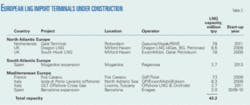
Currently, several LNG import and regasification facilities are under construction that will come on stream over the next few years (Table 2). These projects will add more than 50% to existing LNG import capacity. The good news is that development of this capacity appears to be keeping pace with the expected increase in LNG imports into Europe, and it is not expected that LNG import capacity will be a limiting factor on future imports into Europe.
Author’s note: Sources for data in this article are the Waterborne Energy Inc., European Waterborne LNG Report, and Purvin & Gertz Inc., Global LNG Market Outlook.
The author

Chris Holmes ([email protected]) is a vice-president with international energy consultants Purvin & Gertz Inc. in its London office. He has worked for Amoco (UK) Ltd., as a process engineer at its Milford Haven refinery and as a refined products trader in London and for international energy advisers Gaffney, Cline & Associates as a senior consultant. He holds a BSc (honors) in chemical engineering from the University of Birmingham.