IEA revises oil demand forecast upward on improving economic outlook
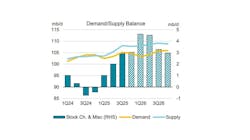
Global oil demand is expected to increase by 830,000 b/d in 2025, supported by an improving macroeconomic and trade environment, according to the International Energy Agency (IEA)’s December Oil Market Monthly Report (OMR). This was reflected by resurgent third-quarter demand of 1.1 million b/d, more than doubling from the second-quarter’s underwhelming 450,000 b/d.
“After a spate of breakthrough US trade deals were reached over the summer, economic sentiment rebounded quickly, helping emerging and developing economies return to their pre-April trend. Still, the tariff turbulence has essentially rendered 2025 second-quarter a lost quarter for non-OECD oil consumption and the as yet unresolved negotiations over tariffs with a number of countries will continue to weigh on markets,” IEA said.
The stronger outlook also carries into 2026, where IEA has raised its demand growth forecast by 90,000 b/d to 860,000 b/d year-on-year (y-o-y). Falling oil prices, along with the weaker US dollar—both of which are currently hovering around 4-year lows—will likely boost oil demand in the coming year.
“Gasoil and jet/kerosene together make up half of this year’s growth, while fuel oil continues to lose share to natural gas and solar in power generation. In 2026, petrochemical feedstocks will drive the bulk of demand expansion, with their share rising to more than 60%, up from 40% in 2025,” IEA continued.
On the supply side, global oil supply dropped by 610,000 b/d month-on-month (m-o-m) to 107.5 million b/d in November, extending the decline from September’s record high of 109 million b/d. OPEC+ accounted for 80% of the decline over the 2-month period, reflecting significant unplanned outages in Kuwait and Kazakhstan, while output from sanctions-hit Russia and Venezuela contracted sharply. Meantime, Russian oil exports fell by 420,000 b/d in November, and together with weaker prices, reduced export revenues to $11 billion—$3.6 billion less than a year earlier.
In IEA's latest monthly report, global oil supply growth has been revised down by 100,000 b/d to 3 million b/d for 2025 and by 20,000 b/d to 2.4 million b/d for 2026, bringing total supply to 106.2 million b/d and 108.6 million b/d, respectively.
After navigating substantial unplanned refinery outages in November, refined product markets have loosened somewhat, but new sanctions in first-quarter 2026 will pose additional challenges, according to IEA. The sharp contrast between surging crude supply and unexpectedly tight product markets has pushed refinery margins back to levels not seen since the aftermath of Russia’s invasion of Ukraine.
Refinery run forecasts for 2026 have been raised to 84.4 million b/d, with annual growth of 750,000 b/d.
Global observed inventories climbed to a 4-year high in October, reaching 8,030 million bbl. Stock builds averaged 1.2 million b/d over the first 10 months of the year. October alone saw a 42 million bbl increase (+1.4 million b/d), driven by an 83 million bbl rise in oil on water, while on-land inventories fell by 41 million bbl, including a 26 million bbl drop in OECD stocks. Preliminary November data points to another increase in global stocks, largely reflecting a rise in non-OECD on-land crude.
North Sea Dated crude declined by around $1/bbl m-o-m to $63.63/bbl in November—its fifth straight monthly decrease and the longest losing streak in 11 years. Near-record oil on water, soft crude fundamentals, and low volatility kept prices near 4-year lows of around $63/bbl, despite tightening sanctions and strong diesel cracks.
“Much has been made about the apparent disconnect between the current global oil surplus on the one hand and inventories near decade lows at key pricing hubs on the other. Indeed, despite record volumes of oil piling up on water, benchmark crude oil prices eased only marginally in November, with North Sea Dated last trading at around $63/bbl and WTI at $59/bbl, with lower forward prices disincentivizing storage. Still, the market trends have clearly been affecting prices over time, with ICE Brent down by nearly $20/bbl since January,” IEA commented in the report.