Global oil market rebalancing amid COVID-19 risk

The outbreak of COVID-19 has had a major impact on crude oil demand. The containment measures greatly reduced travel, thereby reducing oil demand. Oil demand is expected to fall by 8% in 2020, marking the largest decline in history and more than twice as large as the previous record.
Global oil demand in April imploded by 22 million b/d year-over-year, when the price of US crude futures tumbled to negative $40/bbl with significant supply at that time.
Oil demand has improved aggressively in May and June, reflecting relaxed lockdown measures and the reopening economies in some major countries. This, combined with supply reduction efforts from both the Organization of the Petroleum Exporting Countries (OPEC) and non-OPEC countries, lifted oil prices back to above $40/bbl in June from lows in April.

How COVID-19 evolves will very much determine the future of oil market and prices this year. The latest high COVID-19 infection rates in the US, Brazil, and the renewed outbreaks in Asia bring fears back to the market. However, forecasts still call for a gradual recovery of oil demand and economic activities in the year’s second half, as countries and medical establishments are better prepared.
Due to low oil prices and surging storage, world oil supply is falling by an unprecedented pace in 2020, either because of policy decisions or directly from commercial pressure.
To balance the market, OPEC and other oil producing countries including Russia (OPEC+) provided the largest production cut on record. Meantime, extensive shut-ins are happening to non-OPEC production, primarily in the US shale patch and Canada oil sands.
Given the current assumptions of demand and supply, global oil market balance is expected to turn from surplus to deficit in the third and fourth quarter of 2020, alleviating global inventory overhang amassed over the first half. Overall, world oil stocks will still build by 1.5 million b/d for the year of 2020, OGJ forecasts.
Again, a significant resurgence of COVID-19 cases will post a major risk to the recovery of the global oil market. There is no doubt that before a certain degree of certainty is restored, the path of oil price recovery will be choppy. If this process lasts long, prolonged disruption of supply will undermine the ability of supply to keep up with demand recovery, which would send oil prices to an unusual high.
Worldwide oil demand
Containment measures in most countries and territories brought transportation and mobility to an unprecedented halt, wiping out fuel demand substantially. Globally, lockdowns were at their most intense and widespread from about mid-March through mid-May.
Oil demand is also reduced by the disruption in economic activity due to COVID-19. The income elasticity of oil demand is usually high, which indicates that declines in economic growth, business, employment, and income lead to falls in oil demand.
In its latest World Economic Outlook (June 2020), the International Monetary Fund (IMF) forecasts global economic activity to contract by 4.9% in 2020, 1.9 percentage points below its April 2020 WEO forecast. Growth of the advanced economy group is projected at –8% in 2020, while growth of the group of emerging market and developing economies is forecast at –3%.

Global oil demand is now predicted by the International Energy Agency (IEA) to decline by 8.1 million b/d in 2020, or 8%, to 91.72 million b/d, marking the largest oil demand contraction in history. In contrast, IEA’s initial pre-COVID-19 projection in January of this year was an increase of 800,000 b/d.
Global oil demand over the first half of the year contracted by 11.38 million b/d year-on-year. Taking the greatest hit from lockdown measures, global oil demand in this year’s second quarter fell by 17.8 million b/d from a year ago. Demand in April was nearly 22 million b/d lower than a year ago, down to a level last seen in 1995.
From the trough of “Black April,” the year-on-year contraction in global oil demand has been gradually narrowing in recent months, as economies gradually reopened in some areas. Between mid-May and mid-June, a total of 46 countries/regions relaxed COVID19 lockdown measures and mobility picked up. The y-o-y contraction narrowed to 18.6 million b/d in May, and 12.9 million b/d in June.
Oil demand in China recovered quickly in March and April after the initial hit of COVID-19 in January and February. Due to relaxed lockdown restrictions, demand in March climbed 2.7 million b/d (27%) month-on-month, and in April it increased by another 1.1 million b/d (9%), which was only 50,000 b/d lower than last year’s level in April.
Meantime, China has been importing crude at high levels taking advantage of very low crude oil prices and available domestic storage.
India’s oil demand fell by 670,000 b/d year-on-year in March and 2.1 million b/d in April. With less transportation restrictions, oil demand rebounded by 1.1 million b/d month-on-month in May.
US oil demand recovered 14% in May from April, although the May level was still 20% below that of May 2019. More than 80% of the increase was driven by motor gasoline with the reopening of states.
Overall, a demand recovery is expected for the remainder of the year. Total global oil demand at the end of 2020 is expected to recover to around 95% of the level seen at the end of 2019.

The outlook for the rest of 2020 rests on assumptions of falling infection/fatality rates and a gradual normalization of the global economy from coronavirus lockdowns. According to IMF projections, global activity is expected to trough in the second quarter of 2020, recovering thereafter. In 2021 global growth is projected to turn positive at 5.4%.
Alternative outcomes are possible. First, there is still a high degree of uncertainty around how the pandemic is evolving, including the length of the pandemic, and required lockdowns. In some countries, the number of COVID-19 cases is still high. Others are experiencing new outbreaks.
In the US, Texas paused its reopening plan and again shut down certain establishments after a spike in new cases. The US reported record high numbers of new COVID-19 cases, while also recording the largest number of cases in the world. Most countries in Latin America are still struggling to contain infections. Brazil became the second country in the world to surpass 1 million cases in June. Beijing, the Chinese capital, has seen another wave of infections since the second week of June.
Second, as countries move out of the predicament at different paces, the prospects for world economic improvement remain highly uncertain. Voluntary social distancing may continue and affect spending. Some business sectors may take longer to bounce back after the pandemic fades due to firm closures and exited workforce.

Behavioral changes on oil demand caused by COVID-19, including more telework and less business travel, could have a lingering impact. Work-related commuting usually accounts for over 30% of global gasoline demand. The International Labor Organization (ILO) estimates that 18% of the world’s workforce will permanently work from home in the future, compared to 8% before the crisis.
World oil supply
Driven by a record OPEC+ production cut and extensive shut-ins of US producers, global oil production is now forecast to decline by 6.36 million b/d y-o-y in 2020.
Global upstream spending is set to reach $383 billion this year, the lowest level in 15 years and a staggering 29% decrease compared to 2019, according to Rystad Energy analysis.
Shale and tight oil investments is expected to take the biggest hit, now forecast to fall by 52.2% year-over-year to $67.3 billion. Oil sands investments will follow, with a decline of 44% to $5 billion. Other onshore investments are forecast to fall by 23.4% to $182.4 billion this year.
To rebalance the market, the OPEC+ group reached an agreement in April to cut production by 9.7 million b/d in May and June, amounting to 10% of total crude supply. To help speed the rebalancing, the group agreed in June to extend the record cut through July. From August through December, the total reduction will drop to 7.7 million b/d and then decline to 5.8 million b/d from January 2021 through April 2022.


IEA data shows that global oil production fell by nearly 12 million b/d in May from April and is expected to fall by a further 2.4 million b/d in June.
The OPEC+ group reduced supply in May by 9.4 million b/d versus April, delivering a compliance rate of 89%. The compliance rates of Saudi Arabia and Russia reached or approached 100%, while other Gulf producers exceeded 90%.
Saudi Arabia’s crude production was reduced from 12 million b/d at the beginning of April to 8.5 million b/d in May, with an additional 1 million b/d of recalibration slated for June. This will be Saudi’s lowest production in nearly 2 decades.
Iraq produced more than 650,000 b/d above its target output level in May and is now being asked to make up for its non-compliance in future months. Another supply point to watch is the re-emergence of Libyan oil on the market.
OGJ forecasts that OPEC crude production will average 25.5 million b/d in 2020, down from 29.5 million b/d in 2019 and 31.4 million b/d in 2018. Call for OPEC crude declines to 24 million b/d in 2020 from 28.9 million b/d in 2019.
Total non-OPEC oil supply will decline by 3 million b/d year-over-year, led by the US, Russia, and Canada. However, production in Brazil and Norway will continue to increase as new projects come online.
In the US, low oil prices and limited storage forced extensive shut-ins. The country’s crude oil production this year is expected to drop 6.4% to 11.45 million b/d.
Russia fulfilled its promise in May, cutting its crude oil and condensate production from April by an unprecedented 1.95 million b/d to the lowest level in 15 years—9.4 million b/d. According to Energy Minister Alexander Novak, Russia is expected to fully comply with the agreement in June. Also, with deeper output cuts extended by 1 month through July, Russia’s oil production in 2020 is expected to decline nearly 9%, or 1 million b/d, to around 10.5 million b/d.
Hit by economic and storage issues, Canadian oil supply is set to drop 7.58% to 5.12 million b/d. Much of this reduction will come from oil sands projects.
Norway’s oil production rose to 2.1 million b/d in April, its highest in 3 years, driven by Johan Sverdrup field that came online in October 2019 and reached its Phase 1 production plateau of 470,000 b/d in April. Norway’s daily production then fell to 2.03 million b/d in May, the Norwegian Petroleum Directorate reported.
Despite the government-mandated cuts effective from June through December, Norway’s production this year is still set to climb to 2.04 million b/d, up 17.24% from a year ago.

Brazil’s crude oil production had surged since June 2019 thanks to Lula, Buzios, Sapinhoá, Jubarte, and Sul De Lula fields, which boosted production from the pre-salt horizon in the deepwater Santos basin. This year, with more new supplies expected from the near completion Atapu field, Brazil’s oil production in 2020 is forecast to increase 5.5% to 3.1 million b/d.
Brazil’s production will increase further next year when Petrobras plans to start two new production systems in Sepia and Mero fields. Equinor will also expand production at Peregrino field.
Global production is expected to show a moderate recovery in 2021, assuming OPEC+’s production cuts ease further, that Norway, Brazil, and Guyana achieve increased production, and Libya’s production rebounds.
OECD oil inventories
Global oil storage has soared since the breakout of COVID-19. OECD commercial oil inventories were 3.137 billion bbl in April, up 8.4% from 2.89 billion bbl in February and 4% higher than the 5-year average.
Given the current assumptions of demand and supply, global oil market balance is expected to turn from surplus to deficit in the third and fourth quarter of 2020.
Overall, for the year, world oil stocks will build by 1.5 million b/d.

US oil demand
For 2020, US oil demand will fall by 2.4 million b/d, or 11.6%, OGJ forecasts. Demand is expected to move higher in the second half. However, as the US continues to hit new highs in daily coronavirus cases, downside risk to the forecast is particularly high.
US petroleum and other liquid fuels consumption was estimated to average 17.53 million b/d in the first two quarters of the year, according to the latest Energy Information Administration (EIA) data. This compares to 20.3 million b/d for the same period a year ago, a contraction of 13.7%. The second quarter recorded a fall of 4.6 million b/d.
With the escalation of stay-at-home orders to prevent the spread of COVID-19, US petroleum demand in April fell by 22%, or 4.1 million b/d, between March and April, the largest month-on-month decline on record.
Demand for motor gasoline averaged 7.73 million b/d in the first half of the year, down 16% from the level a year ago. Vehicle miles travelled (VMT) during the first 4 months of 2020 contracted by 14.07% year-over-year, as recently reported by the US Bureau of Transportation Statistics.
Gasoline demand was 5.68 million b/d in April, a decrease of 27% from March and 39.2% from April 2019. In April, VMT declined 41% year-over-year. Gasoline demand for May, however, rebounded sharply to 7.3 million b/d. This was an increase of 29% from April and the largest monthly increase on record since 1945.
With the assumption of the gradual loosening of stay-at-home orders, gasoline demand will likely continue to recover in the second half of the year. OGJ forecasts that gasoline demand will fall nearly 12% in 2020 from a year ago. However, downside risk is rising as lockdowns are re-imposed in some states.
Distillates demand did not drop as much as gasoline through COVID-19. US consumption of distillate fuel oil for the first half of the year is estimated to average 3.64 million b/d, 12.2% lower from the same period a year ago. According to data from the US Bureau of Transportation Statistics, trucking freight January through April, as measured by the truck tonnage index (seasonally adjusted), indicated a decrease of 2.11%. This compares to growth of 4.61% in 2019 for the same period a year ago.
US diesel demand fell 22% in April month-on-month. Demand then rebounded 10.6% in May from April due to state economies reopening and a seasonal uptick in freight shipping volumes. Demand is expected to remain subdued as it slowly recovers. Overall, OGJ expects distillate fuel oil demand for 2020 will decline 6%.
The International Air Transport Association (IATA) reported US revenue passenger miles (RPM) over the first 4 months of 2020 were 30.47% lower year-over-year. The fall was as much as 76% in April. The recent weekly DOE statistics show a drop of 65% in estimated jet and kerosene demand in May.
Demand for kerosene and jet fuel averaged 1.1 million b/d in the first half of 2020, down 35.5% year-over-year. US jet fuel demand fell by 19% y-o-y in March. This fall deepened to 65% in April and 67% in May and is projected to stay around 40%-45% below last year’s level for the rest of the year. Jet and kerosene demand will fall by 37% in 2020, OGJ forecasts.
Although ethane-based petrochemical activity has been supported by the increased use of plastics in relation to the COVID-19 pandemic, it also suffered from a drop in plastic demand from the automobile and construction sectors.
Demand for LPG/ethane averaged 2.98 million b/d in the first 6 months, down 5% from the level a year ago. Overall, LPG/ethane demand is expected to contract by 5% in 2020.

US oil production
US crude oil production for the first quarter of 2020 was still 8% higher than that of first-quarter 2019. However, as weak demand, plummeting oil prices, and limited storage capacity take their toll, US oil companies race to shut in oil wells, and US oil production is falling faster than expected. Overall, US crude oil production in 2020 is expected to average 11.45 million b/d, down 6.4% from 2019.
Crude oil production fell by 330,000 b/d in April month-on-month and fell further by 1.02 million b/d in May to 11.36 million b/d. OGJ expects US crude oil production at the end of 2020 to be 2 million b/d lower than the level at the end of 2019.
According to Baker Hughes data, US oil-directed rigs decreased to 189 units for the week ended June 19 compared to 789 units during the year-ago period. The region with the largest decline is the Permian basin. The rig count for the basin was 132 for week ended June 19, down 307 from one year ago.
Most of the major US producers announced production curtailments as demand collapsed. The Permian basin is the most affected area.
ExxonMobil announced plans to reduce production by 400,000 boe/d in the second quarter of 2020, of which 100,000 boe/d will come from the Permian basin. The company estimated that the impact of reduced capital expenditures on Permian production will be 15,000 boe/d in 2020 and 100,000-150,000 boe/d in 2021.
ConocoPhillips curtailed oil production by about 265,000 b/d in May and by around 460,000 b/d gross in June. However, the company says it can bring the production back within a few weeks once market conditions improve.
Chevron plans to shut in a total of 200,000-300,000 boe/d of production in May and up to 400,000 boe/d in June. About half of the production cut will come from the US, primarily the Permian basin and other short-cycle projects.
BP announced an investment reduction of $1 billion in its shale business (BPX) and said that BPX production will fall to 70,000 boe/d in 2020 from 499,000 boe/d in 2019.
Continental, EOG Resources, Occidental, Marathon, Diamondback, Noble, Parsley, and many others announced cuts.
According to a survey from the Federal Reserve Bank of Dallas, firms could generally cover operating expenses for existing wells at WTI prices between $23-$36/bbl. Thus, companies may soon reverse production cuts if there is sustainable price recovery above that level.
However, with the sharp reduction in upstream spending for 2020, nearly half compared with earlier guidance, the prospects for a significant recovery in US shale production is slim. To profitably drill new wells shale companies generally need a WTI price of $45-50/bbl, though some Permian producers can drill profitably at $30-40/bbl.
With depressed commodity prices, impairments are surging this year. According to Deloitte, since 2010, US shale gas has impaired more than $450 billion of invested capital, while generating $300 billion of negative free cash flow. The firm expects a write-down of $300 billion in assets in 2020 alone, which could trigger many bankruptcies due to high debt burdens.
As operators delay bringing on wells, completion rates have fallen even more sharply. The slowdown has increased inventory of drilled but uncompleted (DUC) wells. Although drilling activity may not recover until next year, a quicker recovery of completions activity is expected.
Production from the Gulf of Mexico averaged 1.88 million b/d in 2019, up 6.82% from a year ago. The decrease in investment in 2020 leads to a lower production outlook, as new projects and brownfield phases face delays and potential changes in scope. However, a production recovery is anticipated in 2021.
US natural gas liquids (NGL) production grew 10.07% in 2019 to 4.81 million b/d. Over the first quarter of 2020, NGL production averaged 5.12 million b/d, up nearly 10% from the first quarter of 2020. Production started falling rapidly after March as US gas production started declining. NGL production fell from 5.25 million b/d in March, an all-time high, to 4.73 million b/d in May. US NGL production for 2020 is forecast to decline 0.7% from a year ago.
US total oil supply in 2020, including crude oil and NGL, is expected to decrease nearly 5% from a year ago to 16.2 million b/d.

US refining
The impact of COVID-19 on refining businesses is severe, including decreased product demand and low profitability. US refiners have taken measures, including reducing capital and operating expenses, reducing throughput and temporary idling of facilities, to address the impacts.
US refinery runs have been in continuous decline since the start of 2020. For the first half of the year, US refinery runs averaged 14.98 million b/d, down 10.87% from first-half 2019 levels. Meanwhile, US refining capacity increased 1% from a year before to nearly 19 million b/d, a new record. US refiners’ average utilization rate was 78.9% in the first half of 2020, compared to 89.4% a year ago.
Refinery runs in April fell by 2.6 million b/d to 13.2 million b/d, the largest decline on record since 1985. Capacity utilization rate of 70% for the month marked the lowest monthly rate on record since 1985.
With domestic petroleum demand having rebounded and export levels steady in May, refinery runs increased by 130,000 b/d for the month, the first monthly increase in 2020. Refining activity declined further in the export-oriented US Gulf Coast but rose in the import-dependent Midwest and North East. However, the overall capacity utilization rate of 70.3% was still the second lowest rate for May on record since 1985.
Refining margins are historically low. Refining cash margins for May of 2020 were $3.56/bbl for the Midwest, $5.64/bbl for the West Coast, $0.25/bbl for the Gulf Coast, and $0.67/bbl for the East Coast, according to Muse Stancil & Co. These compare to cash refining margins of $23.42/bbl, $18.18/bbl, $6.73/bbl, and $2.36/bbl for these regions respectively for May 2019.
The refining business environment is expected to recover gradually in the second half of year. However, all refining indicators will remain well below normal levels. For full-year 2020, OGJ forecasts an average refining utilization rate of 81%, a record annual low.
Overall, US oil refining activities are not expected to fully recover by 2022, not only due to the development of demand, but also due to higher maintenance outages to compensate for work cancelled in 2020.

US oil trade
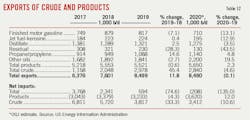
Estimated US crude oil net imports averaged 2.75 million b/d for the first half of this year, compared to 4.18 million b/d a year ago, according to the EIA.
Crude imports over the first 6 months were estimated to have declined by 13.8% year-on-year, reflecting high crude oil inventories and reduced US refining activities. However, from the trough in mid-April, crude oil imports gradually rebounded in May and June.
Over the first quarter of 2020, US crude oil exports averaged 3.5 million b/d, up 27.5% from a year ago. Although data shows that crude exports started declining after March, overall crude exports over the first half were still nearly 16% higher compared to a year ago.
It is noteworthy that China imported in May its first cargo of US crude oil since November 2019, and a record amount of US oil is set to be delivered to China in July as refiners there had bought cheap US oil in April, according to Refinitiv data. In addition, falling VLCC freight rates provide a boost to US exports. However, with rapidly declining US crude oil production, US crude oil exports are expected to move lower in the second half.
Estimated product net exports averaged 3.5 million b/d for the first half of the year compared to 3.17 million b/d over the same period a year ago.
Product imports over the first 6 months were estimated to have declined by 13% year-on-year, reflecting lower product demand.
Product exports over the first quarter of 2020 averaged 6 million b/d, up 13.3% from the first quarter of 2019. However, product exports dropped dramatically in May. For the week ended on May 15, product exports averaged 3.68 million b/d, compared to 5.1 million b/d a year ago.
US oil inventories
US total petroleum inventory, including crude oil and refined products but excluding the Strategic Petroleum Reserve, increased year-on-year for the 20th consecutive month and was estimated to stand at 1.46 billion bbl at the end of June. Nevertheless, it was still within the 5-year range.
US commercial crude oil inventories reached 540 million b/d by the end of May and are expected to reach around 556 million bbl at the end of June, an all-time high. The increase in US crude oil inventories reflects low refinery runs. Falling crude oil exports and rising crude imports in recent months also boosted crude stocks. Crude oil stocks will move lower towards the end of the year as US crude oil production declines.
Oil product stocks will end June with around 900 million bbl, up nearly 100 million bbl from a year ago, owing to a large increase in distillate fuel oil and motor gasoline as demand plunges.
US natural gas
OGJ expects US natural gas consumption will decline 3.6% this year, reflecting warmer weather and softer industrial and commercial consumption owing to COVID-19. Weaker LNG exports should also be anticipated during 2020.
Year-to-date through June, US consumption of natural gas averaged 88.58 bcfd, compared to 90.42 bcfd for the same period a year ago.
Over the first half of 2020, industrial consumption averaged 22.53 bcfd, compared to 23.9 bcfd over the same period a year ago. OGJ forecasts that industrial demand for natural gas will decrease 9% in 2020 to around 21 bcfd as a result of lower expected manufacturing activity. In 2019, industrial consumption averaged 23 bcfd and accounted for about 27% of total US natural gas consumption.
Over the first 6 months, natural gas consumed by power generation is expected to average 28.61 bcfd compared to 26.38 bcfd over the same period a year ago. Natural gas consumed by power generation is expected to climb nearly 2% in 2020 to 31.5 bcfd.
Gas usage of US power-generation is increasing year-over-year via market share gains. The US power generation sector consumed 30.98 bcfd of gas in 2019, accounting for 36.38% of total domestic gas consumption. This compares to 28.97 bcfd in 2018, and 35.14% of total gas consumption.
Gas consumption in the residential and commercial sectors is set to decline in 2020. Commercial demand down due to closures of restaurants and other stores due to COVID-19 lockdown policies. Another contributing factor is warmer winter weather. The National Oceanic and Atmospheric Administration (NOAA) recorded a 9.38% decline in heating degree-days for the 2019-2020 heating season compared to the 2018-2019 heating season.
US natural gas production has been surging in recent years. Marketed production and dry gas production reached record highs of 99.16 bcfd and 92.2 bcfd in 2019, up 10.29% and 10.04% respectively from a year ago.
After reaching a peak in December 2019, US monthly gas production has steadily declined as a result of imploding demand, decreased drilling, and limited storage. Overall, OGJ forecasts US marketed gas production will decline 2.6% to 96.6 bcfd in 2020.
US working rigs targeting gas for the week ended June 19, according to Baker Hughes, decreased to 75 rigs, 102 fewer than were drilling for gas at this time a year ago.
Natural gas production declined the most in the Appalachian and Permian regions. In the Appalachian region, low gas prices discourage producers from engaging in directional drilling of natural gas, while in the Permian region, low oil prices reduce associated gas output from oil-directed wells.
According to EIA’s Drilling Productivity Report, Appalachian gas production grew to 32.09 bcfd in 2019 from 28.45 bcfd in 2018 and 23.96 bcfd in 2017. Gas production from the region reached a peak of 33.43 bcfd in December 2019 and has been continuously falling since, reaching 32.68 bcfd in May.
In 2019, gross gas production in the Permian region increased by 30.7% year-over-year to 15.03 bcfd. After reaching a peak of 16.93 bcfd in March, the Permian region’s gas production began to drop sharply, the report indicated.
US net gas exports averaged 5.24 bcfd in 2019, up 166% from 1.97 bcfd a year ago and was equivalent to 5.68% of total US dry gas production. This year, the growth rate of US net gas exports will slow to 27%.

US LNG exports in 2020 are expected to expand 14.4%, down from a growth rate of 67.85% in 2019. The lower growth rate reflects lower global gas demand caused by COVID-19 and unfavorable LNG prices.
According to data from IHS Markit, in late March, natural gas deliveries to US facilities that produce LNG for export reached 9.8 bcfd, a record high, but fell to less than 4 bcfd in June.
A mild winter and efforts to ease COVID-19 spread have led to a decline in global natural gas demand, and higher natural gas storage inventories in Europe and Asia, thereby reducing the demand for LNG imports and resulting in historically low LNG spot prices in Europe and Asia.
More than 70 cargos from the US were cancelled for June and July deliveries, according to Reuters. More than 40 shipments were canceled for August deliveries. In comparison, 74 shipments were exported from the US in January.
Meantime, US LNG export capacity continues to grow. In May, the third train at Freeport LNG in Texas began commercial operation. Later in the summer, the third train at Cameron and three of Elba’s small mobile modular liquefaction system units will come online, bringing the US total liquefaction capacity to 8.9 bcfd base load capacity and 10.1 bcfd peak capacity.
The total amount of natural gas in storage is 2.8 tcf as of May, which is 18% higher than the 5-year (2015-2019) average. It is expected that during the injection season from April to October, the inventory will increase by 2.1 tcf and exceed 4.1 tcf by Oct. 31, a record level.
Henry Hub spot prices averaged $1.87/MMbtu for the first half of this year, compared to $2.74/MMbtu for the same period a year ago. Gas prices are expected to rise above $2/MMbtu later this year as US production declines and demand recovers in the winter. For 2020 as a whole, natural gas prices at Henry Hub will drop to $2.09/MMbtu from $2.56/MMbtu in the previous year.
About the Author

Conglin Xu
Managing Editor-Economics
Conglin Xu, Managing Editor-Economics, covers worldwide oil and gas market developments and macroeconomic factors, conducts analytical economic and financial research, generates estimates and forecasts, and compiles production and reserves statistics for Oil & Gas Journal. She joined OGJ in 2012 as Senior Economics Editor.
Xu holds a PhD in International Economics from the University of California at Santa Cruz. She was a Short-term Consultant at the World Bank and Summer Intern at the International Monetary Fund.

Laura Bell-Hammer
Statistics Editor
Laura Bell-Hammer is the Statistics Editor for Oil & Gas Journal, where she has led the publication’s global data coverage and analytical reporting for more than three decades. She previously served as OGJ’s Survey Editor and had contributed to Oil & Gas Financial Journal before publication ceased in 2017. Before joining OGJ, she developed her industry foundation at Vintage Petroleum in Tulsa. Laura is a graduate of Oklahoma State University with a Bachelor of Science in Business Administration.