Navitas takes FID for field development offshore Falkland Islands
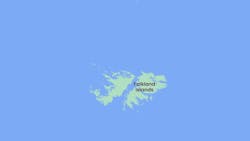
Navitas Petroleum Development and Production Ltd. (NPDP) has taken a final investment decision (FID) on Phase 1 development of Sea Lion oil field about 220 km to the north of the Falkland Islands.
The Falkland Islands government has approved the field development and production program for Phases 1 and 2 of the Northern Development Area within the field.
Following the approvals, the licenses covering Sea Lion will move into the Exploitation Phase, which lasts 35 years, or longer if needed to complete production. The total post-FID funding requirement is $1.8 billion to first oil and $2.1 billion to project completion (including contingencies and financing costs).
Phase 1 targets 170 million bbl at a peak production of about 50,000 b/d. This initial stage consists of drilling 11 subsea wells tied back to a redeployed floating production, storage, and offloading (FPSO) vessel.
The first well is not expected to be spudded for over 12 months, and first oil is currently planned for 2028.
Phase 2 is expected to add another 12 wells and recover a further gross 2C resource of 149 million bbl.
Sea Lion has 319 million bbl of certified resources and total gross full field 2C resource of 917 million bbl, with 727 million bbl categorized as development pending.
As part of the Phase 1 sanction, Navitas has entered into a number of commercial contracts, including an FPSO charter agreement, drilling rig contract, a framework agreement for the supply of drilling and completion services, and an agreement for the engineering, procurement, construction, installation and commissioning of subsea umbilicals, risers, and flowlines.
NPDP is operator of Sea Lion (65%) with partner Rockhopper Exploration plc (35%).
About the Author
 Alex Procyk
Alex Procyk
Upstream Editor
Alex Procyk is Upstream Editor at Oil & Gas Journal. He has also served as a principal technical professional at Halliburton and as a completion engineer at ConocoPhillips. He holds a BS in chemistry (1987) from Kent State University and a PhD in chemistry (1992) from Carnegie Mellon University. He is a member of the Society of Petroleum Engineers (SPE).